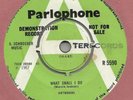
Beverly Ann, "You've Got Your Mind On Other Things" 47-9468 • Promo 45rpm
$
215


Favourite Auctions
To save auctions to your favourites, please login
If you don't have an account, please register
Description
Here is an very rare, excellent condition promo 45 rpm copy of the northern soul hit by then-17-year-old Beverly Ann (Bremers):
"You've Got Your Mind On Other Things,"
b/w "Until You"
[A sample has been uploaded for eBay to attach within the pictures. If you do not see it, please bookmark and revisit this page through a browser window. Thanks. P.S. The recording is through a cell phone.]
RCA Victor, Catalog #47-9468
Matrix/runout: UPKM-8660 -- 4S H
Side A is Near Mint / Near Mint-
Side B is Very Good Plus
Free shipping. This will be dispatched within one mail day, with insurance.
★
The 7" vinyl 45 RPM record has bright and unmarked yellow RCA Victor (no dog) labels. Its condition is exceptional for any 56-year old media. There's no wear at the spindle nor to the outer edge. "Until You" has a couple shallow marks that do not disrupt sound. There are no skips, pops, nor background noise.
Both songs are pure joy to listen to at volume, down low, or through headphones. Its recording is lush with plenty of room for the bright tones, guitar and choral parts to soar over the rhythm and organ. Beverly's voice is unbelievable, perfectly suited for the songs. From the opening bar to closing note, this record is more than a musical treasure. It's evocative. A listener exists in it.
The song has the best elements from music of the time: a lively UK-pop jangle ("Green Tambourine" was the #1 song), a shining female vocal lead, an exultant and soulful chorus and rhythm arrangement, identifiable, sentimental verses, and a touch of wide swinging country-western twang.
★
"You've Got Your Mind On Other Things" was written by Lee Porter and Ron Miller. Jimmy Wisner provided musical arrangement on both tracks. "Until You" is credited to Tarner & Franklin.
These promotional copies were sent out to radio stations in January 1968. By February, it was being played on pop radio, country, easy listening, and R&B/soul stations, giving Beverly the widest audience of her career. The song quickly made it onto the March 2nd Billboard Hot 100 chart.
The record helped make Beverly Ann a nationally recognized name by the time she turned 18 that March. By age 19 she was on her way to a starring role in Hair on Broadway [now performing as Beverly Bremers]. She had a gold record at age 21 with the LP, "The Me Nobody Knows," following the success of the single, "Don't Say You Don't Remember." The week of her 22nd birthday, her voice carried over the end credits of George Romero's The Crazies. The song, "Heaven Help Us," was the only vocal piece in the entire film's soundtrack, and an apt song for an unsettling sci-fi/horror film by the infamous "Night Of The Living Dead" director. Romero personally chose Beverly for this unique part. If you see the film, linger for the credits and you'll hear her.
She toured occasionally but her career remained largely in musical theater. She's featured on the original Broadway cast album for "Hair," won an Obie Award, earned multiple Tony Award nominations, and wrote a number of original musicals. Ironically, the only platinum-certified song credited to Beverly Bremers is one she never recorded: she penned the theme song of Disney's Mousercise. The program aired six days a week for 12 years. The records that included it were available in department stores, by mail order, and at their theme parks. It was one of the Walt Disney Company's best-selling music releases.
★ * ★ * ★ * ★ * ★ * ★ * ★ * ★ * ★ * ★ * ★ * ★
[Below is social context as I interpret it from conversations with vets, spouses, and music historians. I did not live through this era.]
Beverly Ann's achievements through the decades would have been hers regardless, but of immeasurable importance was the timing of this record when it entered station rotations here in the United States and around the world on Armed Forces Radio. The Winter of 1967-68 was historic. Most Americans listened to their radios part of each day; there were concerning reports out of Southeast Asia.
What the American public heard daily was how drastic the toll was on the enemy forces, how its poorly-supplied, under-fed combatants who had no extra ammo or food, wore hand-sewn rags and makeshift sandals, how they hid in tunnels or abused villagers before retreating, often across national borders where the armies of the United States and South Vietnam were prohibited from engaging. We at home received palatable capsules of equal parts information and propaganda — enemy casualty tallies, names for new offensive operations against supply lines or areas of rumored occupation, and quotes from commanders and politicians expressing every confidence that the North's surrender was inevitable. Anti-war voices were minimized or ignored, and entertainment filled the rest of the airtime.
Overnight, the military conflict in Vietnam turned into a nightmare.
In the dark morning hours of January 30th—the date on which Tet, the Vietnamese Lunar New Year holiday fell that year—the most significant attack of the entire war was launched against U.S. and South Vietnamese forces on all fronts, from the northernmost outposts all along the Cambodian border, deep into South Vietnamese villages and cities. American soldiers had been fighting against communist North Vietnam for years, but until then, nothing of the sort had ever happened. Deployed American soldiers expected the country's holiday to be relatively calm, as past ones had been. Instead, they were hit with wave after wave of attacks.
The Tet Offensive persisted with few interruptions until Fall when it was finally quelled. It was reported as a tactical victory by the U.S. and South Vietnam, but the toll shook Americans everywhere, demoralizing a segment of the enlisted men and women, and driving domestic support for the war lower than ever. Some of the most depraved acts committed by either side occurred that year, and before Summer was up, 1968 had become the bloodiest year our military endured since the Second World War. History recognizes the Tet Offensive as the turning point of the entire war. Good news or bad though, when the reports ended, the music played on.
★
price rating