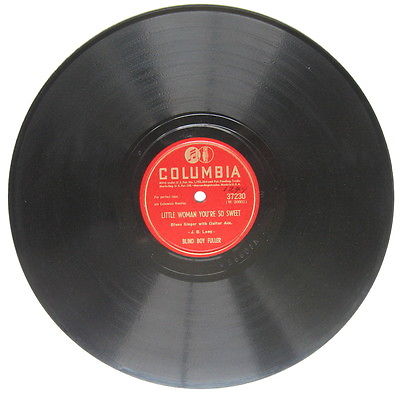
Blind Boy Fuller: Step It Up & Go / Little Woman You're So Sweet 78RPM CBS#37230
$
29


Favourite Auctions
To save auctions to your favourites, please login
If you don't have an account, please register
Description
Record is EXCELLENT Life and career Fulton Allen was born in Wadesboro, North Carolina, United States, to Calvin Allen and Mary Jane Walker. He was one of a family of 10 children, but after his mother's death he moved with his father to Rockingham. As a boy he learned to play the guitar and also learned from older singers the field hollers, country rags, and traditional songs and blues popular in poor, rural areas. He married Cora Allen young and worked as a labourer, but began to lose his eyesight in his mid-teens. According to researcher Bruce Bastin, "While he was living in Rockingham he began to have trouble with his eyes. He went to see a doctor in Charlotte who allegedly told him that he had ulcers behind his eyes, the original damage having been caused by some form of snow-blindness." Only the first part of this diagnosis was correct. A 1937 eye examination attributed his vision loss to the long-term effects of untreated neonatal conjunctivitis.[2] By 1928 he was completely blind, and turned to whatever employment he could find as a singer and entertainer, often playing in the streets. By studying the records of country blues players like Blind Blake and the "live" playing of Gary Davis, Allen became a formidable guitarist, and played on street corners and at house parties in Winston-Salem, NC, Danville, VA, and then Durham, North Carolina. In Durham, playing around the tobacco warehouses, he developed a local following which included guitarists Floyd Council and Richard Trice, as well as harmonica player Saunders Terrell, better known as Sonny Terry, and washboard player/guitarist George Washington. Bull City Blues, Durham, North Carolina In 1935, Burlington record store manager and talent scout James Baxter Long secured him a recording session with the American Recording Company (ARC). Allen, Davis and Washington recorded several tracks in New York City, including the traditional "Rag, Mama, Rag". To promote the material, Long decided to rename Allen as "Blind Boy Fuller", and also named Washington Bull City Red. Over the next five years Fuller made over 120 sides, and his recordings appeared on several labels. His style of singing was rough and direct, and his lyrics explicit and uninhibited as he drew from every aspect of his experience as an underprivileged, blind Black person on the streets—pawnshops, jailhouses, sickness, death—with an honesty that lacked sentimentality. Although he was not sophisticated, his artistry as a folk singer lay in the honesty and integrity of his self-expression. His songs contained desire, love, jealousy, disappointment, menace and humor.[3]
price rating