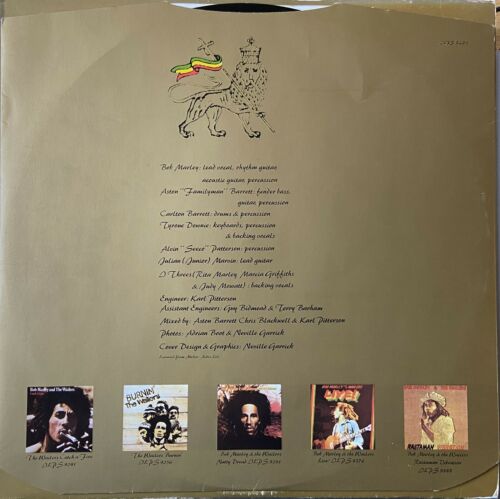
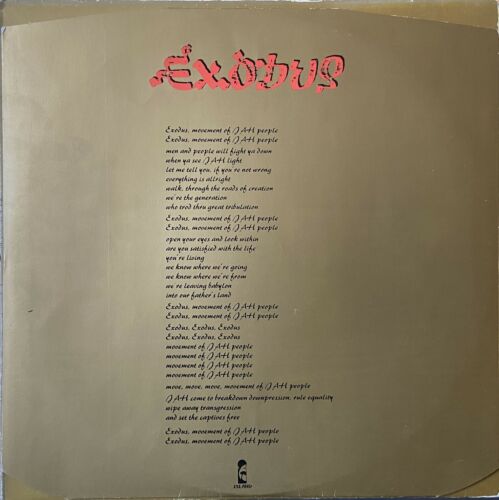
Bob Marley And The Wailers "Exodus" Island ILPS 9498 A2/B UK 1st + inner 1977
£
15
$
20



Favourite Auctions
To save auctions to your favourites, please login
If you don't have an account, please register
Description
Bob Marley & The Wailers ? "Exodus" Island Records ?ILPS 9498 UK 1st press. Vinyl, LP, housed in a printed inner sleeve, and released with an embossed sleeve in 1977.
The vinyl appears to have been lightly played and is in great condition. It played through beautifully on my elderly stereo - no hop, stick or jump. It is housed in its original printed inner sleeve, which shows minimal signs of wear, and which is also in great condition - no rips or writing. The embossed sleeve has some ring-wear to the front and back, but is otherwise in good shape, again, with no rips or writing. The spine is intact and legible. Matrix / Runout Side 1 : I-160 ILPS 9498 A-2 F 4 STERLING Matrix / Runout Side 2 : I-105 ILPS 9498 B EG
"Exodus" is Bob Marley and the Wailers' ninth studio album, first released in June 1977 through Island Records, following 2Rastaman Vibration" in 1976.
On 3 December 1976, an assassination attempt was made on Bob Marley's life in which his chest was grazed and his arm was struck with a bullet, but he survived. Following the assassination attempt Marley left Jamaica and was exiled to London, where "Exodus" was recorded.
"Exodus" is a reggae album, incorporating elements of blues, soul, British rock and funk. The album's production has been characterised as laid-back with pulsating bass beats and an emphasis on piano, trumpet and guitar. Unlike previous albums from the Wailers, "Exodus" thematically moves away from cryptic story-telling; instead it revolves around themes of change, religious politics, and sex. The album is split into two halves: the first half revolves around religious politics, while the second half is focused on themes of sex and keeping faith.
The album was a success both critically and commercially; it received gold certifications in the US, UK and Canada, and was the album that propelled Marley to international stardom.
In 1974 the Wailers disbanded, with each of the three main members pursuing solo careers. Despite the break-up, Marley continued recording as "Bob Marley & The Wailers". His new backing band included brothers Carlton and Aston "Family Man" Barrett on drums and bass respectively, Al Anderson and Junior Marvin on lead guitar, Tyrone Downie and Earl "Wya" Lindo on keyboards, and Alvin "Seeco" Patterson on percussion. The "I Threes", consisting of Judy Mowatt, Marcia Griffiths, and Marley's wife, Rita, provided backing vocals. In 1975, Marley had his international breakthrough with his first hit outside Jamaica, "No Woman, No Cry", from the "Natty Dread" album. This was followed by his breakthrough album in the United States, "Rastaman Vibration", which became the 48th best-selling album on the Billboard Soul Charts in 1978.
"Exodus" is a reggae album which features a "laid-back" production, that contains a "stoned atmosphere that's simultaneously funky and political" according to Cam, an Emeritus from Sputnikmusic.
Cam described the album's musical style as being "different," noting that Marley's style of reggae was not what was prominent in Jamaica during the time, and that the album's music sounds unlike any reggae that came before its release. Emeritus continued to describe the album's sound as being rooted in the blues and soul, with elements of British Rock with a reggae "façade thrown on top" however Emeritus praised this saying "if Exodus was straight reggae, it probably wouldn't be as good as it is."
"Exodus" contains elements of pulsating bass beats, pianos and funk along with a "liquid-y bass," drumming and guitars with the inclusion of trumpets in the title track. Unlike previous albums "Exodus" lyrical content moves away from cryptic story-telling and instead is clearer and more straight forward, the lyrics touch upon themes of change, religious politics and sex. Vocally, Marley provides a minimalist approach, trying not to reach his falsettos.
The album's track listing is split over two halves, the first half features songs of religious politics and opens with "Natural Mystic" which is a slow tempo "fade up" song, followed by "So Much Things To Say" which was described by the BBC as being "exuberant" and features a reggae-scat. The following two songs "Guiltiness" and "The Heathen" explore darker territory, before ending on the album's title track. The second half of the album features songs revolving around sex and keeping faith.
Cam from Sputnikmusic gave the album five out of five stars, calling it a "classic". Emeritus praised the album's "laid-back tones" and commended Marley's vocals and lyrical content. As described by Rolling Stone magazine, "Exodus" is an album with "the magnificent rhythm section of Aston Barrett, bass, and Carlton Barrett, drums, and the spidery lead guitar of Julian "Junior" Marvin — and the flatness of the material Bob Marley has given them to work with"
"Jamming", "Waiting in Vain", "One Love/People Get Ready", and "Three Little Birds" were all major international hits. "Exodus" peaked at number 20 on the Billboard 200 and at number 15 on the Black Albums chart, as well as remaining in the UK charts for 56 consecutive weeks, where it peaked at number 8.
In 1999, Time magazine named "Exodus" the best album of the 20th century. In 2001, the TV network VH1 named it the 26th greatest album of all time. In 2003, the album was ranked number 169 on Rolling Stone magazine's list of the 500 greatest albums of all time, maintaining the rating in a 2012 revised list.
price rating