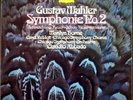
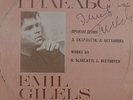
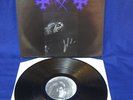
Boris Goldstein Violin Scriabin Prokofiev Debussy 'LIGO' RIGAS USSR LP
£
40
$
53


Favourite Auctions
To save auctions to your favourites, please login
If you don't have an account, please register
Description
MEGA RARE LP 1958-61 on LIGO ( LATVIA LATVIAN RIGA RIGAS FABRIKA ) LABEL BEFORE IT WAS CHANGED TO MELODIYA MELODIJA STATE USSR LABEL
Boris Goldstein, violin
Ella Selkina, piano
?- 08289/90
COVER: VG / VINYL: EX+ IN GREAT CONDITION, LOOKS AND PLAYS LOVELY WITH NO PROBLEMS
Handel-Flesch
Aria
Beethoven
Violin Sonata No.5 in F major ("Spring"),Op.24
Scriabin
Nocturne in F sharp minor,Op.5 No.1
Prokofiev-Heifetz
Gavotte
Debussy-Heifetz
Prélude à l'après-midi d'un faune
Gershwin-Heifetz
Two Fragments from the Opera "Porgy and Bess":
It Ain't Necessarily So
My Man's Gone Now
Vladigerov
Joro
Label:
"LIGO" RIGAS FABRIKA ( Melodiya ) D-08289/90, Mono, GOST 5289-56
USSR
Bellaccord Electro, generally known as Bellaccord, is a record label founded in Latvia in 1931 by Helmars Rudzitis. After the invasion of Latvia by the Soviet Union in 1940, the company produced records under the labels R?gas ska?uplašu fabrika (1940-41 and 1945-57), Baltija (1957), L?go (1958-61) and Melodija (1961-64) - Wikipedia
????? ??????????
Real Name:
????? ???????????? ?????????? (Boris Emmanuilovich Goldstein)
Profile:
Boris Goldstein (1922–1987), also known as Busya Goldshtein (???? ??????????), was a prominent Soviet prodigy violinist whose career suffered greatly from the anti-Semitic discrimination in the USSR. In 1974, Goldstein immigrated to Germany where he had been giving concerts and worked as a professor at the Hochschule für Musik Würzburg. He was a brother of composer and musicologist Mikhail Goldstein(1917–1989), who pulled the infamous Nikolai Ovsianiko-Kulikovski hoax. Notable students of Boris Goldstein include Zakhar Bron and Alexander Skwortsow.
As a young prodigy, he started violin studies in Odessa with the eminent pedagogue Pyotr Stolyarsky. Four years later, Goldsteins moved to Moscow where Busya enrolled in the Special Children Group at the Moscow Conservatory (which later became a Central Music School) and continued his studies with professor Abram Yampolsky. Boris Goldstein, who was nine years old at the time, performed some of the most advanced pieces by Bach, Paganini, and Mendelssohn with prominent orchestras.
In 1933, Goldstein participated in the First All-Union Competition of Performers. Joseph Stalin personally gave a special prize to the young genius, as well as the new apartment in the center of Moscow to his family. When Jascha Heifetz was touring in the Soviet Union in 1934, he held an audience for a few young violinists. Maestro immediately singled out Boris as by the far the most brilliant and talented.
Goldstein received the fourth prize at the Henryk Wieniawski Violin Competition (1935) in Warsaw and was among the winners at the International Ysaye Competition, one of the most prestigious concourses in the world. In 1937, top prizes at Ysaye were taken by Busya, David Oistrach, Elisabeth Gilels, and Mikhael Fikhtengolts, all Stolyarsky students, thus proving the undisputed status of the Soviet music school.
At the end of the thirties, Busya Goldstein had been touring around the USSR, causing sensations nearly at every concert. He performed the Second Violin Concert by Sergei Prokofiev, with an orchestra conducted by the composer. Goldstein made a few records, including Song Without Word by Tchaikovsky, Slavic Dance by Antonín Dvo?ák, Concerto No. 1 by Henryk Wieniawski, works by Frédéric Chopin and Fritz Kreisler.
Unfortunately, during the Second World War his career took a drastic turn. After graduating from the Central Music School, Goldstein entered the Moscow Conservatory and continued studies with professor Lev Zeitlin. As any other musician, during the war he was obliged to perform for soldiers, as well as the workers at military factories across the whole country. In 1943, Boris Goldstein got expelled from the Conservatory because he didn't pass a 'Brief History of the Bolsheviks Communist Party' exam in time. Vissarion Shebalin (head of Conservatory at the time) didn't want make an exception for the brilliant artist, even though he spent over six months at various distant Northern Fleet locations. Only five years later, when Alexander Sveshnikov was appointed a new head of the Conservatory, Goldstein was able to return and graduate in 1953.
Unlike many other prodigy musicians, Boris Goldstein was able to maintain and master his skills even further as an adult performer. According to several critics, his rare recitals in the fifties, such as the performance of Bach, Beethoven and Brahms concerts with USSR State Orchestra conducted by Nikolay Anosov on 24th November 1951, showed an unprecedented virtuosity and unique sound, putting the musician on the same scale with Isaac Stern, Henryk Szeryng, Ida Haendel and other great violinists.
After being expelled from the Conservatory, Goldstein was never able to recover his career. As a Jewish musician and a naïve, kind-hearted man he didn’t know how to "grease the wheels" and orchestrate behind-the scenes politics. Without a patron to protect and promote him, Goldstein was only allowed to perform in the distant corners of the Soviet Union with a very limited audience to appreciate his talent. He gave concerts in Moscow and other large cities sporadically and almost never traveled abroad, so international audience was convinced that Goldstein ended his career in the early youth. Also, Boris wasn't able to get a teaching position at the Moscow Conservatory for many years.
In 1974, Goldstein immigrated to Germany. Two years later, he became a professor at the Hochschule für Musik Würzburg. Slowly his career recovered – Boris gave concerts at the most prestigious venues in Germany, France, Norway, Spain, Netherlands, Switzerland, and Israel. Yehudi Menuhin invited Goldstein to perform at the Beethoven Music Festival in 1975. Boris became a friend with German composer Bertold Hummel and premiered his Dialogue for Violin and Organ in 1977. Together with his daughter, a pianist Julia Goldstein, he performed works by Ernest Bloch, Francis Poulenc, Arthur Honegger, Maurice Ravel, and Claude Debussy. The violinist gave his last concert in 1987 in Israel.
Many legendary musicians and composers praised Boris Goldstein and his talent, such as Fritz Kreisler, Jacques Thibaud, Joseph Szigeti, Carl Flesch, Miron Polyakin, Aram Khachaturian, and Sergei Prokofiev.
COVER: VG / VINYL: EX+
IN GREAT CONDITION, LOOKS AND PLAYS LOVELY WITH NO PROBLEMS
PLEASE ASK ALL QUESTIONS PRIOR TO BIDDING, THANK YOU.
HAPPY BIDDING!
price rating












![Rammstein - Rammstein: Paris (Deluxe Box Edt.) [Vinyl] Neu in Originalfolie](https://www.popsike.mobi/php/thumbnail.php?url=https://www.popsike.pics/pix/20180914/153180392459.jpg)