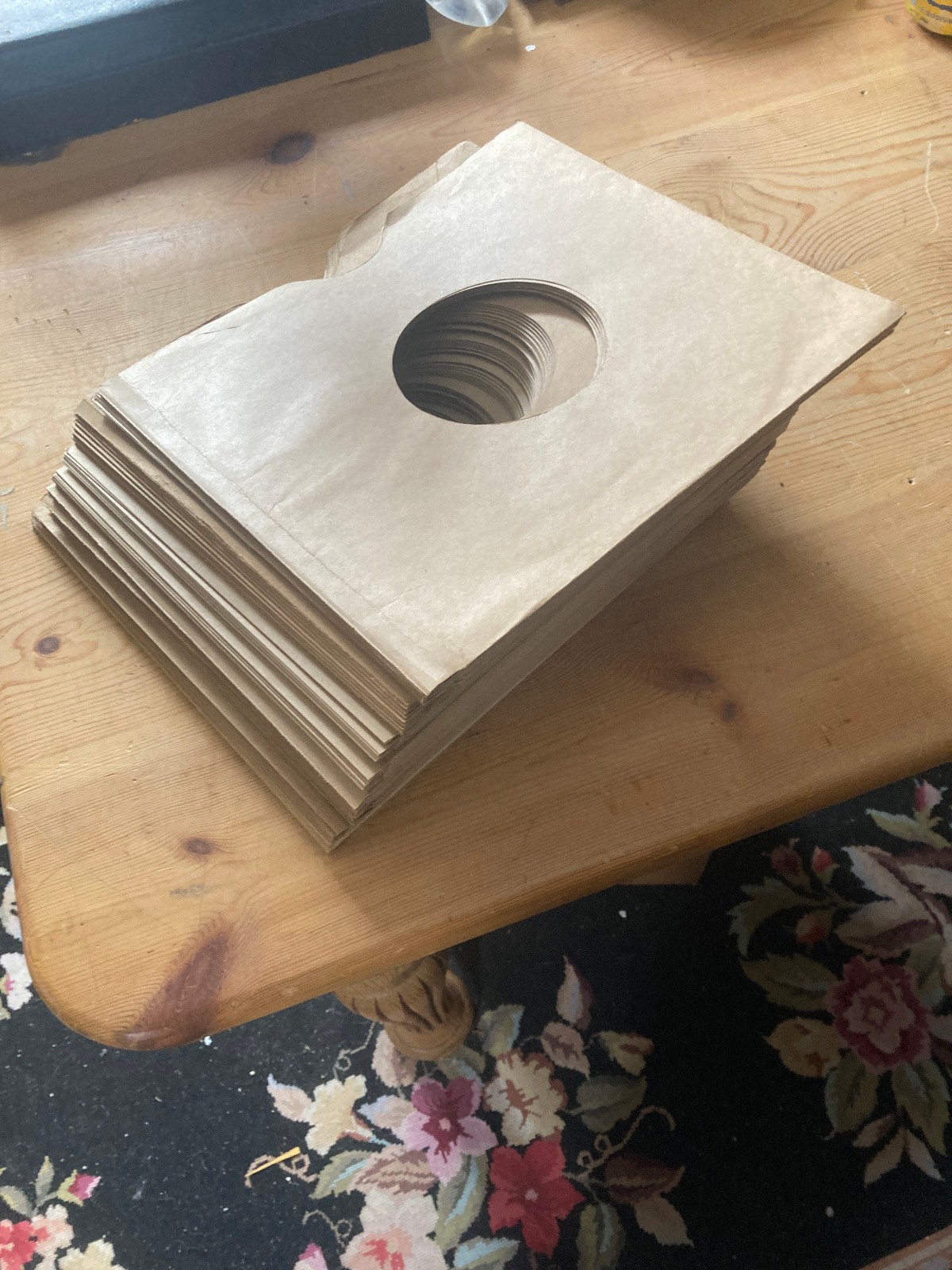
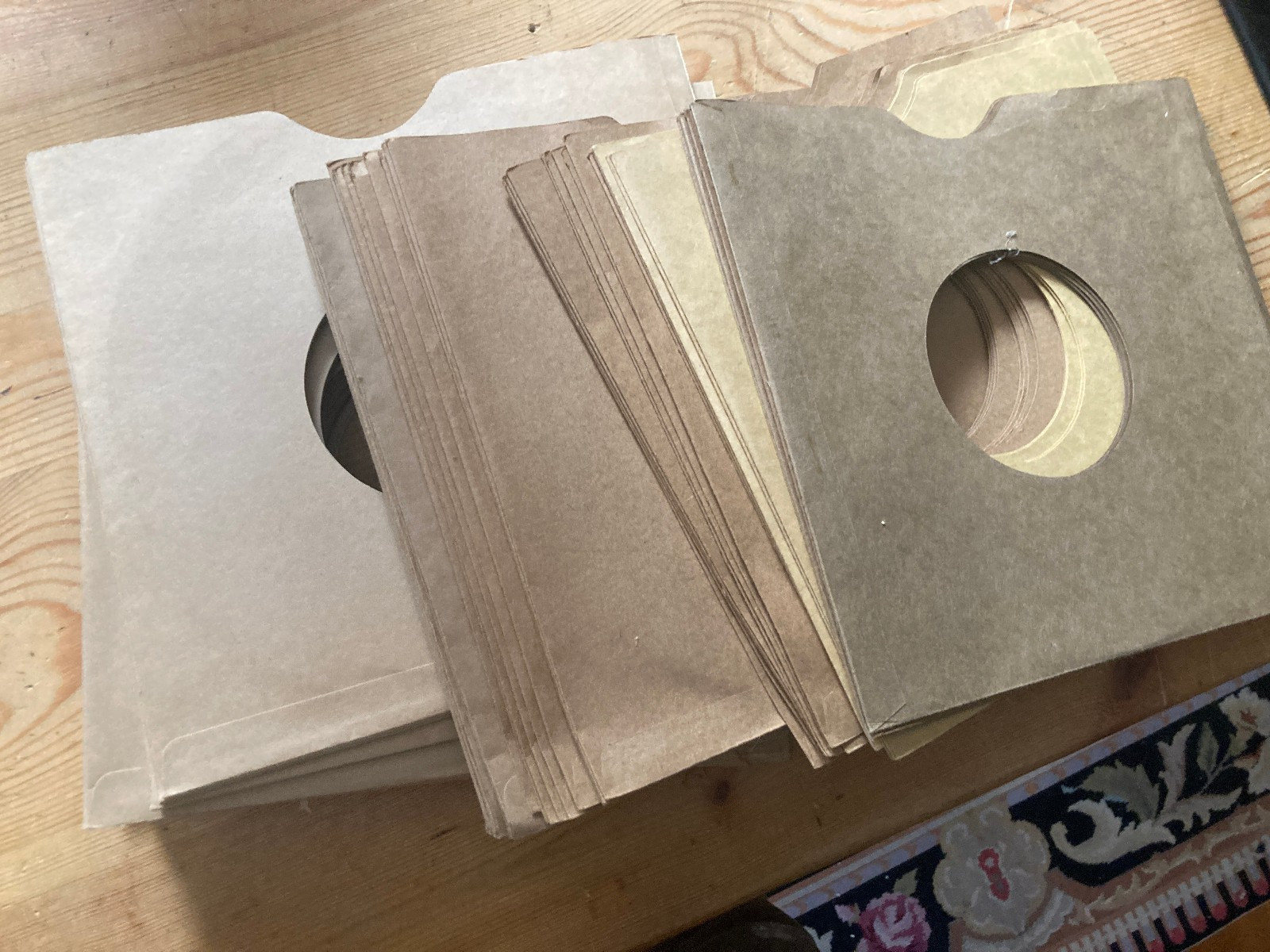
Brown heavy duty paper sleeves for 78 records--over 70 here (phonograph) victrol
$
29



Favourite Auctions
To save auctions to your favourites, please login
If you don't have an account, please register
Description
This is a lot of over 70 heavy brown paper (heavier than manila) record sleeves--the kind you find in the old 78 albums. all are clean (a few have stamped numbers on them) no writing noted
FREE SHIPPING (I will ship with a random 78 to get media rate)
WIKIPEDIA:
Early disc recordings were produced in a variety of speeds ranging from 60 to 130 rpm, and a variety of sizes. As early as 1894, Emile Berliner's United States Gramophone Company was selling single-sided 7-inch discs with an advertised standard speed of "about 70 rpm".[21]
One standard audio recording handbook describes speed regulators, or governors, as being part of a wave of improvement introduced rapidly after 1897. A picture of a hand-cranked 1898 Berliner Gramophone shows a governor and says that spring drives had replaced hand drives. It notes that:
The speed regulator was furnished with an indicator that showed the speed when the machine was running so that the records, on reproduction, could be revolved at exactly the same speed...The literature does not disclose why 78 rpm was chosen for the phonograph industry, apparently this just happened to be the speed created by one of the early machines and, for no other reason continued to be used.[22]
A multinational product: an operatic duet sung by Enrico Caruso and Antonio Scotti, recorded in the US in 1906 by the Victor Talking Machine Company, manufactured c. 1908 in Hanover, Germany, for the Gramophone Company, Victor's affiliate in EnglandIn 1912, the Gramophone Company set 78 rpm as their recording standard, based on the average of recordings they had been releasing at the time, and started selling players whose governors had a nominal speed of 78 rpm.[23] By 1925, 78 rpm was becoming standardized across the industry. However, the exact speed differed between places with alternating current electricity supply at 60 hertz (cycles per second, Hz) and those at 50 Hz. Where the mains supply was 60 Hz, the actual speed was 78.26 rpm:[24] that of a 60 Hz stroboscope illuminating 92-bar calibration markings. Where it was 50 Hz, it was 77.92 rpm: that of a 50 Hz stroboscope illuminating 77-bar calibration markings.[23]
Edison Records Diamond Disc label, early 1920s. Edison Disc Records always ran at 80 rpm.At least one attempt to lengthen playing time was made in the early 1920s. World Records produced records that played at a constant linear velocity, controlled by Noel Pemberton Billing's patented add-on speed governor.[25]
Acoustic recording
Early recordings were made entirely acoustically, the sound was collected by a horn and piped to a diaphragm, which vibrated the cutting stylus. Sensitivity and frequency range were poor, and frequency response was irregular, giving acoustic recordings an instantly recognizable tonal quality. A singer almost had to put their face in the recording horn. A way of reducing resonance was to wrap the recording horn with tape.[26]
Even drums, if planned and placed properly, could be effectively recorded and heard on even the earliest jazz and military band recordings. The loudest instruments such as the drums and trumpets were positioned the farthest away from the collecting horn. Lillian Hardin Armstrong, a member of King Oliver's Creole Jazz Band, which recorded at Gennett Records in 1923, remembered that at first Oliver and his young second trumpet, Louis Armstrong, stood next to each other and Oliver's horn could not be heard. "They put Louis about fifteen feet over in the corner, looking all sad."[27][28]
Electrical recording
An electronically recorded disc from Carl Lindström AG, Germany, c. 1930During the first half of the 1920s, engineers at Western Electric, as well as independent inventors such as Orlando Marsh, developed technology for capturing sound with a microphone, amplifying it with vacuum tubes[29] (known as valves in the UK[30]), and then using the amplified signal to drive an electromechanical recording head. Western Electric's innovations resulted in a broader and smoother frequency response, which produced a dramatically fuller, clearer and more natural-sounding recording. Soft or distant sounds that were previously impossible to record could now be captured. Volume was now limited only by the groove spacing on the record and the amplification of the playback device. Victor and Columbia licensed the new electrical system from Western Electric and recorded the first electrical discs during the spring of 1925. The first electrically recorded Victor Red Seal record was Chopin's "Impromptus" and Schubert's "Litanei" performed by pianist Alfred Cortot at Victor's studios in Camden, New Jersey.[29]
A 1926 Wanamaker's ad in The New York Times offers records "by the latest Victor process of electrical recording".[31] It was recognized as a breakthrough; in 1930, a Times music critic stated:
... the time has come for serious musical criticism to take account of performances of great music reproduced by means of the records. To claim that the records have succeeded in exact and complete reproduction of all details of symphonic or operatic performances ... would be extravagant ... [but] the article of today is so far in advance of the old machines as hardly to admit classification under the same name. Electrical recording and reproduction have combined to retain vitality and color in recitals by proxy.[32]
Examples of Congolese 78 rpm records A 10-inch blank for making an individually cut one-off recording made from Decelith, a proprietary PVC-based material produced by a German Company ECW that was used to make commercial flexible blanks prior to World War II[33]The Orthophonic Victrola had an interior folded exponential horn, a sophisticated design informed by impedance-matching and transmission-line theory, and designed to provide a relatively flat frequency response. Victor's first public demonstration of the Orthophonic Victrola on 6 October 1925, at the Waldorf-Astoria Hotel was front-page news in The New York Times, which reported:
The audience broke into applause ... John Philip Sousa [said]: '[Gentlemen], that is a band. This is the first time I have ever heard music with any soul to it produced by a mechanical talking machine' ... The new instrument is a feat of mathematics and physics. It is not the result of innumerable experiments, but was worked out on paper in advance of being built in the laboratory ... The new machine has a range of from 100 to 5,000 [cycles per second], or five and a half octaves ... The 'phonograph tone' is eliminated by the new recording and reproducing process.[34]
Sales of records plummeted precipitously during the early years of the Great Depression of the 1930s, and the entire record industry in America nearly foundered. In 1932, RCA Victor introduced a basic, inexpensive turntable called the Duo Jr., which was designed to be connected to their radio receivers. According to Edward Wallerstein (the general manager of the RCA Victor Division), this device was "instrumental in revitalizing the industry".[35]
78 rpm materials
The production of shellac records continued throughout the 78 rpm era, which lasted until 1948 in industrialized nations.[36]
During the Second World War, the United States Armed Forces produced thousands of 12-inch vinyl 78 rpm V-Discs for use by the troops overseas.[37] After the war, the use of vinyl became more practical as new record players with lightweight crystal pickups and precision-ground styli made of sapphire or an exotic osmium alloy proliferated. In late 1945, RCA Victor began offering "De Luxe" transparent red vinylite pressings of some Red Seal classical 78s, at a de luxe price. Later, Decca Records introduced vinyl Deccalite 78s, while other record companies used various vinyl formulations trademarked as Metrolite, Merco Plastic, and Sav-o-flex, but these were mainly used to produce "unbreakable" children's records and special thin vinyl DJ pressings for shipment to radio stations.[38]
78 rpm recording time
The playing time of a phonograph record is directly proportional to the available groove length divided by the turntable speed. Total groove length in turn depends on how closely the grooves are spaced, in addition to the record diameter. At the beginning of the 20th century, the early discs played for two minutes, the same as cylinder records.[39] The 12-inch disc, introduced by Victor in 1903, increased the playing time to three and a half minutes.[40] Because the standard 10-inch 78 rpm record could hold about three minutes of sound per side, most popular recordings were limited to that duration.[41] For example, when King Oliver's Creole Jazz Band, including Louis Armstrong on his first recordings, recorded 13 sides at Gennett Records in Richmond, Indiana, in 1923, one side was 2:09 and four sides were 2:52–2:59.[42]
In January 1938, Milt Gabler started recording for Commodore Records, and to allow for longer continuous performances, he recorded some 12-inch discs. Eddie Condon explained: "Gabler realized that a jam session needs room for development." The first two 12-inch recordings did not take advantage of their capability: "Carnegie Drag" was 3m 15s; "Carnegie Jump", 2m 41s. But at the second session, on 30 April, the two 12-inch recordings were longer: "Embraceable You" was 4m 05s; "Serenade to a Shylock", 4m 32s.[43][44] Another way to overcome the time limitation was to issue a selection extending to both sides of a single record. Vaudeville stars Gallagher and Shean recorded "Mr. Gallagher and Mr. Shean", written by themselves or, allegedly, by Bryan Foy, as two sides of a 10-inch 78 in 1922 for Victor.[45] Longer musical pieces were released as a set of records. In 1903 The Gramophone Company in England made the first complete reco
price rating