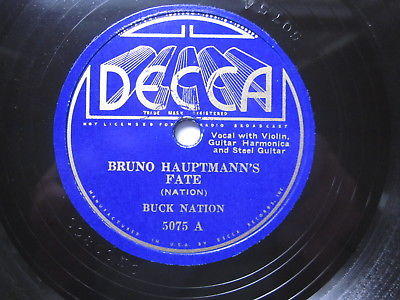
"Bruno Hauptmanns Fate/End of Public Enemy # One" Buck Nation 1935 Decca EX- ec
$
51


Favourite Auctions
To save auctions to your favourites, please login
If you don't have an account, please register
Description
Up for auction is this original, excellent minus condition, 78rpm disc, "Bruno Hauptmann's Fate" b/w "The End Of Public Enemy Number One" by Buck Nation on "3-D" Decca Records #5075 from 1935. Songs were recorded February 19, 1935, a year before Hauptmann was electrocuted in Trenton, New Jersey.
Artists:
- Fiddle [Uncredited] – Bill Benner
- Harmonica [Uncredited] – Jake Watts
- Steel Guitar [Uncredited] – Bill Butler
- Vocals – Buck Nation
- Written-By – Nation
Lorraine & John @ jbvvg ~ North Bennington, Vermont, USA ~ Rare & Unusual Records & Collectibles since 1981.
~~~~~~~~~~~~~~~~~~~~~~~~~~~~~~~~~~~~~~~~~~~~~~~~~~~~~~~~~~~~~~~~~~~~~~~~~~~~~~~~~~~~~ from Discogs.com: Buck Nation Real Name: Rex Kelley
Born Rex Frederick Kelley in Burke, South Dakota in 1910, he recorded as Rex Kelly (2) and Bud Kelly (2) (on the Paramount and Broadway labels, respectively, in 1932), and as Buck Nation for his 1935 and later sides on Decca and other labels. In the early 1940s he recorded as a member of The Airport Boys on the Bluebird label, with Ed West and Lloyd West, and in 1946 as a member of The Six Westernaires, with Slim Duncan and Porky Freeman, on the Black & White label. He died in January 1965 in New York State.
from Wikipedia: (in part)
In the latter part of the 20th century, the case against Bruno Hauptmann came under serious scrutiny. For instance, one item of evidence at his trial was a scrawled phone number on a board in his closet, which was the number of the man who delivered the ransom, Dr John F. Condon. A juror at the trial said this was the one item that convinced him the most, but a reporter later admitted he had written the number himself. It is also alleged that the eyewitnesses who placed Hauptmann at the Lindbergh estate near the time of the crime were untrustworthy (including one legally blind man who had claimed to have seen Hauptmann near the Lindbergh home), and that neither Lindbergh nor the go-between who delivered the ransom initially identified Hauptmann as the recipient.
In fact, Condon, after seeing Hauptmann in a lineup at New York Police Department Greenwich Street Station told FBI Special Agent Turrou that Hauptmann was not "John," the man whom Condon claimed he had passed the ransom money to in St. Raymond's Cemetery. He further stated that Hauptmann looked different (for instance that he had different eyes, was heavier, and had different hair), and that "John" was actually dead because he had been murdered by his confederates.
While waiting in a car nearby, Lindbergh heard the voice of "John" calling to Condon during the ransom drop-off, but never saw him. Although he testified before the Bronx grand jury that he heard only the words "hey doc", and that it would be very difficult to say he could recognize a man by his voice, he identified Hauptmann as having the same voice during his trial in Flemington. The police beat Hauptmann while in custody at the Greenwich Street Station.
It has also been alleged that certain witnesses were intimidated, and some claim that the police planted or doctored evidence, such as the ladder. There are also allegations that the police doctored Hauptmann's time cards and ignored fellow workers who stated that Hauptmann was working the day of the kidnapping. These and other findings prompted J. Edgar Hoover of the FBI to question the manner in which the investigation and the trial were conducted. Hauptmann's widow campaigned until the end of her life to have her husband's conviction reversed.
Erastus Mead Hudson was a fingerprint expert who knew about the then-rare silver nitrate process of collecting fingerprints from wood and other surfaces on which the previous powder method would not work. He found that Hauptmann's fingerprints were not on the wood, even in places that the man who made the ladder must have touched. Upon reporting this to a police officer and stating that they must look further, the officer said, "Good God, don't tell us that, Doctor!" The ladder was then washed of all fingerprints, and Norman Schwarzkopf, Sr., the superintendent of the New Jersey Police, refused to disclose to the public that Hauptmann's prints were not on the ladder.
Several books have been written proclaiming Hauptmann's innocence. These books variously criticize the police for allowing the crime scenes to become contaminated, Lindbergh and his associates for interfering with the investigation, Hauptmann's trial lawyers for ineffectively representing him, and the reliability of the witnesses and physical evidence presented at the trial. British journalist Ludovic Kennedy in particular questioned much of the evidence, such as the origin of the ladder and the testimony of many of the witnesses. A recent book on the case, A Talent to Deceive by British investigative writer William Norris, not only declares Hauptmann's innocence but also accuses Lindbergh of a cover-up of the killer's true identity. The book incriminates Dwight Morrow, Jr., Lindbergh's brother-in-law.
For more than 50 years, Hauptmann's widow fought with the New Jersey courts without success to have the case re-opened. In 1982, the 82-year-old Anna Hauptmann sued the State of New Jersey, various former police officers, the Hearst newspapers that had published pre-trial articles insisting on Hauptmann's guilt, and former prosecutor David T. Wilentz (then 86) for over $100 million in wrongful-death damages. She claimed that the newly discovered documents proved misconduct by the prosecution and manufacture of evidence by government agents, all of whom were biased against Hauptmann because he happened to be of German ethnicity. In 1983, the US Supreme Court refused her request that the federal judge considering the case should be disqualified because of judicial bias, and in 1984 the judge dismissed her claims.
In 1985, over 23,000 pages of Hauptmann-case police documents were found in the garage of the late Governor Hoffman. These documents, along with 34,000 pages of FBI files, which, although discovered in 1981, had not been disclosed to the public, represented a windfall of previously undisclosed information. As a direct result of this new evidence, Anna Hauptmann again amended her civil complaint on July 14, 1986, to clear her late husband's name by continuing to assert that he was "framed from beginning to end" by the police looking for a suspect. Among her allegations were suggestions that the rail of the ladder taken from the attic, where they used to live in 1935, was planted by the police and that the ransom money was left behind by Isidor Fisch, who was possibly the real kidnapper. In 1990, New Jersey's governor, James Florio, declined her appeal for a meeting to clear Bruno Hauptmann's name. Anna Hauptmann died on October 10, 1994.
Some might describe this item as a gem, one-of-a-kind, the holy grail, a first edition, grade A, top quality, 5 star, five star, a museum piece, stone mint, out of print, unavailable, rare, rarely seen, unique, psa 10, investment quality, trending, new to the market, may never be seen again or never before seen, but I won’t. Not in visible font anyway. This also has nothing to do with bit-coins.
price rating