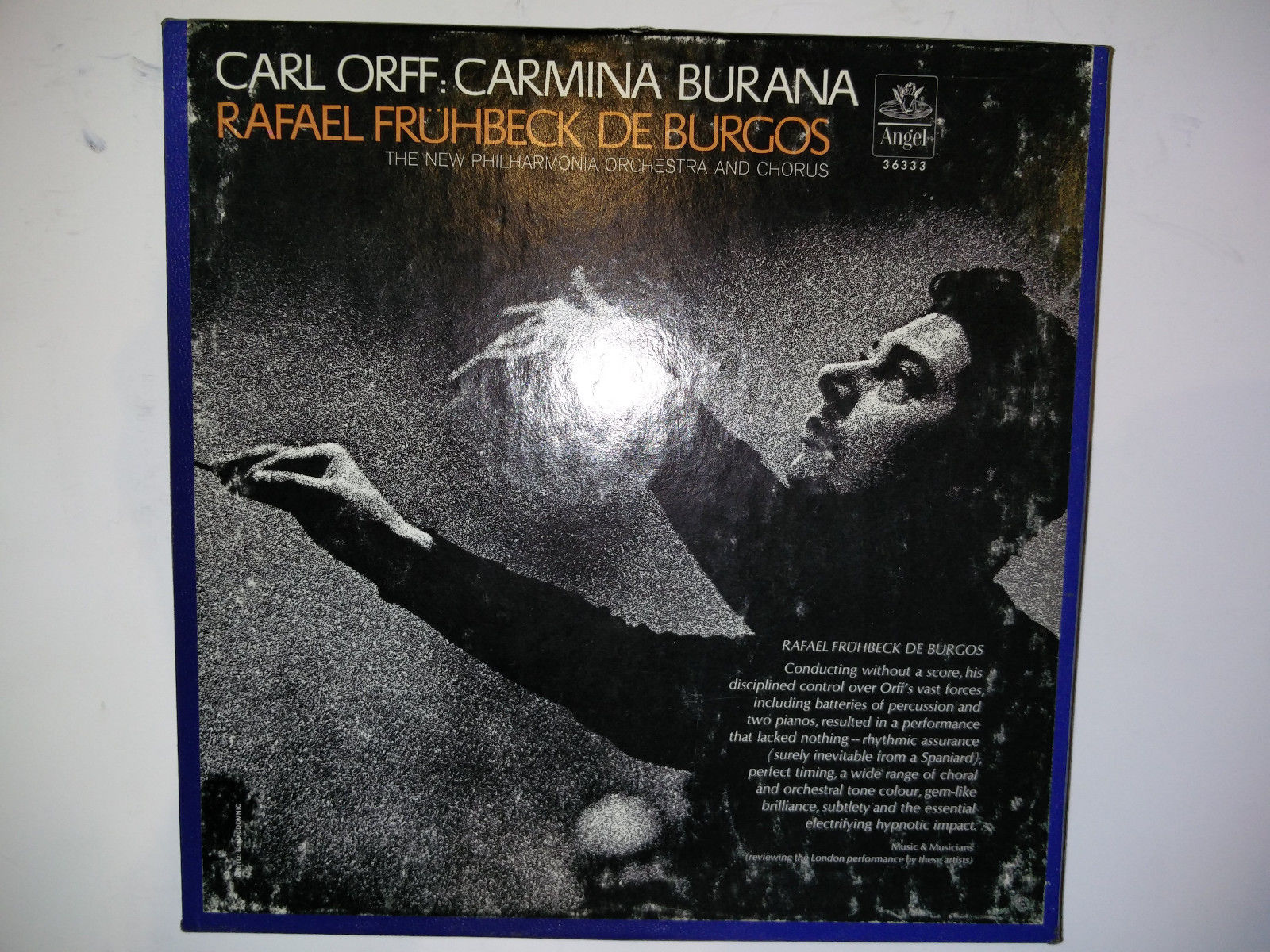
CARMINA BURANA - Carl Orff,de Burgos - AMPEX Reel Tape 7.5 IPS - klangfilm ton
€
90
$
105


€ 90
Sold For
Feb 5, 2017
Sold Date
Feb 2, 2017
Start Date
1
Number Of Bids
Germany
Country Of Seller
eBay
Sold at
Favourite Auctions
To save auctions to your favourites, please login
If you don't have an account, please register
Description
CARMINA BURANA
CARL ORFF, Composer
RAFAEL FRÜBECK DE BURGOS, Conductor
- Baritone Vocals – Harve Presnell
- Choir – The Rutgers University Choir
- Composed By – Carl Orff
- Conductor – Eugene Ormandy, F. Austin Walter
- Liner Notes – David Johnson (4)
- Orchestra – The Philadelphia Orchestra
- Soprano Vocals – Janice Harsanyi
- Tenor Vocals – Rudolph Petrak*
Tracklist:
Side 1:
A Fortuna Imperatrix Mundi / Part I - Primo Vere; Uf Dem Anger / Part II - In Taberna (Begining) 28:52
Side 2:
B Part II - In Taberna (Conclusion) / Part III - Cour D'amours; Blanzif Et Helena / Fortuna Imperatrix Mundi 29:18
originally recorded and pressed in USA 1960
LONDON 2 Track In-Line 7.5 IPS Reel to Reel Tape
L36333 Stereo Angel tapes released by LONDON ffrr
Carmina Burana is a scenic cantata composed by Carl Orff in 1935 and 1936, based on 24 poems from the medieval collection Carmina Burana. Its full Latin title is Carmina Burana: Cantiones profanæ cantoribus et choris cantandæ comitantibus instrumentis atque imaginibus magicis ("Songs of Beuern: Secular songs for singers and choruses to be sung together with instruments and magic images"). Carmina Burana is part of Trionfi, a musical triptych that also includes Catulli Carmina and Trionfo di Afrodite. The first and last movements of the piece are called Fortuna Imperatrix Mundi ("Fortune, Empress of the World") and start with the very well known "O Fortuna". THE PHILHARMONIA ORCHESTER
In 1934, Orff encountered the 1847 edition of the Carmina Burana by Johann Andreas Schmeller, the original text dating mostly from the 11th or 12th century, including some from the 13th century. Michel Hofmann (de), then a young law student and Latin and Greek enthusiast, assisted Orff in the selection and organization of 24 of these poems into a libretto, mostly in Latin verse, with a small amount of Middle High German and Old Provençal. The selection covers a wide range of topics, as familiar in the 13th century as they are in the 21st century: the fickleness of fortune and wealth, the ephemeral nature of life, the joy of the return of Spring, and the pleasures and perils of drinking, gluttony, gambling and lust.
Orff was influenced melodically by late Renaissance and early Baroque models including William Byrd and Claudio Monteverdi. It is a common misconception that Orff based the melodies of Carmina Burana on neumeatic melodies; while many of the lyrics in the Burana Codex are enhanced with neumes, almost none of these melodies had been deciphered at the time of Orff's composition, and none of them had served Orff as a melodic model. His shimmering orchestration shows a deference to Stravinsky. In particular, Orff's music is very reminiscent of Stravinsky's earlier work, Les noces (The Wedding).
Rhythm, for Orff as it was for Stravinsky, is often the primary musical element. Overall, it sounds rhythmically straightforward and simple, but the metre will change freely from one measure to the next. While the rhythmic arc in a section is taken as a whole, a measure of five may be followed by one of seven, to one of four, and so on, often with caesura marked between them. These constant rhythmic changes combined with the caesura create a very "conversational" feel – so much so that the rhythmic complexities of the piece are often overlooked.
Orff developed a dramatic concept he called "Theatrum Mundi" in which music, movement, and speech were inseparable. Babcock writes that "Orff's artistic formula limited the music in that every musical moment was to be connected with an action on stage. It is here that modern performances of Carmina Burana fall short of Orff's intentions." Although Carmina Burana was intended as a staged work involving dance, choreography, visual design and other stage action, the piece is now usually performed in concert halls as a cantata. A notable exception is the Trans-Siberian Orchestra version which features strobe lights and what appears to be flames engulfing the stage, wings and balconies, pulsing intensely in time to the music. A danced version choreographed by Loyce Houlton for the Minnesota Dance Theatre in 1978 was prepared in collaboration with Orff himself.
Carmina Burana is structured into five major sections, containing 25 movements total. Orff indicates attacca markings between all the movements within each scene.
Much of the compositional structure is based on the idea of the turning Fortuna Wheel. The drawing of the wheel found on the first page of the Burana Codex includes four phrases around the outside of the wheel: "Regnabo, Regno, Regnavi, Sum sine regno". (I shall reign, I reign, I have reigned, I am without a realm). Within each scene, and sometimes within a single movement, the wheel of fortune turns, joy turning to bitterness, and hope turning to grief. "O Fortuna", the first poem in the Schmeller edition, completes this circle, forming a compositional frame for the work through being both the opening and closing movements.
Orff's style demonstrates a desire for directness of speech and of access. Carmina Burana contains little or no development in the classical sense, and polyphony is also conspicuously absent. Carmina Burana avoids overt harmonic complexities, a fact which many musicians and critics have pointed out, such as Ann Powers of The New York Times.
Carmina Burana is scored for a large orchestra of three flutes (second and third doubling first and second piccolos), three oboes (third being English horn), three clarinets in B-flat and A (third doubling piccolo clarinet in E-flat, second doubling bass clarinet), two bassoons, one contrabassoon, four horns in F, three trumpets in B-flat and C, two trombones, one bass trombone one tuba; a percussion section with 5 timpani, two snare drums, bass drum, triangle, cymbals, suspended cymbal, antique cymbals, ratchet, castanets, tambourine, sleigh bells, tam-tam, tubular bells, three bells, three glockenspiels, gong, xylophone; two pianos, one celesta; strings; two SATB mixed choirs (one large and one small, although a subset of the large chorus may be used for the small chorus) and one boys' choir; and soprano soloist, tenor soloist, baritone soloist, and short solos for three tenors, baritone and two basses
A reduced version for soloists, SATB mixed choir, children's choir, two pianos and six percussion (timpani + 5) was prepared by Orff's disciple, Wilhelm Killmayer, in 1956 and authorized by Orff himself, to allow smaller ensembles the opportunity to perform the piece.
Some of the solo arias pose bold challenges for singers: the only solo tenor aria, Olim lacus colueram, is often sung almost completely in falsetto to demonstrate the suffering of the character (in this case, a roasting swan). The baritone arias often demand high notes not commonly found in baritone repertoire, and parts of the baritone aria Dies nox et omnia are often sung in falsetto, a unique example in baritone repertoire. Also noted is the solo soprano aria, Dulcissime which demands extremely high notes. Orff intended this aria for a lyric soprano, not a coloratura, so that the musical tensions would be more obvious.
Please see the pictures for further information.
Pictures are part of the article description.
---------------------------------------------------------------------
Shipping
Shipping Germany: 5 EUR
EU - 14 EUR
Worldwide - 19,50 EUR
tubenarr@t-online.de
price rating