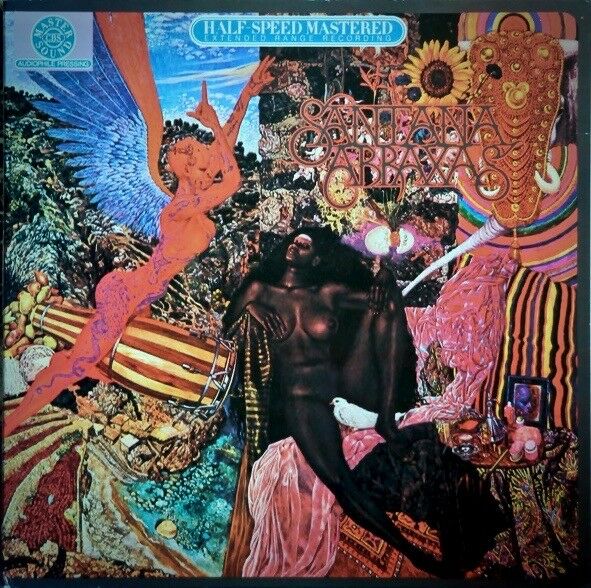
CBS Master Sound LP HC-40130: Santana - Abraxas - 1981 CANADA NM Half Speed
C$
75
$
54


C$ 75
Sold For
Jan 31, 2019
Sold Date
Dec 31, 2018
Start Date
C$ 125
Start price
1
Number Of Bids
Canada
Country Of Seller
eBay
Sold at
Favourite Auctions
To save auctions to your favourites, please login
If you don't have an account, please register
Description
****Welcome to our listing, thanks very much for looking!
****See our own website! We have lots of out of print LPs and CDs! Find us on the web at -
hearthedifference.net
****Shipping cost is only an estimate - it depends on the actual weight and size of the package as well as the service required. We do not profit from shipping costs, so if we overcharge, we will refund the difference back to you. It's always best to wait for our invoice before paying for your item. We will combine shipping for multiple items purchased.
****Please see our other listings - new items added daily!****To access our eBay store click on the little red door at the top right section of any of our eBay listings or, click on -
http://stores.ebay.com/Hear-The-Difference
Background -
Santana is the primary exponent of Latin-tinged rock, particularly due to their combination of Latin percussion (congas, timbales, etc.) with bandleader Carlos Santana's distinctive, high-pitched lead guitar playing. The group was the last major act to emerge from the psychedelic San Francisco music scene of the 1960s and enjoyed massive success at the end of the decade and into the early '70s. The musical direction then changed to a more contemplative and jazzy style as the band's early personnel gradually departed, leaving the name in the hands of Carlos Santana, who guided the group to consistent commercial success over the next quarter-century. By the mid-'90s, Santana seemed spent as a commercial force on records, though the group continued to attract audiences for its concerts worldwide. But the band made a surprising and monumental comeback in 1999 with Supernatural, an album featuring many guest stars that became Santana's best-selling release and won a raft of Grammy Awards.Mexican native Carlos Santana (born July 20, 1947, in Autlan de Navarro, Mexico) moved to San Francisco in the early '60s, by which time he was already playing the guitar professionally. In 1966, he formed the Santana Blues Band with keyboard player and singer Gregg Rolie (born June 17, 1947, in Seattle, Washington) and other musicians, the personnel changing frequently. The group was given its name due to a musicians' union requirement that a single person be named a band's leader and it did not at first indicate that Carlos was in charge. Bass player David Brown (born February 15, 1947, in New York, New York) joined early on, as did Carlos' high-school friend conga player Mike Carabello (born November 18, 1947, in San Francisco), though he did not stay long at first. By mid-1967, the band's lineup consisted of Carlos, Rolie, Brown, drummer Bob "Doc" Livingston, and percussionist Marcus Malone. The name was shortened simply to Santana and the group came to the attention of promoter Bill Graham, who gave it its debut at his Fillmore West theater on June 16, 1968. Santana were signed to Columbia Records, who sent producer David Rubinson to tape the band at a four-night stand at the Fillmore West December 19-22, 1968. The results were not released until almost 30 years later, when Columbia/Legacy issued Live at the Fillmore 1968 in 1997.
Livingston and Malone left the lineup in 1969 and were replaced by Carabello and drummer Michael Shrieve (born July 6, 1949, in San Francisco), with a second percussionist, Jose "Chepito" Areas (born July 25, 1946, in Leon, Nicaragua) making Santana a sextet. The band recorded its self-titled debut album and began to tour nationally, making an important stop at the Woodstock festival on August 15, 1969. Santana was released the same month. It peaked in the Top Five, going on to remain in the charts over two years, sell over two million copies, and spawn the Top 40 single "Jingo" and the Top Ten single "Evil Ways." Santana's performance of "Soul Sacrifice" was a highlight of the documentary film Woodstock and its double-platinum soundtrack album, which appeared in 1970.
The band's second album, Abraxas, was released in September 1970 and was even more successful than its first. It hit number one, remaining in the charts more than a year and a half and eventually selling over four million copies while spawning the Top Five hit "Black Magic Woman" and the Top Ten hit "Oye Como Va." By the end of the year, the group had added a seventh member, teenage guitarist Neal Schon (born February 27, 1954).
Santana's third album, Santana III, was performed by the seven bandmembers (and marked guitarist Neil Schon's debut with the group), though several guest musicians were also mentioned in the credits, notably percussionist Coke Escovedo, who played on all the tracks. Released in September 1971, the album was another massive hit, reaching number one and eventually selling over two million copies while spawning the Top Ten hit "Everybody's Everything" and the Top 20 hit "No One to Depend On." But it marked the end of the Woodstock-era edition of Santana, which broke up at the end of the tour promoting it, with Carlos retaining rights to the band name.
Following a tour with Buddy Miles that resulted in a live duo album (Carlos Santana & Buddy Miles! Live!), Carlos reorganized Santana and recorded the fourth Santana band album, Caravanserai; each track featured individual musician credits. From the previous lineup, Rolie, Shrieve, Areas, and Schon appeared, alongside pianist Tom Coster, percussionist James Mingo Lewis, percussionist Armando Peraza, guitarist/bassist Douglas Rauch, and percussionist Rico Reyes, among others. (Rolie and Schon left to form Journey.) The album was released in September 1972; it peaked in the Top Five and was eventually certified platinum. It was nominated for a Grammy Award for Best Pop Instrumental Performance with Vocal Coloring. Carlos, who had become a disciple of the guru Sri Chinmoy and adopted the name Devadip (meaning "the eye, the lamp, and the light of God"), next made a duo album with John McLaughlin, guitarist with the Mahavishnu Orchestra (Love Devotion Surrender).
Meanwhile, the lineup of Santana continued to fluctuate. On Welcome, the band's fifth album, released in November 1973, it consisted of Carlos, Shrieve, Areas, Coster, Peraza, Rauch, keyboard player Richard Kermode, and singer Leon Thomas. The album went gold and peaked in the Top 20. In May 1974, Lotus, a live album featuring the same lineup, was released only in Japan. (It was issued in the U.S. in 1991.) Carlos continued to alternate side projects with Santana band albums, next recording a duo LP with John Coltrane's widow Alice Coltrane (Illuminations). Columbia decided to cash in on the band's diminishing popularity by releasing Santana's Greatest Hits in July 1974. The compilation peaked in the Top 20 and eventually went double platinum.
The sixth new Santana album, Borboletta, followed in October. The band personnel for the LP featured Carlos, Shrieve, Areas, Coster, Peraza, a returning David Brown, saxophonist Jules Broussard, and singer Leon Patillo, plus guest stars Flora Purim, Airto Moreira, and Stanley Clarke. Borboletta peaked in the Top 20 and eventually went gold. Carlos steered Santana back to a more commercial sound in the mid-'70s in an attempt to stop the eroding sales of the band's albums. He enlisted Santana's original producer, David Rubinson, to handle the next LP. The band was streamlined to a sextet consisting of himself, Coster, Peraza, Brown, drummer Ndugu Leon Chancler (Shrieve having departed to work with Stomu Yamashta), and singer Greg Walker.
The result was Amigos, released in March 1976, which returned Santana to the Top Ten and went gold. The band was back only nine months later with another Rubinson production, Festival, for which Santana consisted of Carlos, Coster, returning members Jose "Chepito" Areas and Leon Patillo, drummer Gaylord Birch, percussionist Raul Rekow, and bass player Pablo Telez. This album peaked in the Top 40 and went gold. Never having issued a live album in the U.S., Santana made up for the lapse with Moonflower, released in October 1977; that band consisted of Carlos, Coster, Areas, Rekow, Telez, returning member Greg Walker, percussionist Pete Escovedo, drummer Graham Lear, and bass player David Margen. The album peaked in the Top Ten and eventually went platinum, its sales stimulated by the single release of a revival of the Zombies' "She's Not There" that peaked in the Top 20, Santana's first hit single in nearly six years.
Turning to producers Dennis Lambert and Brian Potter, Santana returned to the studio for Inner Secrets, released in October 1978. The revamped lineup this time was Carlos, Rekow, Walker, Lear, Margen, and returning members Coke Escovedo and Armando Peraza, keyboard player Chris Rhyne, and guitarist/keyboard player Chris Solberg. The album was quickly certified gold, and a revival of the Classics IV hit "Stormy" made the Top 40, but Inner Secrets peaked disappointingly below the Top 20. Once again adopting his guru name of Devadip, Carlos issued his first real solo album (Illuminations/Oneness) in February 1979. Marathon, the tenth Santana band studio album, followed in September, produced by Keith Olsen; the band here comprised Carlos, Rekow, Lear, Margen, Peraza, Solberg, singer Alex Ligertwood, and keyboard player Alan Pasqua. The album equaled the success of Inner Secrets, peaking outside the Top 20 but going gold, with "You Know That I Love You" becoming a Top 40 single. Again, Carlos followed in the winter with another solo effort (The Swing of Delight).
Santana (Carlos, Rekow, Lear, Margen, Peraza, Ligertwood, keyboard player Richard Baker, and percussionist Orestes Vilato) spent some extra time on their next release, not issuing Zebop! until March 1981, and the extra effort paid off. Paced by the Top 20 single "Winning," the album reached the Top Ten and went gold. The band lavished similar attention on Shango, which was released in August 1982. The same lineup as that on Zebop! was joined by original member Gregg Rolie, who also co-produced the album. A music video helped Santana enjoy their first Top Ten single in more than a decade with "Hold On," but that did not translate into increased sales for the album, which peaked in the Top 20 but became the band's first LP not to at least go gold. Carlos followed with another solo album (Havana Moon), but did not release a new Santana band album until February 1985 with Beyond Appearances, produced by Val Garay. By now the lineup consisted of Carlos, Rekow, Peraza, Ligertwood, Vilato, returning member Greg Walker, bass player Alphonso Johnson, keyboard player David Sancious, drummer Chester C. Thompson, and keyboard player Chester D. Thompson. "Say It Again," the album's single, reached the Top 40, but that was better than the LP did.
Santana staged a 20-year anniversary reunion concert in August 1986 featuring many past bandmembers. The February 1987 album Freedom marked the formal inclusion of Buddy Miles as a member of Santana, alongside Carlos, Rekow, Peraza, Vilato, Johnson, Chester D. Thompson, and returning members Tom Coster and Graham Lear. The album barely made the Top 100. Carlos followed in the fall with another solo album (Blues for Salvador), winning his first Grammy Award in the process (Best Rock Instrumental Performance for the title track). In 1988, he added Wayne Shorter to the band for a tour, then put together a reunion edition of Santana that featured Areas, Rolie, and Shrieve beside Johnson, Peraza, and Thompson. In October, Columbia celebrated the 20-year anniversary of the band's signing to the label with the retrospective Viva Santana! The next new Santana album was Spirits Dancing in the Flesh, released in June 1990, for which the band was Carlos, Peraza, Thompson, returning member Alex Ligertwood, drummer Walfredo Reyes, and bass player Benny Rietveld. A modest seller that made only the lower reaches of the Top 100, it marked the end of the band's 22-year tenure at Columbia Records.
In 1991, Santana signed to Polydor Records, which, in April 1992, released the band's 16th studio album, Milagro. The lineup comprised Carlos, Thompson, Ligertwood, Reyes, Rietveld, and percussionist Karl Perazzo. Polydor was not able to reverse the band's commercial decline, as the album became Santana's first new studio release not to reach the Top 100. The group followed in November 1993 with Sacred Fire: Live in South America, which featured Carlos, Thompson, Ligertwood, Reyes, Perazzo, singer Vorriece Cooper, bass player Myron Dove, and guitarist Jorge Santana, Carlos' brother. The album barely made the charts. In 1994, Carlos, Jorge, and their nephew Carlos Hernandez released Santana Brothers, another marginal chart entry. The same year, Areas, Carabello, Rolie, and Shrieve formed a band called Abraxas and released the album Abraxas Pool, which did not chart.
Santana left Polydor and signed briefly to EMI before moving to Arista, run by Clive Davis, who had been president of Columbia during the band's heyday. Carlos and Davis put together Supernatural, which was stuffed with appearances by high-profile guest stars including Wyclef Jean, Eric Clapton, Lauryn Hill, Rob Thomas (Matchbox Twenty), and Dave Matthews. Arista released the album in June 1999, followed by the single "Smooth" featuring Thomas. The album and single hit number one and in 2000, a second single, "Maria Maria," also topped the charts. Supernatural's sales exploded; its sales exceeded ten million copies. The album garnered 11 Grammy nominations, and Carlos himself took eight awards: Record of the Year ("Smooth"), Album of the Year; Best Pop Performance by a Duo or Group with Vocal ("Maria Maria"); Best Pop Collaboration with Vocals ("Smooth"); Best Pop Instrumental Performance ("El Farol"); Best Rock Performance by a Duo or Group with Vocal ("Put Your Lights On"); Best Rock Instrumental Performance ("The Calling"); and Best Rock Album. "Smooth," written by Thomas with Itaal Shur, also won the Grammy for Song of the Year.
The follow-up, Shaman, appeared in 2002 with appearances from Macy Gray, Michelle Branch, and Chad Kroeger (Nickelback), among many others. While it was not a blockbuster on the level of Supernatural, it sold over two million copies in the U.S. Three years later, All That I Am arrived with yet another assortment of collaborators, including Steven Tyler, Branch, Big Boi, Joss Stone, and Bo Bice. Guitar Heaven appeared in 2010 and featured Carlos with several guest vocalists taking on some of the most popular guitar-based rock tracks of all time, including "Whole Lotta Love" (with Chris Cornell), "Sunshine of Your Love" (with Thomas), and "Photograph" (with Chris Daughtry). While it peaked at number five on the Billboard 200, it failed to reach gold status. In 2012, the guitarist switched gears with Shape Shifter, the debut recording for his own Starfaith label. Carlos wrote or co-wrote all but two of its 13 tracks (all but one an instrumental), and produced the sessions. One year later, he announced the re-formation of Santana's classic late-'60s lineup, including Neal Schon, Gregg Rolie, Mike Shrieve, Mike Carabello, and Marcus Malone (the last of whom had been homeless until being discovered by a reporter and reunited with the guitarist). Santana's next solo album, 2014's Corazón, again placed him in a duets context, this time with an A-list of vocalists and musicians from the world of Latin music, including Gloria Estefan, Juanes, Pitbull, Los Fabulosos Cadillacs, and Lila Downs.
In a 2013 interview, Carlos Santana revealed that he was pursuing a reunion of the personnel that recorded Santana III. Nearly two years later, the guitarist, Rolie, Schon, Shrieve, and Carabello reconvened in a studio -- only Jose "Chepito" Areas was absent -- with bassist Benny Rietveld and percussionist Karl Perazzo. "Anywhere You Want to Go," written by Rolie, was issued as a pre-release single in March 2016, followed by Santana IV in April.
In 2004, Carlos Santana had been at PBS Soundstage concert where he saw the Isley Brothers in concert with Burt Bacharach. Though the guitarist had been a fan of both artists, he was deeply moved by Ron Isley's performance. A decade later he was touring with Rod Stewart, whose band included Kimberly Johnson-Breaux, sister-in-law of Ron. When the singer popped backstage he and Santana met for the first time. The guitarist invited Isley on-stage to sing "It's Your Thing" and "That Lady." It worked so well, the pair began discussing a collaboration. First, Isley contributed vocals to Santana IV. Following its release, the guitarist and his wife, jazz drummer Cindy Blackman Santana, joined the Isley Brothers in a Las Vegas studio -- without prep -- to record material for what would become 2017's Power of Peace. The material consisted primarily of classic soul, pop, and blues covers including Stevie Wonder's "Higher Ground," Marvin Gaye's "Mercy Mercy Me (The Ecology)," Burt Bacharach's and Hal David's "What the World Needs Now Is Love," Willie Dixon's "I Just Want to Make Love to You" Swamp Dogg's "Total Destruction to Your Mind," and Curtis Mayfield's "Gypsy Woman," among others. The 13-song album was released in July, a week after Santana's 70th birthday. - William Ruhlmann
The San Francisco Bay Area rock scene of the late '60s was one that encouraged radical experimentation and discouraged the type of mindless conformity that's often plagued corporate rock. When one considers just how different Santana, Jefferson Airplane, Moby Grape, and the Grateful Dead sounded, it becomes obvious just how much it was encouraged. In the mid-'90s, an album as eclectic as Abraxas would be considered a marketing exec's worst nightmare. But at the dawn of the 1970s, this unorthodox mix of rock, jazz, salsa, and blues proved quite successful. Whether adding rock elements to salsa king Tito Puente's "Oye Como Va," embracing instrumental jazz-rock on "Incident at Neshabur" and "Samba Pa Ti," or tackling moody blues-rock on Fleetwood Mac's "Black Magic Woman," the band keeps things unpredictable yet cohesive. Many of the Santana albums that came out in the '70s are worth acquiring, but for novices, Abraxas is an excellent place to start. - Alex Henderson
Abraxas is the second studio album by latin rock band Santana. Building upon the interest generated by their first album released in August 1969 entitled Santana and their highly acclaimed live performance at the Woodstock Festival in August 1969, the band released Abraxas in September 1970. The album's mix of rock, blues, jazz, salsa, and other influences was very well received, showing a musical maturation from their first album and refining the band's early sound.
In 2016, the album was selected for preservation in the National Recording Registry due to its "cultural, historic, or artistic significance.”
Abraxas features a mixture of Latin influences with familiar rock themes such as showcased electric guitar, organ, and heavy drums. The album also demonstrates Santana's stylistic versatility, including tracks such as "Samba Pa Ti" (a classic slow-burning piece) and "Incident at Neshabur", both being instrumentals. The latter has several rhythm and time signature changes consistent with its jazz feel. Latin percussion — congas, bongos and timbales, as well as a conventional rock drum setup, expanded Santana's foray into Latin rhythm. The piece 'Samba Pa Ti' was originally recorded in the key of G, and is in fact two separate unfinished pieces which were combined to a single piece comprising a slow emotive first part followed by an extended play out in a faster tempo; This piece along with 'Black Magic Woman,' written by Peter Green, helped underpin the truly unique blend of Latin American / Blues / Rock style created by the artist.
In 2003 the album was ranked number 207 on Rolling Stone magazine's list of the 500 greatest albums of all time. The album was also included in the book 1001 Albums You Must Hear Before You Die.
The instrumental, "Samba Pa Ti" ("Samba for You"), was covered by José Feliciano, who added lyrics, and also by Angélique Kidjo, who put lyrics in Yoruba on her album Oyo. It is also one of the tracks featured in Nick Hornby's book, 31 Songs. It was used in the UK as the background music for TV ads for Marks & Spencer food in 2006. It also was featured as the ending song in the Cold Case episode, "Dead Heat", which aired November 8, 2009.
Abraxas was deemed "culturally, historically, or artistically significant" by the Library of Congress and was selected for preservation in their National Recording Registry in 2016.
Santana's Abraxas is featured in the 2009 Coen Brothers film A Serious Man as a point of contention regarding the Columbia House Record Club.
-
CBS MASTER SOUND (Audiophile, Half Speed LP) Record LP item - RED record labels with BLACK lettering
-
Record Made in CANADA
-
Pressing is in STEREO - recordings are from 1970 - originally issued on the COLUMBIA Record Label
-
Limited Edition LP
-
Record Speed: 33 1/3 rpm
-
Record Made / Issued in: 1981
-
Record Catalog Number: HC 40130
Featured on this item:
Santana
Title of this Audiophile LP -
Abraxas
Track Listings -
A1. Singing Winds, Crying Beasts - Written-By – Michael Carabello - 4:48A2. Black Magic Woman / Gypsy Queen - Written-By – Gabor Szabo, Peter Green - 5:24
A3. Oye Como Va - Vocals – Rico Reyes Written-By – Tito Puente - 4:19
A4. Incident At Neshabur - Piano – Alberto Gianquinto Written-By – Alberto Gianquinto, Carlos Santana - 5:02
B1. Se A Cabo - Arranged By – C. Areas Written-By – Chepito Areas - 2:51
B2. Mother's Daughter - Written-By – Gregg Rolie - 4:28
B3. Samba Pa Ti - Arranged By – Gregg Rolie Arranged By, Written-By – Carlos Santana - 4:47
B4. Hope You're Feeling Better - Written-By – Gregg Rolie - 4:07
B5. El Nicoya - Arranged By – C. Areas, M. Carabello, Rico Reyes Vocals, Percussion – Rico Reyes Written-By – Chepito Areas - 1:32
Other Information / Performers / Credits on this LP include -
• Manufactured By – CBS Records Canada Ltd.
• Distributed By – CBS Records Canada Ltd.
• Bass – David Brown
• Congas – Mike Carabello
• Drums – Michael Shrieve
• Keyboards, Vocals – Gregg Rolie
• Lead Guitar, Vocals – Carlos Santana
• Timbales, Congas – José Chepitó Areas
From the CBS Master Sound Series, Half-Speed Mastered Extended Range Audiophile Pressing
Manufactured and distributed by CBS Canada Ltd.
Red labels
• Phonographic Copyright (p) – CBS Inc.
• Mastered At – CBS Studios, New York
• Arranged By – Santana (tracks: A1 to A4, B2, B4)
• Engineer – David Brown, John Fiore
• Producer – Fred Catero, Santana
1981 CBS Inc. / "Columbia", "Mastersound" are trademarks of CBS Inc.
Gate-fold sleeve.
No Poster.
Mastered with TLC at Half-Speed at the CBS Recording Studios, New York on the CBS DisComputer/TM System by Jo Gastwirt.
• Barcode: 0 7464-40130-1
CONDITION Details:
LP Jacket:-
The gate-fold jacket is in Near MINT minus condition - no seam splits!
-
The jacket has NO splits of any kind - it is completely solid and intact, and shows only some very minimal shelf wear along the seams and corners.
-
It has NO drill holes or saw marks of any kind.
-
There is NO writing on the front or back of the jacket.
-
The cover has clean and sharp colors and it comes with the paper insert describing the CBS Master Sound series of LPs.
-
The LP is in Near MINT minus condition - super glossy and appears as new!
-
This is the copy you want for your LP collection - any super picky audiophile should be happy with this one!
-
As for any record, even brand new, sealed ones, we always recommend a proper record cleaning before playing!
A Short Note About LP GRADING -
- Mint = Only used for sealed items.
- Near Mint = Virtually flawless in every way.
- Near Mint Minus = Item has some minor imperfections, some audible.
- Excellent = Item obviously played and enjoyed with some noise.
- Very Good Plus = Many more imperfections which are noticeable and obtrusive.
price rating