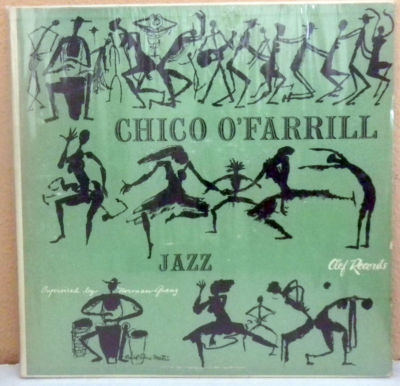
CHICO O'FARRILL JAZZ: RARE 10" LP CLEF#132 (1951/52) NICE NM COVER HEAR...RARE
$
28


Favourite Auctions
To save auctions to your favourites, please login
If you don't have an account, please register
Description
snw_ecp
TITLE : CHICO O'FARRILL JAZZ
ARTIST : CHICO O'FARRILL & HIS ORQHESTRA
LABEL & RECORD #: CLEFF #132 (1951/2) A NORMAN GRANZ PRODUCTION!
VINYL CONDITION: HEAR SOUNDS CLIPS INCLUDED: HEAVY VINYL!!!! side a has some light noise (i WILL INCLUDE THE LAST 3 SOUND CLIP AS AN EXAMPLE, no skips....side B (1ST TRGEE SOUND CLIPS is vg++ AND BETTER..there are light scuffs than mostly do not affect significantly the sound quality of this vintage 10" lp!
LABELS CONDITIONS: SEE SCAN : NM!!!
COVER CONDITION: SEE SCAN : GREAT COVER ART!!!....NM...STILL IN SHRINK FILM BUT OPENED....61 YEARS OLD!!!!1...MUSIC TO BE LOST FOREVER????
REMARKS: COLLECTOR''S ITEM
Arturo Chico O'Farrill was born on this date in 1921. He was an Afro-Cuban composer, arranger, trumpeter, and band leader.
Bandleader, arranger
Legendary composer and bandleader Chico O'Farrill is credited with introducing the Latin rhythms of his native Cuba to the bebop and swing masters of American jazz during the late 1940s and into the 1950s and 1960s. His Afro-Cuban fusion compositions were recorded by the most popular jazz musicians of the time. Among his groundbreaking works of Latin jazz were the "Afro-Cuban Suite," "Aztec Suite," and "Cuban Dances." His long-standing career began in Cuba during the mid 1940s and spanned over 50 years. In the 1990s and into the twenty-first century, O'Farrill's composing and bandleading skills remained in popular demand. In addition to recording and performing concerts regularly in New York City, he toured Spain and contributed original works to Broadway productions and films.
Arturo "Chico" O'Farrill was born on October 28, 1921, in Havana, Cuba. His mother was Cuban, and his father was a well-to-do Irish attorney. From an early age O'Farrill's parents steered him in the direction of a legal career, and it was tacitly understood that one day he would join his father as a partner in the law firm. O'Farrill himself expressed little objection to the plan, but the unanticipated whims of fate set the stage for O'Farrill to pursue a musical career that ultimately endeared him to the jazz world as an innovator of the Latin jazz movement and a legend in his own time. He was in his teens when his parents ushered him off to the United States to attend a military school in Georgia during the 1930s. Jazz at that time wielded a strong influence in American music, although the music culture was unknown to the adolescent O'Farrill until he arrived in the United States. At school he was exposed to American music, especially bebop, and the sound of the brass horns sent a singular message to the young O'Farrill. He became enamored with the music, so much so in fact that he set his mind to learning to play trumpet. By the time he returned home to Cuba, he had been performing regularly with the dance band at his school and was determined to pursue a career in music.
Initially his decision incurred intense opposition from his parents. Although he complied with their wishes and enrolled in law college, his ardent fervor for playing jazz music failed to subside. Before long his father deferred to the younger man's passion for jazz and arranged music lessons for his son. Subsequently, O'Farrill studied under the prominent Cuban conductor Felix Guerrero. Thereafter, O'Farrill became versed in the intricacies of orchestration and musical composition, in lieu of the fine points of jurisprudence. His passion for jazz was bolstered, and his interest in composing and arranging music was born when he was introduced to the mechanics and techniques of musical transcription. He found an outlet for his creativity in arranging—and re-arranging—musical scores. He deftly applied his newly acquired skill by transposing music for the trumpet; the musical repertoire of the depression-era trumpeter, Bunny Berigan, was a particular favorite of O'Farrill. By 1945, he was working professionally as an arranger for a Cuban band called Orquestra Bellemar. His fascination with melody progression, rhythm, and orchestration overshadowed even his desire to play the horn.
In the mid-1940s O'Farrill resumed trumpeting, nonetheless, to join a colleague, guitarist Isidro Perez, and the Perez Orchestra. The group performed regularly as the house orchestra at a Cuban club called Montmartre, and it was in fact the untimely financial failure of the club that sent O'Farrill packing for a return trip to the United States in 1948.
O'Farrill resigned himself to finding his place in the New York City jazz theater. Among other incentives, he was infatuated with the double-time strains of Dizzy Gillespie's jazz moods. Ultimately it was a jazz bandleader, Gil Fuller, who hired the newly immigrated O'Farrill to develop arrangements behind the scenes as a ghostwriter, and the assignments ultimately led to O'Farrill's contact with swing bandleader Benny Goodman. Goodman hired O'Farrill in 1949, and O'Farrill furnished Goodman with many popular arrangements, including "Shiskabop," and the Goodman classic, "Undercurrent Blues." Despite the resounding success of O'Farrill's arrangements, he and Goodman eventually parted ways because O'Farrill's experimental jazz styles conflicted with Goodman's conservative style and aversion for experimentation.
O'Farrill regardless established a solid reputation among his peers while working with Goodman. As a result new opportunities surfaced, including an offer from avant-garde jazz producer, Norman Granz. Granz was more willing than Goodman to gamble on O'Farrill's innovative fusion rhythms, in particular his new and untested Latin styles and Cuban beats, which were not unlike those pioneered a decade earlier by Frank "Machito" Grillo. O'Farrill signed with Granz and gained stride as a composer in the 1950s; most notably he wrote his first extended jazz suite, utilizing a combination of African and Latin rhythms. The piece, aptly titled "Afro-Cuban Jazz Suite," became a classic of Latin-jazz fusion. He wrote the work for Machito's orchestra, which recorded the jazz suite ultimately with the popular alto saxophonist Charlie Parker on solos. Parker's deftly intuitive interpretation of the music served as a boon to O'Farrill's career. It led to greater exposure for the creative Cuban arranger and enhanced his reputation. During that early phase of his American career, O'Farrill wrote such classics as Stan Kenton's "Cuban Episode" and Gillespie's "Manteca Suite." Also during those years he toured both the United States and Cuba with his Chico O'Farrill Orchestra, and between 1951 and 1954 the group recorded six albums of big band jazz selections. Yet even as a mambo craze swept through the North American popular music culture in the 1950s, O'Farrill, on the intensity of the popularity of "Afro-Cuban Suite" became increasingly absorbed with Afro-Cuban fusion rhythms.
O'Farrill moved to Mexico City for a time in the mid 1950s and early 1960s. His career proceeded at a steady pace both as a bandleader and as a composer. During his Mexican sojourn he wrote another great hit, "Aztec Suite," for flugelhorn bopper Art Farmer. While in Mexico, O'Farrill married singer Guadalupe Valero. Their son, pianist Arturo O'Farrill, Jr., served as artistic director for O'Farrill Sr.'s band in 2000.
After nearly a decade in Mexico, O'Farrill returned to the United States, although his years in Mexico were marred by the knowledge that serious political upheaval had ravaged his native Cuba. After Fidel Castro assumed control of the island in 1959, tensions rose between Cuba and the United States, and O'Farrill as a result visited Cuba briefly in 1960 to perform for the last time in that country; he never again returned to his homeland
TRACKS SIDE A:
Roy Eldridge, Al Porcino (tp) Eddie Bert, Bill Harris, Bart Varsalona, Ollie Wilson (tb) Lenny Hambro, Charlie Kennedy (as) Flip Phillips (ts) Pete Mondello (bars, ts) Ralph Burns (p) Billy Bauer (g) Ray Brown (b) Jo Jones (d) Chico O'Farrill (arr, cond)
NYC, August 7, 1951
1- FLAMINGO
2- BRIGHT ONE
3- DANCE ONE
4- LAST ONE
Bernie Glow, Al Porcino, Dick Sherman, Al Stewart, Nick Travis (tp) Eddie Bert, Carl Elmer, Fred Zito (tb) Lennie Hambro, Charlie Kennedy (as) Flip Phillips, Eddie Wasserman (ts) Danny Bank (bars) Gene DiNovi (p) Clyde Lombardi (b) Don Lamond (d) Chico O'Farrill (arr, cond)
NYC, March 24, 1952
1- GUESS WHAT
2- IT AIN’T NECESSARY THE BLUES
3- HEAT WAVE
4- CRY BABY CRY
WEB REMARKS:
Selected discography
Cuban Blues: The Chico O'Farrill Sessions, Polygram, 1950.
Chico O'Farrill Jazz, Clef, 1951.
Jazz North of the Border and South of the Border, Verve, 1951.
Chico O'Farrill, Norgran, 1951.
The Second Afro-Cuban Jazz Suite, Norgran, 1951.
Music from South America, Verve, 1951.
Afro-Cuban, Clef, 1951.
Mambo/Latino Dances, Verve, 1951.
Mambo Dance Sessions, Norgran, 1954.
Chico's Cha Cha Cha, Palladium, 195?.
Nine Flags, Impulse!, 1966.
Married Well, Verve, 1968.
SHIPPING CHARGES........FOR GATEFOLDS With 2 Lps ADD S&H FOR 2
ATT: PUERTO RICO & HAWAII: MEDIA SHIPPING WILL LAST 8-10 DAYS TO REACH YOU...PRORITY MAIL IS $7.00 BUT WILL REACH YOU IN APROXIMATELY 3 DAYS!
INTERNATIONAL SHIPPING....Packages weighing over 4 pounds (usually 6 or 5 single lps depending on packaging and thickness of vinyl) must ship Priority Mail International by postal rules (Will arrive more quickly and carries insurance based on the value!!) - 1st Class is not even possible above 4 pounds. ALSO NOTE: If your single item or total purchase is over $75 then shipping MUST be by insured priority mail for your protection as well as mine. I do not ship expensive packages without insurance.
ITALY CUSTOMERS:
ITALY……. ADD $11 FOR REGISTRATION!!! No exceptions! Sorry, I’m following Other Dealers Suggestions Regarding Problems With the Delivery/Handling of Items…I personally had 2 of 4 problems, Mexico was the Other) in ten years (Thousands Of Records Sold) in the business!!!
(Gli acquirenti italiani sono tenuti ad aggiungere 11 dollari per la spedizione registrata. Non si fanno eccezioni)
POSTAL RATES & WEIGHTS - LPs
LBS.
1
1.4
1.9
2.6
3
# of LPs
1
2
3
4
5
USA MEDIA $4.00 $4.00 $4.00 $4.25 $4.50 USA PRIORITY $7.00 $11.00 $11.00 $13.00 $14.00 EUROPE $14.75 $17.75 $22.00 $26.00 $31.00 ASIA $14.75 $17.75 $22.00 $26.00 $31.00 SOUTH AMERICA $12.00 $15.00 $18.50 $23.50 $30.00 CENTRAL AMERICA $12.00$14.00
$18.50 $23.50 $27.00 CARIBBEAN $12.00 $15.00 $18.50 $23.50 $27.00 MEXICO $11.00 $13.50 $16.00 $20.75 $22.00 CANADA $7.00 $10.00 $12.00 $14.00 $16.00
* We offer a money back + shipping costs guarantee on our records (unless otherwise noted) if you feel the LP was not graded properly We Must Be Notified Of Any Discrepancy in 2 Days after received. . We will issue a full refund upon its return, once our mistake has been verified. Record Must Be Returned in 3 Days…Foreign in 7 Days….We have available the insurance option…
WE USE STURDY CARDBOARD MADE BY BAGS UNLIMITED IN ORDER TO TO PROTECT YOUR RECORDS FOR ANY MISHANDLING/DAMAGE WHILE IN-TRANSIT
Record Grading: Standard guidelines for grading records comes down to a subjective judgment that may vary from person to person. We grade records and LP covers visually AND (when possible) play-tested. We make every effort to give full disclosure (remember that the LP has at least 12 tracks and the grading may vary between each other) and your satisfaction is guaranteed. Don't assume that our vinyl determination of "Very Good+" is the same as yours!
MM RECORDS: are shiny, with no visible defects. They might have some minor superficial (“Paper”) scuff but they should play without any noise. Writing, stickers or other markings cannot appear on the label, nor can any “spindle marks” from someone trying to blindly put the record on the turntable. Major factory defects also must not be present; a record and label obviously pressed off center is not Near Mint. If played, it will do so with no surface noise. (NM records don’t have to be “never played”; a record used on an excellent turntable can remain NM after many plays if the disc is properly cared for.)
NM COVERS: have no creases, ring wear or seam splits of any kind.
NM PICTURES SLEEVES: should look as if they never housed a record. This is a great reason to remove your 45s from their picture sleeves and keep them separate. Just keeping the 45 inside the sleeve will cause damage than can reduce the grade of the sleeve.
VG++ (Excellent) RECORDS: Barely noticeable play wear and background noise. May have surface scuffs and/or superficial marks, which will be inaudible or indiscernible from the background, no scratches. Very nice, no flaws noted.
VG++ COVERS: Artwork is still as close to perfect as can be. Some impression to the cover (minor outer ring wear) but no ink wear! Some slight creases to the corners, but not wrinkled and obtrusive to the eye. The corners can show white (where the artwork pasted slick was) meaning, slight wear. No seam splits or writing on the cover or taped repairs can make this grade.
VG+ RECORDS: may show some slight signs of wear, including light scuffs or very light scratches that do not affect the listening experience. Slight warps that do not affect the sound are OK. Minor signs of handling are OK, too, such as telltale marks around the center hole, but repeated playing has not misshapen the hole. There may be some very light ring wear or discoloration, but it should be barely noticeable
.VG+ COVERS: should have only minor wear. A VG+ cover might have some very minor seam wear or a split (less than one inch long) at the bottom, the most vulnerable location. Also, a VG+ cover may have some defacing, such as a cut-out marking. Covers with cut-out markings can never be considered Near Mint Unless Tiny/Small (EG: Tiny DH).
VG+ PICTURE SLEEVES: might show some very light creasing where it is obvious that a record once resided (or still does reside). A VG+ picture sleeve might have some very minor seam wear or a split (less than one inch long) at the bottom, the sleeve’s most vulnerable location.
VG RECORDS: have more obvious flaws than their counterparts in better shape. They lack most of the original gloss found on factory-fresh records. Groove wear is evident on sight, as are light scratches deep enough to feel with a fingernail. When played, a VG record has surface noise, and some scratches may be audible, especially in soft passages and during a song’s intro and ending. But the noise will not overpower the music otherwise. Minor writing, tape, or a sticker can detract from the label. Many collectors who have jukeboxes will use VG records in them and not think twice. They remain a fine listening experience, just not the same as if it were in better shape.
VG COVERS and PICTURE SLEEVES: will have many signs of human handling. Ring wear in the middle or along the edges of the cover where the edge of a record would reside, is obvious, though not overwhelming. Some more creases might be visible. Seam splitting will be more obvious; it may appear on all three sides, though it won’t be obvious upon looking. Someone might have written or stamped a price tag on it, too.
RECORDS GRADED VG OR BELOW WILL BE "SOLD AS IS"
(We Will Try To Grade Them As Accurately As Possible!)
TERMS & CONDITIONS
- You bid to win
- I am Honest & Fair and expect you to act in the same manner
- If you change your mind after the auction - I will still be charged by ebay for re-listing the item & for the final auction fee - so will need to file an unpaid item dispute to ensure that I am reimbursed by Ebay - I do not do it as some kind of revenge! so please understand my predicament
- Please ask any questions PRIOR to placing a bid
- Payment within 5 days
- my postage & packaging rates are fair & dispatch will be prompt
- Please leave feedback when your item arrives - then I know that you have received it and I can leave feedback for you
- If you are unhappy in any way please contact me first! Prior to using Negative feedback as we may have been able to reach a resolution that makes both of us happy!
- NEGATIVE FEEDBACK will always be left for timewasters
- Items are listed as accuretly as possible & any faults observed will be brought to your attention in the listing
- Lets make Ebaying a fair & honest way of buying & selling Reasonably products online!
price rating