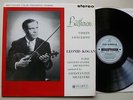
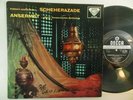
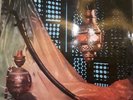
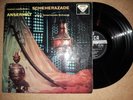
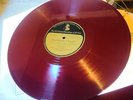
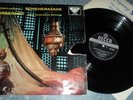
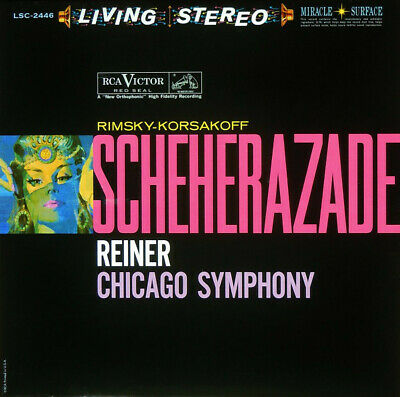
CLASSIC RECORDS LP LSC-2446: Scheherazade - Fritz Reiner CSO, 1990s USA 200gm NM
C$
200
$
145

C$ 200
Sold For
Jan 31, 2021
Sold Date
Apr 28, 2020
Start Date
1
Number Of Bids
Canada
Country Of Seller
eBay
Sold at
Favourite Auctions
To save auctions to your favourites, please login
If you don't have an account, please register
Description
****Welcome to our listing, thanks very much for looking!
****See our own website! We have lots of out of print LPs and CDs! Find us on the web at -
hearthedifference.net
****Shipping cost is only an estimate - it depends on the actual weight and size of the package as well as the service required. We do not profit from shipping costs, so if we overcharge, we will refund the difference back to you. It's always best to wait for our invoice before paying for your item. We will combine shipping for multiple items purchased.
****Please see our other listings - new items added daily!
Background -
Nikolai Rimsky-Korsakov's works are distinguished by his colorful and imaginative orchestration, and Scheherazade is perhaps the finest example of them all (Claude Debussy, no slouch of an orchestrator himself, paid Scheherazade the highest compliment by using a passage from its second movement, virtually unaltered, in both La mer and Daphnis et Chloe). Scheherazade's gorgeous melodies and vast, impeccably employed palette of orchestral colors have made it Rimsky-Korsakov's most popular work.Rimsky-Korsakov's headnote explains the scenario: "The Sultan Schahriar, persuaded of the falseness and faithlessness of women, has sworn to put to death each one of his wives after the first night. But the Sultana Scheherazade saved her life by interesting him in tales she told him during 1,001 nights. Pricked by curiosity, the Sultan put off his wife's execution from day to day, and at last gave up entirely his bloody plan." Four such lifesaving narratives, rendered in music, follow. In later years, Rimsky-Korsakov declared that Scheherazade should be regarded as a symphonic suite with an unspecified Oriental program. This makes sense in light of the fact that the music itself has very little narrative logic. However, some details of the program remain relevant.
The first movement, titled The Sea and Sinbad's Ship, opens with the growling chords that represent the Sultan, followed by the sinuous solo violin melody that depicts Scheherazade weaving her tales. Scheherazade recedes, and a swaying melody enters in barcarole time on the strings, swelling like the sea. Brass accents occasionally cause the sea to crash and storm, and sweetly scored interludes suggest island dalliances, but the movement ends with a quiet depiction of what must be calm seas and steady wind.
The Story of the Kalender Prince concerns a prince who disguises himself as a beggar and searches for wisdom. His melancholy theme first appears in solo woodwinds, then enters the strings and quickens as the Prince sets out on his journey. Rimsky-Korsakov suggested that "one might see a fight" when a martial variant of the Sultan's theme enters, surrounded by nervous string oscillations, while a later section with fluttering woodwinds and pizzicato string chords suggests "Sinbad's mighty bird, the Roc."
The third movement is called The Prince and the Princess and explores an unnamed Eastern palace; the Prince appears as a sensual, langorous string theme, the Princess as a relaxed arc of flute melody. Nevertheless, the beginning of the fourth movement finds the Sultan in an irascible mood, and Scheherazade tries to appease him by describing the restless energy of the festival at Baghdad. From there, the action moves out to the sea, where the weather has worsened. Brass cry out, winds sweep up and down, and the music grows to a massive climax topped by a frightening bitonal crash depicting the ship striking rocks and sinking. The storm subsides, and finally the themes of Scheherazade and the Sultan mingle, Scheherazade's violin playing its highest harmonics. - Andrew Lindemann Malone
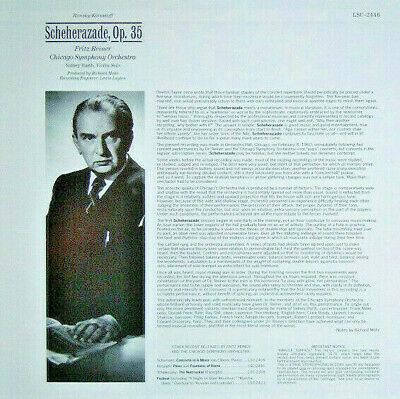
Fritz Reiner was a legend among conductors. Universally admired for his music-making, widely disliked for his aggressive and exacting temperament, and survived by a legacy of definitive recorded performances, he was largely responsible for the artistic ascendancy of the Chicago Symphony Orchestra, and exerted considerable influence on generations of musicians.
Born in Budapest in 1888, he studied piano with his mother and, at the age of 15, entered the Franz Liszt Academy -- an institution that also boasts Bela Bartók, Zoltan Kodály, Ernst von Dohnányi, George Szell, Eugene Ormandy, Georg Solti and Antal Dorati as graduates. Reiner gained conducting experience at a number of regional opera houses before eventually returning to Budapest in 1911 to serve at the city's Volksoper, where his reputation as a conductor of special abilities finally emerged.
In 1914 Reiner accepted a position at the Dresden Court Opera, where he formed a fortuitous relationship with both the conductor Arthur Nikisch and the composer Richard Strauss; Reiner would eventually give the German premier of Strauss' Die Frau ohne Schatten, and would remain a devoted interpreter of the composer's works throughout his career. The economic chaos and emergent anti-Semitism that followed the First World War made Reiner anxious to leave Europe, and an invitation (in 1921) to become the music director of the Cincinnati Symphony Orchestra provided just the right opportunity. From that point onward, Reiner's career was firmly rooted in the United States, where he became a citizen in 1928.
After resigning his post at Cincinnati Reiner became a professor of conducting at the Curtis Institute of Music in Philadelphia, where his students included both the young Leonard Bernstein and Lukas Foss; Bernstein, in particular, credited Reiner with a great deal of influence in his development.
In 1938 he became the director of the Pittsburgh Symphony -- one of several positions that established Reiner as a fine builder of orchestras, with a talent for steering ensembles toward new levels of quality and success. A number of Reiner's well-known recordings stem from his tenure there. Guest appearances during his Pittsburgh years include those at Covent Garden and the San Francisco Symphony. From Pittsburgh he moved to the Metropolitan opera, where he remained on the conductor roster until 1953; his advocacy of Strauss' operas was especially strong there, and his performances of Salome and Elektra number among the most memorable evenings in the Met's history.
1953 was a watershed year for Reiner, since it was then that he assumed the directorship of the Chicago Symphony Orchestra. This was to become his signature partnership, and the position that would establish his lasting legacy. His relationship with the orchestra was never a smooth one -- he was known for hostility and impatience in rehearsal, and for firing musicians for mistakes in concerts -- but he undeniably raised the ensemble from its status as a good American orchestra to that of one of the finest in the world. Unlike a number of other prominent conductors who excelled in narrow corners of the musical canon, Reiner maintained his excellent standards and clarifying precision throughout an especially broad repertory that crossed boundaries of nationality and style. He was as renowned for his performances of new works, such as Bartók's Concerto for Orchestra -- a piece that Reiner himself commissioned from the dying composer -- and Alan Hovhaness' Mysterious Mountain as he was for his Mahler, Strauss and Haydn. His tenure in Chicago also resulted in what was then an unprecedented volume of fine recordings, some of which still remain as favorites, despite the improved fidelity of modern competitors. Reiner resigned from Chicago in 1962 (after only nine seasons), and died the following year of heart failure. - Allen Schrott
-
CLASSIC RECORDS LP item - this item is opened, in NEAR MINT condition
-
Record Made in the USA
-
Pressing is in STEREO
-
Record Speed: 33 1/3 rpm
-
Audiophile reissue on 200-gram virgin vinyl - long out of print
-
Record Made in: circa mid 1990's
-
Record Catalog Number: LSC 2446
Featured on this item:
Rimsky-Korsakoff // Fritz Reiner & CSO
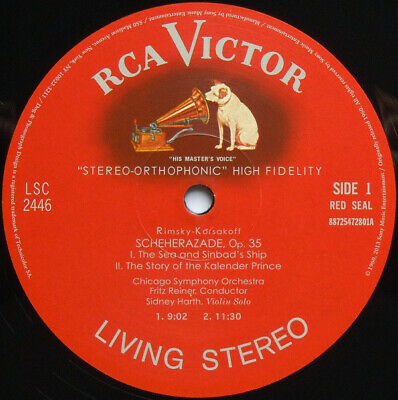
Music on This LP - Scheherazade, Op. 35 A1. The Sea And Sinbad's Ship - 9:02
A2. The Story Of The Kalender Prince - 11:30
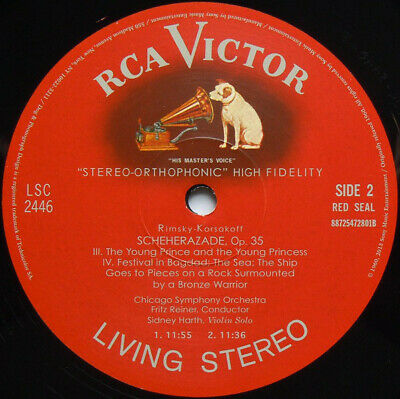
B1. The Young Prince And The Young Princess - 11:55
B2. Festival In Baghdad; The Sea; The Ship Goes To Pieces On A Rock Surmounted By A Bronze Warrior - 11:36
Other Information / Performers / etc. -
• Recorded At – Orchestra Hall, Chicago
• Manufactured By – Classic Records
• Copyright (c) – RCA
• Composed By – Rimsky-Korsakov
• Conductor – Fritz Reiner
• Engineer [Recording] – Lewis Layton
• Liner Notes – Richard Mohr
• Orchestra – Chicago Symphony Orchestra
• Producer – Richard Mohr
• Soloist [Violin Solo] – Sidney Harth
Recorded in Orchestra Hall, Chicago, on February 8, 1960.
CONDITION Details:
The LP jacket is in near mint overall condition. The jacket is tight and solid, with NO seam splits, NO cut out marks and NO discoloration. The jacket appears as NEW with no flaws. A superb example of a collector's grade audiophile LP - the pictures with this listing are of the actual item.
The LP is in near mint overall condition! There are no serious marks on the vinyl - virtually as NEW. There may be some dust and a finger print or two on the vinyl, nothing serious. However, this is not a new audiophile LP....some extraneous sound is inevitable and should be expected for a vintage LP. There are NO serious spindle marks on the record labels either. Please clean the LP before auditioning it for best results. This is a superb example of a very rare, out of print classical LP.A Short Note About LP GRADING -
- Mint = Only used for sealed items.
- Near Mint = Virtually flawless in every way.
- Near Mint Minus = Item has some minor imperfections, some audible.
- Excellent = Item obviously played and enjoyed with some noise.
- Very Good Plus = Many more imperfections which are noticeable and obtrusive.
For best results, always thoroughly clean your LPs before playing them.
LPs can be audiophile quality pressings (any collector of fine MFSL, half speeds, direct to discs, Japanese/UK pressings etc., can attest to the difference a quality pressing can make to an audio system).
Don't let this rarity slip by!!!price rating