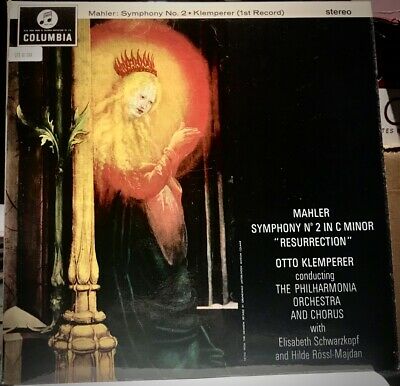
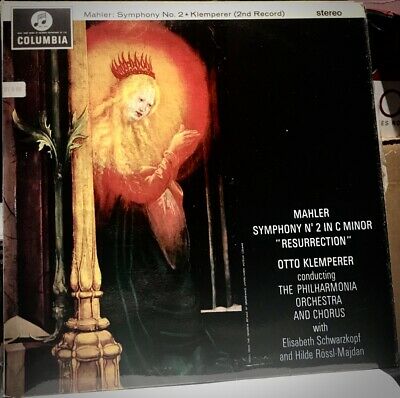
COLUMBIA 2-LPs SAX-2473/74: MAHLER - Symphony No. 2 - Klemperer - 1963 UK NM
$
300

$ 300
Sold For
May 18, 2020
Sold Date
Feb 24, 2020
Start Date
1
Number Of Bids
USA
Country Of Seller
eBay
Sold at
Favourite Auctions
To save auctions to your favourites, please login
If you don't have an account, please register
Description
****Welcome to our listing, thanks very much for looking!
****See our own website! We have lots of out of print LPs and CDs! Find us on the web at -
hearthedifference.net
****Shipping cost is only an estimate - it depends on the actual weight and size of the package as well as the service required. We do not profit from shipping costs, so if we overcharge, we will refund the difference back to you. It's always best to wait for our invoice before paying for your item. We will combine shipping for multiple items purchased.
****Please see our other listings - new items added daily!
****To access our eBay store click on the little red door at the top right section of any of our eBay listings or, click on -
http://stores.ebay.com/Hear-The-Difference
Background -
German conductor Otto Klemperer attended the Hoch Conservatorium in Frankfurt-am-Main, studied violin and piano at the Klindworth-Scharwenka and Stern Conservatories in Berlin, and composition with the German composer Pfitzner. He made his début in Berlin in 1905, where he conducted fifty performances of Offenbach's Orpheus in the Underworld, not a work that would now be identified with Klemperer's serious and profoundly personal approach to music.Shortly afterwards, he visited Gustav Mahler in Vienna and impressed the composer by playing a scherzo from a Mahler symphony by memory at the piano. With Mahler's personal recommendation, Klemperer was appointed choirmaster and conductor at the German Opera in Prague. He held this post for three years, during which he returned to Vienna to assist in rehearsals for Mahler's later symphonies. Again with Mahler's help, he became conductor at the Hamburg Opera in 1910. There followed a succession of appointments in Barmen (1913), Strasbourg (1914-1916), Cologne (1916-1924) and Wiesbaden (1924-1927) and visits to Barcelona, Rome, the U.S.S.R., and the U.S. between 1920 and 1936.
In 1927, he was engaged as director of the Kroll Opera House in Berlin, where he remained until 1931 when political pressures and financial difficulties forced its closure. In addition to better-known operas, Klemperer introduced new works which ran counter to the Nazis' idealized view of German culture, such as Schoenberg's Die glückliche Hand and Erwartung; Hindemith's two operas, Cardillac and Neues von Tag; and Janacek's From the House of the Dead. Indeed, Klemperer was then noted more for his interest in contemporary music than for his interpretations of the mainstream Classical and Romantic repertory on which, in later life, he concentrated almost entirely.
After a highly successful series of London concerts in 1929, Klemperer returned to Germany in 1931 to conduct the Berlin State Opera. As a Jew, he was in danger of persecution and, though honored with a gold medal for his "outstanding contribution to German culture," a German newspaper of the time sourly commented "[h]is whole outlook ran counter to German thought and feeling."
Klemperer was dismissed in 1933 and fled with his family first to Austria and later to Switzerland. While there, he was appointed conductor of the Los Angeles Philharmonic Orchestra and lived in California from 1935 to 1939 during which he also conducted the New York Philharmonic and Philadelphia Symphony Orchestra. In 1937, he helped to reorganize the Pittsburgh Symphony Orchestra, though refused to become its conductor.
Following a brain tumor that left him partially paralyzed, his career faltered. In 1940, Klemperer became a U.S. citizen, but his sufferings were increased by a manic depressive state characterized by recurring cycles of exhilaration and depression. In 1951, an accident at the Montreal airport forced Klemperer to conduct from a chair. To prove himself competent, he hired an orchestra to perform a concert of works of his own choice at Carnegie Hall. It was a success but, after an argument with American immigration authorities, Klemperer returned to Europe where he continued conducting in Italy, Sweden, Switzerland, and France.
The peak of Klemperer's career came in 1959 with the Philharmonia Orchestra, based in London. When attempts were made to disband the orchestra in 1964, its members appointed him president, and the orchestra was reconstituted. As the New Philharmonia, the group reached new heights in the Beethoven cycles during the early 1960s. In the same period he conducted at Covent Garden Opera House. - Roy Brewer
-
LPs made by COLUMBIA // EMI Records, in the UK / England / Great Britain
-
LPs released in 1963
-
LPs are recorded in STEREO
-
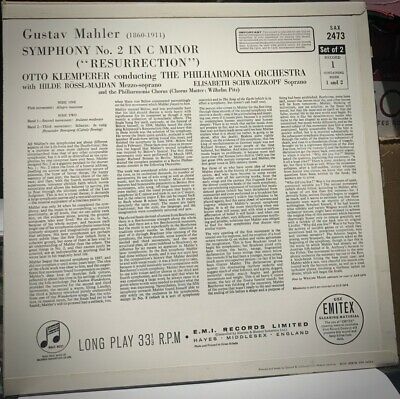
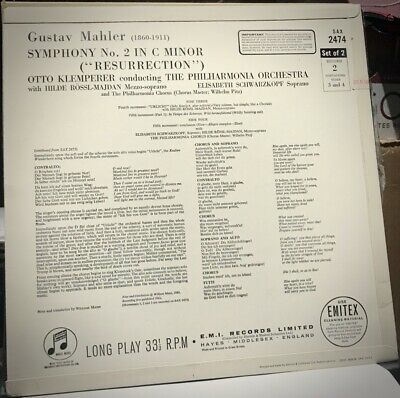
Record Catalog Number: SAX 2473-2474
-
Record Labels are primarily RED with Black & White lettering, with the COLUMBIA single note logo on the labels.
Mahler // Otto Klemperer
Music on this item -
Mahler: Symphony No. 2
A1. First Movement : Allegro Maestoso
B1. Second Movement : Andante Moderato
B2. Third Movement : Scherzo In Ruhig Fliessender Bewegung
C1. Fourth Movement : Urlicht
C2. Fifth Movement: Part 1
D1. Fifth Movement: Conclusion
Performers / Other Information -
• Chorus Master – Wilhelm Pitz
• Conductor – Otto Klemperer
• Mezzo-soprano Vocals – Hilde Rössel-Majdan
• Orchestra – Philharmonia Orchestra
• Soprano Vocals – Elisabeth Schwarzkopf
Red & Black Semi Circle Label w/ "Magic Notes”
CONDITION Details:
The individual LP JACKETS are in near mint minus overall condition! The jackets have NO seam splits or writing on them. The corners and seams are solid with just some light shelf wear. The jacket is laminated with a clear plastic at the front panel only and has the flipped over seams at the top, bottom and spine. Comes with the original inner sleeves. The colors on the jacket are sharp and clean - see our pictures with this listing as they are of the actual item!
The LPs are in near mint minus overall condition! There are NO serious marks on the vinyl. But the LPs may have some very light spider marks (these are caused by sliding the LP in and out of the inner sleeve), and the vinyl may have a finger print or two. Most of the time, spider marks are not audible, but it really depends on the sensitivity of your audio gear. Considering the vintage of this LP title, the vinyl looks near mint minus overall. However, these are not new audiophile LPs....some extraneous noise is inevitable and should be expected for vintage LPs. This LP retains much of the original gloss and sheen! There are NO serious spindle marks on the record labels either - these are terrific collector's grade examples of this recording.A Short Note About LP GRADING -
- Mint = Only used for sealed items.
- Near Mint = Virtually flawless in every way.
- Near Mint Minus = Item has some minor imperfections, some audible.
- Excellent = Item obviously played and enjoyed with some noise.
- Very Good Plus = Many more imperfections which are noticeable and obtrusive.
For best results, always properly clean your LPs before playing them.
The LP is an audiophile quality pressing (any collector of fine MFSL, half speeds, direct to discs, Japanese/UK pressings etc., can attest to the difference a quality pressing can make to an audio system).
Don't let this rarity slip by!!!
price rating