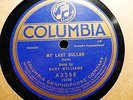
COLUMBIA 78 RPM Record Collins and Harlan “On The 5: 15” /”Ruff Johnson’s Harmon
$
22


Favourite Auctions
To save auctions to your favourites, please login
If you don't have an account, please register
Description
COLUMBIA 78 RPM Record Collins and Harlan “On The 5: 15” /” Ruff Johnson’s Harmony Band” E Visible Condition, nice record. Collins and Harlan as you know were The Happiness Boys who were at one time the highest paid entertainers of the period. On the 5: 15 is about train service in the subway. Lots of talk about different train times but the 5: 15 seems to be the most important, if you miss this one it might be 1 a.m. before you got home. Johnson’s Harmony Band is not politically correct. Samples of early American vaudeville by two of its masters.
Arthur Francis Collins (February 7, 1864 – August 3, 1933) was an American baritone who was one of the most prolific and beloved of pioneer recording artists, regarded in his day as "King of the Ragtime Singers".
He was born in Philadelphia, Pennsylvania and moved with his family to Barnegat, New Jersey around 1879 and as a teenager worked as a volunteer lifesaver on the Jersey shore, beginning an enthusiasm for sailing that became a lifelong pursuit. However, his fine baritone voice – heard in church and in local concert appearances – convinced Collins' family to send him back to Philadelphia for formal training. After concluding his studies, Collins spent some 15 years touring with various stock companies and appearing in summer opera in St. Louis. None of these ventures turned out any long term prospects for Collins, and when he married actress and singer Anna Leah Connelly in 1895 Collins swore off show business and decided to study for a career in bookkeeping. Taking occasional roles for extra money, Collins appeared in a production given by the DeWolf Hopper Opera Company in 1898, and talent scouts for Edison Records requested Collins audition which, according to his wife, took place May 16, 1898.
Within a few years, Collins proved one of the most productive and successful singers in the record business, and in his long career between 1898 and 1925 he worked for every record company active in the United States. He specialized in what were then called coon songs, popular African-American dialect numbers associated with vaudeville and minstrel shows. Collins also utilized an array of vocal effects and caricature voices which gave the impression that there were multiple persons at the horn on his recordings, though it was just Collins. Towards making that end of it more effective, Collins began to work in a duo format with tenor Joe Natus in 1901 and both sang in an Edison group called the Big Four Quartet. It is assumed that Collins first came into contact with tenor Byron G. Harlan within the context of the Big Four Quartet, and from then until the end of Collins' career in the early 1920s, Harlan was Collins's duet partner. Collins & Harlan were probably the most famous and popular male duo on early records.
In 1909, Collins joined John H. Meyer, Henry Burr, and Albert Campbell in the Peerless Quartet, a successful barbershop music group which toured as the Record Makers, and later as the Eight Popular Victor Artists. However, by 1917 bass Frank Croxton began to replace Collins on some records, a situation that became permanent by mid-1919 as Collins did not get along with Burr, who also served as the group's manager.
During a personal appearance at the Princess Theater in Medina, Ohio on October 20, 1921, Collins was badly injured when he fell through an open trap door. While he recovered well enough to resume his singing and recording career, his health began to decline afterward and in 1926, Collins retired, relocating to Florida with his wife. He died at the age of 69 in Tice, Florida on August 3, 1933.
Arthur Collins recorded hundreds of songs, and in many cases he recorded the same song multiple times for various recording outfits. His signature song was The Preacher and the Bear, which he first recorded in 1905. His rendition, widely dispersed among a variety of releases, constitutes the most popular non-operatic record made during the first decade of the twentieth century. Collins was still recording the number in 1922, and a 1908 remake of the piece for Victor remained in their catalog until 1941; at his personal appearances "The Preacher and the Bear" was invariably requested. His recording sold over one million copies, and was awarded a gold disc, only the second one ever presented.
Collins lived up to his reputation as the "King of Ragtime Singers" and recorded more ragtime songs than any other singer during the era when ragtime was at its peak of popularity. Collins recorded some of Bert Williams's songs before Williams did, and even recorded some numbers associated with Williams that the latter never waxed. Collins and Harlan also made best-selling records of tunes old and new that remain well cherished and iconic even in the twenty-first century, such as "Waiting for the Robert E. Lee", "Alexander's Ragtime Band", "Lily of the Valley", and "The Old Grey Mare". Collins survived into the early years of the Jazz Age, and he and Harlan recorded the earliest record known to mention jazz, "That Funny Jass Band from Dixieland" (Victor 18235, recorded January 12, 1917).
If possible we gladly combine shipping items to lessen postage and will hold for you if you are bidding on additional items. The scratches on the left of EVERY picture are from broken glass on scanner - NOT on record.PLEASE don't use eBay auto pay I will invoice you for shipping costs which will be easier and cheaper for you:
The scratches on the left of every photo are my broken glass on scanner – not on item. Images of artists etc. are for information only and not included in auction, record & sleeve only.
We will pack securely but are not responsible for shipping company damage if uninsured.
1 record - $4.70 Add $1 for each additional record (+ insurance if required). (USA ONLY) (Int?l use eBay calculator and I will adjust to get cheapest rate)
E++, Visibly nearly new with no visible signs of wear or damage.
E+, Looks and plays like new with only few signs of handling and play.
E Still very shiny, near new looking, with slight visible signs of wear and a few nearly inaudible scuffs and scratches
E- Still shiny but without the luster of a new record, few scuffs that have little or no effect on play, some light scratches.
E- - Mostly shiny but with even less of the luster of an E- record, more scuffs than E-that have little or no effect on play, light scratches with some light noise.
VG+, Slightly above average condition 78 in which scuffs and general use has dulled the finish somewhat. Wear is moderate but playing is generally free from distortion. Surface noise not overly pronounced.
VG, An average condition 78 - moderate wear throughout, but still very playable and enjoyable. Surface somewhat dull with noise and scratches audible but not intrusive.
VG-, Quite playable still, but with some distortion and may have some graying in loud passages. Music remains loud in most passages. Surface noise and scratches well below music level.
VG- - Quite playable still, but with distortion and most have some graying in loud passages. Music remains loud in most passages. Surface noise and scratches noticeable and may be loud at times.
G+ Quite worn and scratched, but music level is still higher than surface noise. Grey may be throughout but still serviceable. Music begins to sound muffled.
G Not so good. Wear and scratch damage extensive. Listening can become uncomfortable as music and surface noise probably blending. Lowest level music can be understood.
G-, Music barely audible over surface noise & listening is uncomfortable. Record is borderline unplayable.
P Used only for high dollar space fillers like Black Patti, Okeh blues, etc. Music covered by surface noise, scratches, and needle digs, label may be trashed, & listening is almost if not definitely impossible. Record is basically unplayable. What you keep because you can?t bear to toss ? while you look for that E+ copy of Robert Johnson on Vocalion at the local flea markets for $1 (Good Luck!)See Description, A wildcard grade that can be used when standard grading does not apply or when a record (or item) has special attributes (or defects) that can affect how the item is assigned a grade.
price rating