Can 'Tago Mago' 1st UK Press
£
20
$
27


Favourite Auctions
To save auctions to your favourites, please login
If you don't have an account, please register
Description
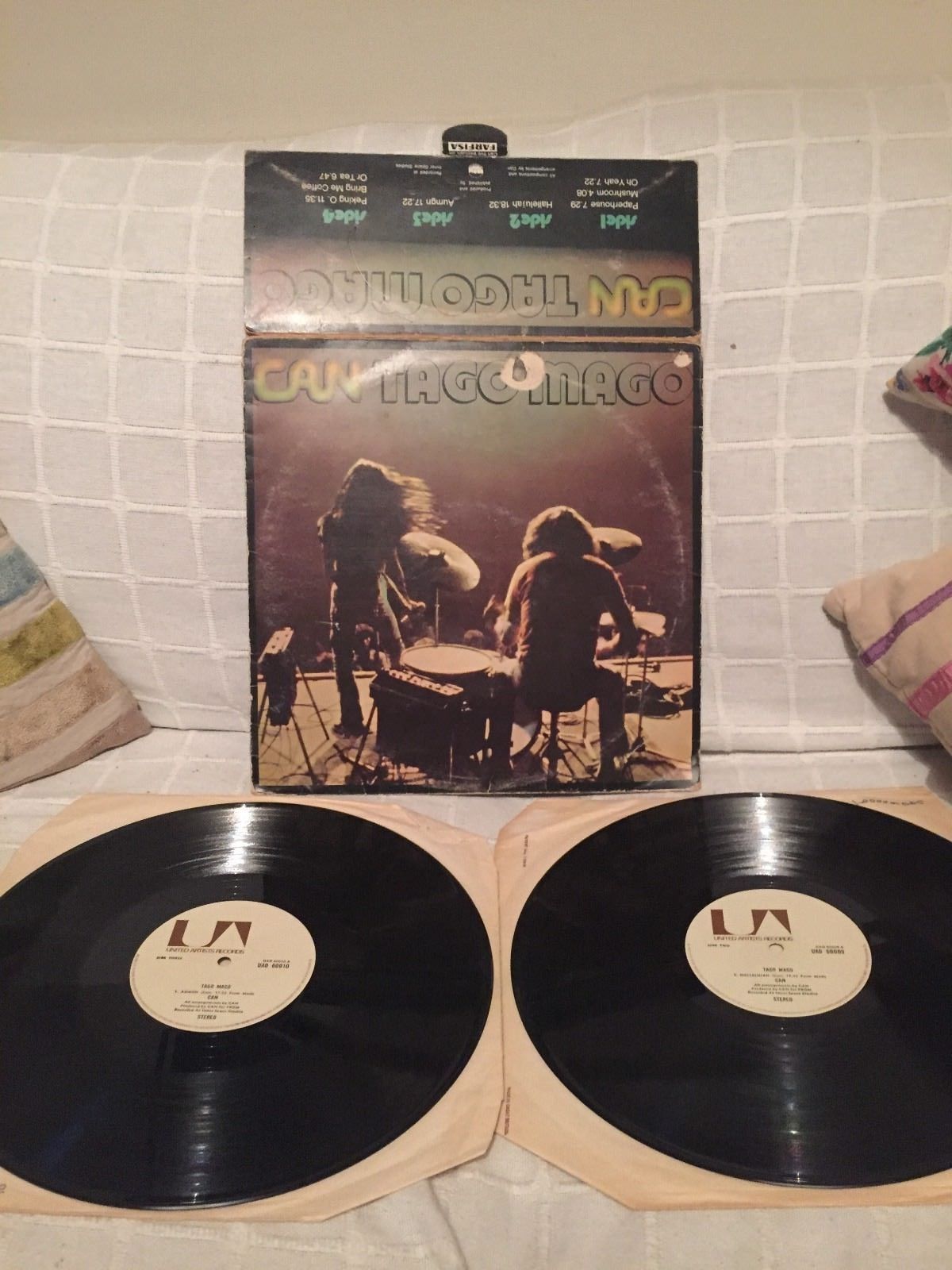
UK Pressing of Can's legendary double-album 'Tago Mago', issued on the Atlantic label in 1971.
Holster-style sleeve is fully intact, but has some pretty strong ringwear, and a round tear on the upper right-hand side of the front cover, the spine is in pretty good condition, and there is assorted minor shelf wear including some small creases. The vinyl - both discs - are in excellent condition, and play without pops, jumps and interruptions, but there are a few minor smudges.
Vinyl: EX/EX Sleeve: VG
Label: UAD60009/10
'Tago Mago', originally issued in 1971, was Can's second album and the first to feature Japanese vocalist/guitarist Damo Suzuki.
A double-album featuring some the group's finest work, 'Tago Mago' is widely considered one of the group's key works alongside the likes of 'Monster Movie' and 'Ege Bamyasi' and a masterpiece of early-seventies experimental rock.
Formed in Cologne in 1968, Can's original line-up was comprised of American vocalist Malcolm Mooney, guitarist Michael Karoli, keyboardist Irmin Schmidt, bassist Holger Czukay, and drummer Jaki Liebeziet.
Blending elements of rock, jazz, early electronics, the avant-garde, minimilism, world music and psychedelia, Can quickly established themselves as one of the most exciting and innovative rock groups to come out of Germany's thriving early-seventies music scene, producing a series of thrilling albums between 1969 and 1981.
Despite having helped create debut recording 'Monster Movie', vocalist Mooney, who suffered from Schizophrenia, left the group in early 1970 and was replaced by Japanese musician Damo Suzuki, who was reportedly spotted by bassist Czukay whilst busking outside a cafe.
With Suzuki, the group went from strength-to-strength. The edgy 'Tago Mago', the cool, antidotal follow-up 'Ege Bamyasi' and the mellow ambience of 'Future Days' showcased the group's unique musical approach, and Can quickly built-up a reputation as one of the most singular and expressive rock bands around.
Suzuki's tenure with Can would end in 1973, with the remaining members continuing as a quartet until the addition of new members Rosko Gee and Reebop Kwaku Baah, who helped create the ambient albums 'Saw Delight'(1977) and 'Out of Reach'(1978).
Can's final album of the decade would be 1979's eponymously-titled effort, which was followed by 'Delay 1968', which, as the title suggests, was recorded a year before debut LP 'Monster Movie' yet wasn't properly issued until 1981.
Can quietly split a year later to allow each member to undertake new projects, yet the original line-up would unexpectedly reform in rather bizarre circumstances when, in 1988, Malcolm Mooney found a plane ticket, which has been sent to him by Holger Czukay several years earlier, stuffed behind his sofa. It would prove an inspirational moment for the American singer, and after meeting up with his former bandmates in Germany, Can surprised almost everybody by reforming and recording the critically-lauded comeback effort 'Rite Time', which was released in 1989.
Rightly considered one of the most influential rock groups of all time, even now Can continue to win over new fans thanks to their fiercely original sonic style, and are a wonderful example of the febrile and highly-imaginative music scene that sprang out of Germany during the late-sixties and early-seventies and gave us such wonderful groups as Kraftwerk, Cluster, Tangerine Dream, Kraan, Amon Duul II, Harmonia, Thirsty Moon, Message, Jane, Grobschnitt and Neu! Great times.
price rating