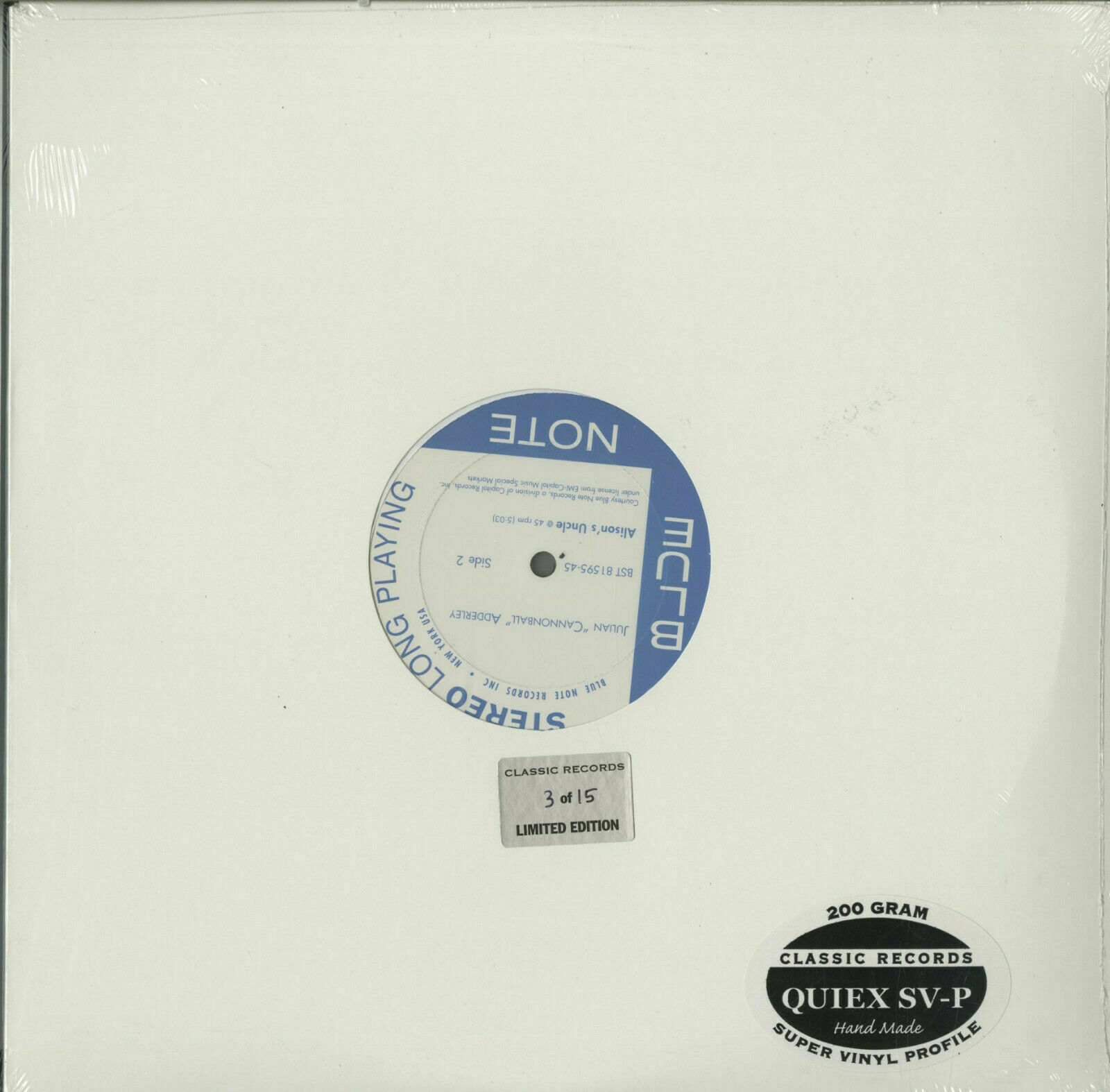
Cannonball Adderley, Somethin' Else 45rpm Clarity-Black LP Comparison Package SS
$
97


Favourite Auctions
To save auctions to your favourites, please login
If you don't have an account, please register
Description
SS: Still Sealed
Label: Blue Note
Catalog Number: BST 81595-45 Jacket Condition: M/ Mint
This auction is for a STILL SEALED, NUMBERED (3 of 15) 45rpm* CLARITY/ BLACK Comparison Package of SIDE 2 of the Classic Records 200gram reissue of Cannonball Adderley's "Somethin' Else" in STEREO. Original jacket is included.
The story of Classic Clarity vinyl starts at a listening session Michael Hobson had at Michael Fremer's listening room in Wyckoff, NJ where Fremer gave the Furutech DeMag demonstration on the Sophie Zelmani "Most of the Time" cut that Hobson knew intimately from the Masked and Anonymous Soundtrack issued by Classic. Fremer played the cut and then Demagnetized the side and played it again to a skeptical Hobson whose mouth promptly dropped open uttering the words " Fremer you bastard, why did you do that to me!" Fremer smiled and said, "I guess that means you will be getting a DeMag" which Hobson promptly did, ultimately becoming the US distributor for all Furutech products. While talking to the Vice President of Furutech at the following CES in Las Vegas, Hobson enquired about how the DeMag worked which Frank Yoo explained as neutralization of the charge in the carbon black added to PVC to make LP's which resulted in "electrical distortion" through the cartridge which distorted the delicate analog signal going to the phono stage. Take away the charge in the vinyl and everything becomes clearer, cleaning and more realistic which is what Hobson had witnessed in the vocal on the DeMag'ed playback of "Most of the Time". One day soon afterwards, it occurred to Hobson that the whole charge issue from the added Carbon Black could be solved by leaving out the additive and ending up with a clearish colored vinyl that sounded like the DeMag'ed black vinyl and was thereafter referred to as "Clarity Vinyl" made exclusively for Classic. Hobson planned on reissuing all Classic titles on Clarity but before doing so wanted reviewers to hear what a difference in the "Clarity" of playback fidelity could be had by removing the carbon black so a number of Clarity/Black Vinyl comparison packages were devised and pressed to be sent out to reviewers in advance of the Clarity Vinyl launch which Classic started with it 45 rpm Clarity Vinyl editions which are out of print, highly coveted and collectible. These remaining copies of the comparison packages are what started it all and are extremely collectible and will likely skyrocket in value over time. Buy them as an investment or to hear the Clarity difference but be careful: once you hear the vail that Clarity lifts you'll be chasing "out of print" Classic Clarity titles like so many others....don't say you weren't warned!
*45 rpm records have long been recognized as providing a higher fidelity musical experience resulting purely from the cartridge being able to extract more of the nuance from the complex vertical and horizontal groove modulations in stereo LP’s. Further, Classic Records 45 rpm “single sided” pressings dramatically reduce the mechanical resonances created by the cartridge during playback by allowing these resonances to be more fully transmitted to and absorbed by the turntable platter. Don't hesitate before the price on the secondary market skyrockets!
Background on Classic 200g Super Vinyl Profile
In 2003, Classic Records launched its now famous Signature Blue Note Mono reissue series.
As part of that series Classic developed an "authentic" 200 gram LP profile that replicated that of an original Blue Note record from the 1950's. Comparing a test pressing on the new profile versus the same title on the normal 180 gram pressing it was discovered that the 200 gram version sounded significantly better. The 200 gram pressing sounded louder, with more definition and solidity of notes across all frequencies and there was more detail - particularly low level detail like room or hall sounds, pages being turned, musicians whispering and automobile sounds outside the studio all became easier to identify. At first it was speculated inside Classic Records that the extra weight resulted in the better performance as no one could come up with a better answer given that the stampers were the same as well as the vinyl pellets used on both 180g and 200g pressings. One day, Michael Hobson, the founder of Classic Records was discussing this unexplainable sonic discovery with the Legendary Mastering Engineer and Sheffield Records founder, Doug Sax when Doug, without hesitation stated "Ah Michael you've discovered the difference in a flat versus conventional profile". Puzzled, Hobson asked for an explanation which Sax described as going all the way back to 1950's mono pressings and what happened when stereo records came out in the early 1960's. Sax explained that in the 1950's when mono records had no vertical modulation (only lateral), pressing PolyVinylChloride PVC (plastic) records were more easily pressed on "Flat Profile" dies fitted to the pressing machines since the grooves on the mono stampers were all the same height (no vertical modulation). The molten vinyl was able to flow evenly across the stampers and fill properly during the molding (pressing) of the record. The problems started when stereo record cutting came into vogue producing stampers that had variable height grooves sticking up across the diameter of each stamper. Using the older mono pressing dies resulted in tremendous problems getting the areas between grooves of different heights to fill properly - a groove that is in front of another taller one often got passed over by the flowing molten vinyl resulting in "non-fill" which was audible and thus a "defective" record. Pressing plants don't like to press defective records and are always looking for high pressing yields or a s few rejects as possible.To solve the problem, the engineers developed a new pressing die profile which tapers from the center of the die, flattens in the middle of the diameter and then tapers again toward the outside of the die. The new profile was "concave" rather than flat. When you put a flat stampers onto the concave dies the stampers distort and are no longer flat - the grooves are no longer perpendicular across the stamper and by association across a finished vinyl pressing. This new die profile created "back pressure" on the flowing vinyl and solved the "non-fill" problem with stereo pressings and resulted in higher yields which was great for pressing plants and good for record companies who wanted good prices on pressings. The problem was and still is that the new profile records don't sound as good as they could because they are not flat across their profile. Using a micrometer across the diameter of a 1950's mono records reveals that the thickness is virtually the same across the record's diameter from center label to outer edge but not so for a newer stereo profile pressing which is convex across its diameter resulting from the concave profile dies / distorted stampers. This is the dirty little secret that Classic had rediscovered was known to old school experts like Doug Sax who founded Sheffield Labs in the 1970's. After the discovery, Classic Records never looked back and all of its releases and re-pressings after 2003 were on the new 200 gram Flat Profile dies that were specially made for Classic. Some years later Classic discovered that the very same profile was used by JVC in Japan to produce the legendary UHQR pressings for Mobile Fidelity which are well known to sound better than the conventional Mobile Fidelity pressings of the same titles - it all makes sense now. The long and the short of this is that Classic 200g Super Vinyl Profile (Flat Profile) pressings are as good as it gets for proper playback without groove distortion from non-flat pressings - Period.
Background on Clarity Vinyl Pressings
In 2008, Classic discovered that de-magnitizing black vinyl records leads to better sound in playback. The engineers at Furutech in Japan, makers of a commercial record demag machine, explained that the carbon black that was added to PVC record pellets contained trace metal that became randomly magnetized and while spinning below an electro-mechanical transducer (phono cartridge) caused electrical distortion inside a cartridge during LP playback. Hence, demagnetizing a black vinyl record dramatically reduces the electrical distortion and leads to more "Clarity" in playback. Michael Hobson, founder of Classic Records reasoned that if the carbon black were removed then the result should be more Clarity in playback. Working closely with the PVC manufacturer Kenan, Classic developed its own proprietary "Clarity Vinyl" devoid of the problems with trace magnetic particles contained in black vinyl formulas. A Clarity vinyl pressing on a flat profile die is the absolute ultimate pressing possible and even a step above the JVC UHQR black vinyl pressings. Not to be missed - you can hear the difference!
price rating