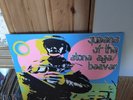
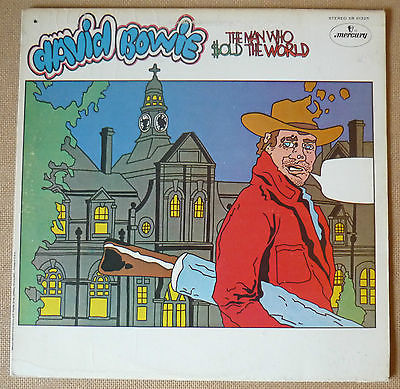
DAVID BOWIE The Man Who Sold The World LP MERCURY 1970re US unofficial SR 61325
£
18
$
24


Favourite Auctions
To save auctions to your favourites, please login
If you don't have an account, please register
Description
U.K. BUYERS PLEASE IGNORE THE SHIPPING COSTS MARKED ON EBAY BECAUSE WE ARE ITALIAN SELLERS
BEFORE BIDDING, PLEASE
CAREFULLY READ BELOW THE CORRECT SHIPPING COST!
THESE RATES ARE FOR BOXES UP TO 1 KILOS (1 or 2, maybe 3, LPs).
WE COMBINED SHIPPING DISCOUNTS
WE ARE POSTING EVERYWHERE IN THE WORLD.
SO IN ORDER TO AVOID MISUNDERSTANDING WE ADVISE YOU TO ENQUIRE
ABOUT POSTAGE COST BEFORE YOU ACTUALLY BID/PURCHASE THE ITEM
FOR ITEMS FROM & OVER £ 22.00 WE’LL SHIP
ONLY WITH REGISTERED MAIL
NO EXCEPTIONS PLEASEPLEASE ASK FOR ANY INFORMATION
DAVID BOWIE
with TONY VISCONTI, MICK RONSON, MICK WOODMANSEY, RALPH MACE
The cliché about David Bowie says he's a musical chameleon, adapting himself according to fashion
and trends. While such a criticism is too glib, there's no denying that Bowie demonstrated remarkable
skill for perceiving musical trends at his peak in the '70s. After spending several years in the late '60s
as a mod and as an all-around music-hall entertainer, Bowie reinvented himself as a hippie singer/songwriter.
Prior to his breakthrough in 1972, he recorded a proto-metal record and a pop/rock album,
eventually redefining glam rock with his ambiguously sexy Ziggy Stardust persona. Ziggy made Bowie
an international star, yet he wasn't content to continue to churn out glitter rock.
By the mid-'70s, he developed an effete, sophisticated version of Philly soul that he dubbed "plastic soul,"
which eventually morphed into the eerie avant-pop of 1976's Station to Station.
Shortly afterward, he relocated to Berlin, where he recorded
three experimental electronic albums with Brian Eno
"THE MAN WHO SOLD THE WORLD"
<unofficial reissue, originally published in 1970>
Produced by Tony Visconti
LP MERCUTY RECORDS SR 61325
PRINTED IN U.S.A. 1973 UNOFFICIAL REPRESSING
This version: Matrix is etched, not stamped as the original 1970 release.
The unofficial (bootleg Counterfeit) came out in 1973 and bears the scratched Matrix .
This came out after big success and desire for the rare (didn't sell much) Mercury sleeve
Barcode and Other Identifiers
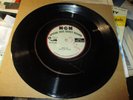
LABEL: MERCURY - RED LABEL with 12 OVAL LOGOS - BLACK TEXT
Catalog on cover (front, spine, rear): SR 61325
Catalog on labels: SR-61325 (Side 1 / Side 2)
Matrix / Runout (Side A, Etched): SR-61325-A-M2
Matrix / Runout (Side B, Etched): SR 61325-B-M1
On label: Produced by Tony Visconti
rim text reads "Manufactured and Distributed by Mercury Record Productions, Inc."
On Back Sleeve: All selections written by David Bowie
All selections published by PRS, Ltd. (ASCAP)
Recorded at Trident Studios and Advision Studios, London, England
from my records collection
tracklisting
Side A: THE WIDTH OF A CIRCLE - ALL THE MADMEN
BLACK COUNTRY ROCK - AFTER ALL
Side B: RUNNING GUN BLUES - SAVIOUR MACHINE - SHE SHOOK ME COLD
THE MAN WHO SOLD THE WORLD - THE SUPERMEN
grading
RECORD VG+ but (please, read above description)
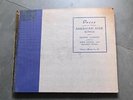
SLEEVE VG but (please, see pictures and read above description)
Even though it contained no hits, The Man Who Sold the World, for most intents and purposes,
is the beginning of David Bowie's classic period. Working with guitarist Mick Ronson
and producer Tony Visconti for the first time, Bowie developed a tight, twisted heavy guitar rock
that appears simple on the surface but sounds more gnarled upon each listen.
The mix is off-center, with the fuzz-bass dominating the compressed, razor-thin guitars
and Bowie's strangled, affected voice. The sound of The Man Who Sold the World is odd,
but the music is bizarre itself, with Bowie's bizarre, paranoid futuristic tales melded
to Ronson's riffing and the band's relentless attack. Musically, there isn't much innovation
on The Man Who Sold the World -- it is almost all hard blues-rock or psychedelic folk-rock --
but there's an unsettling edge to the band's performance,
which makes the record one of Bowie's best albums....(AllMusic)
price rating