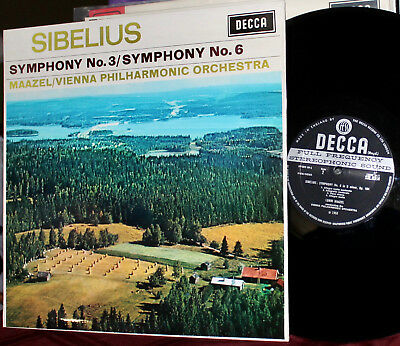
DECCA LP SXL-6364: SIBELIUS Symphony Nos. 3 & 6 - MAAZEL VPO - 1968 UK EARLY OOP
$
100



$ 100
Sold For
Jul 10, 2020
Sold Date
Oct 22, 2017
Start Date
1
Number Of Bids
USA
Country Of Seller
eBay
Sold at
Favourite Auctions
To save auctions to your favourites, please login
If you don't have an account, please register
Description
****Welcome to our listing, thanks very much for looking!
****See our own website! We have lots of out of print LPs and CDs! Find us on the web at -
hearthedifference.net
****Shipping cost is only an estimate - it depends on the actual weight and size of the package as well as the service required. We do not profit from shipping costs, so if we overcharge, we will refund the difference back to you. It's always best to wait for our invoice before paying for your item. We will combine shipping for multiple items purchased.
****Please see our other listings - new items added daily!
****To access our eBay store click on the little red door at the top right section of any of our eBay listings or, click on -
http://stores.ebay.com/Hear-The-Difference
Background -
There are records and then there are "RECORDS". This one belongs in the latter category. Decca is one of the most highly collectible labels produced. The LPs the company issued in the "golden age" of LP recordings are the most sought after by audiophiles across the globe.This LP is extremely rare, especially since it's an early stereo issue. This super heavy STEREO LP features two symphonies, written by Jean Sibelius and performed by Lorin Maazel conducting the Vienna Philharmonic Orchestra. Superb performances! The LP is the earliest STEREO record label vintage, made in the UK / England and issued in 1968. The vinyl is in superb condition given it's age (see below for details).
Lorin Varencove Maazel (March 6, 1930 – July 13, 2014) was an American conductor, violinist and composer. Making his debut at the conducting podium at the age of eight, he embarked on his career in earnest in 1953, establishing a reputation in European concert halls by 1960 but, by comparison, his career in the U.S. progressed far more slowly. However, he would later be appointed music director of the Cleveland Orchestra, Orchestre National de France, Pittsburgh Symphony Orchestra, Bavarian Radio Symphony Orchestra, and the New York Philharmonic, among other posts. Maazel was well-regarded in baton technique and possessed a photographic memory for scores. Described as mercurial and forbidding in rehearsal, he mellowed in old age.
Maazel was a child prodigy, taking his first conducting lesson at age seven with Vladimir Bakaleinikov and making his debut at age eight, conducting the University of Idaho Orchestra in Schubert's "Unfinished" Symphony in Los Angeles on July 13, 1938. At the age of eleven, he guest-conducted the NBC Symphony Orchestra on the radio. At twelve he toured the United States of America to conduct major orchestras. He made his violin debut at the age of fifteen. He attended the Fanny Edel Falk Laboratory School at the University of Pittsburgh as a child, followed by Peabody High School and the University of Pittsburgh. Maazel studied briefly with Pierre Monteux in 1945.
In the early 1950s, Maazel toured as the conductor with the Gershwin Concert Orchestra. The orchestra consisted of 25 members and a noted array of soloists. The orchestra was organized in cooperation with Ira Gershwin, to give the public a comprehensive Gershwin program. The list of soloists included George Gershwin's friend, Jesús Maria Sanromá, Carolyn Long and Theodor Uppman.
In 1960, Maazel became the first American to conduct at the Bayreuth Festspielhaus. He was chief conductor of the Deutsche Oper Berlin from 1965 to 1971 and the Radio-Symphonie-Orchester (RSO) Berlin from 1964 to 1975.
In 1972, Maazel began his tenure as music director at the Cleveland Orchestra, succeeding George Szell. Maazel's emotional, rich interpretation of music greatly differed from Szell's characteristic crisp, defined precision in performance. A notable achievement during this time was the first complete recording of George Gershwin's Porgy and Bess, using an all-African American cast (except for the chorus). Maazel held the post until 1982. He never returned to the Cleveland Orchestra after his departure, although a scheduled engagement in 2006 did not occur because of illness. In 1977, he became music director of the Orchestre National de France in Paris, a position he held until 1991.
From 1982 to 1984, Maazel served at the Vienna State Opera as general manager and principal conductor. In 1980, he succeeded Willi Boskovsky as conductor at the Vienna New Year's Concert and he led this televised annual event each year, until 1986. He returned to it four times: in 1994, 1996, 1999 and 2005.
From 1984 to 1988, Maazel was the music consultant to the Pittsburgh Symphony Orchestra, and its music director from 1988 to 1996. From 1993 until 2002, he was chief conductor of the Bavarian Radio Symphony Orchestra in Munich.
In 1989, expecting – but failing – to become successor to Herbert von Karajan as chief conductor of the Berlin Philharmonic, Maazel suddenly and publicly severed all connections with the orchestra when it was announced that Claudio Abbado was to take over. He claimed that his decision was because he was concerned for the orchestra's well-being.
In 2000, Maazel made a guest-conducting appearance with the New York Philharmonic in two weeks of subscription concerts after an absence of over twenty years, which met with positive reaction from the orchestra musicians. This engagement led to his appointment in January 2001 as the orchestra's next music director, starting in 2002, succeeding Kurt Masur. Maazel conducted the New York Philharmonic on their landmark visit to Pyongyang, North Korea on February 26, 2008. He led the orchestra in renditions of the North Korean and United States national anthems, Dvo?ák's New World Symphony, George Gershwin's An American in Paris, and closed with the traditional Korean folk song "Arirang". Maazel stepped down from the New York Philharmonic after the 2008/09 season.
In 2004, Maazel became the music director of the Arturo Toscanini Philharmonic. From September 2006 till March 2011, he was the musical director of the Orquestra de la Comunitat Valenciana, the house orchestra of the opera house Palau de les Arts, Valencia, Spain. His last concert there as Music Director took place on his 81st birthday on March 6, 2011, conducting his only opera 1984. In March 2010, Maazel was named chief conductor of the Munich Philharmonic, effective with the 2012/13 season. Early in 2014, Maazel cancelled concert engagements as a result of ill health. Subsequently, in June 2014, he announced his resignation as music director of the Munich Philharmonic, effective immediately.
Maazel conducted the music for three operatic films, Don Giovanni (1979), Carmen (1984) and Otello (1986). His own compositions included a poorly reviewed opera, 1984, based on the George Orwell novel Nineteen Eighty-Four. He was depicted conducting Vienna's New Year concert on an Austrian postage stamp issued in 2005. Maazel and his wife, Dietlinde Turban together operated a summer music festival called Castleton Festival at their Castleton, Virginia 600-acre estate, Castleton Farms. Maazel arranged Wagner's Ring Cycle into a 70-minute suite, The 'Ring' Without Words, which he recorded in 1987 with the Berlin Philharmonic.
Maazel's catalogue contained over 300 recordings of works by Beethoven, Brahms, Mahler, Schubert, Richard Strauss and others. He earned 10 Grand Prix du Disque awards.
Maazel died on July 13, 2014, at his Castleton Farms estate in Virginia, from complications due to pneumonia.
Born to American parents in Neuilly, France, conductor Lorin Maazel displayed musical maturity at an early age. Educated in the United States, he studied conducting with Vladimir Bakaleinikov, as well as violin and piano in Pittsburgh. Maazel's conducting career was underway by the tender age of seven, when the legendary Arturo Toscanini invited him to lead the NBC Orchestra in New York. Subsequently, young Maazel directed a series of New York Philharmonic performances at Lewisohn Stadium. In 1939, he conducted the Interlochen Orchestra at the World's Fair in New York, and the Los Angeles Philharmonic at the Hollywood Bowl, sharing the podium with Leopold Stokowski. Maazel's Cleveland Orchestra debut was in 1943, beginning what would become a historic relationship. In 1946, he enrolled in the languages, mathematics, and philosophy departments at the University of Pittsburgh. Concurrently, Maazel was a member of the Pittsburgh Symphony's violin section. In 1951, Maazel traveled to Italy as a Fulbright Scholar to the study music of the Baroque period, and enjoyed success conducting many leading European orchestras.
In 1972, the celebrated Cleveland Orchestra appointed Maazel its fifth music director. He remained in this capacity for a decade. Afterwrd, Maazel served as music director of several prestigious orchestras, including the Deutsch Oper Berlin, Berlin Radio Symphony, and Orchestre National de France, in addition to serving as principal guest conductor of the Philharmonia Orchestra in London. He was the conductor for the Pittsburgh Symphony, and the Bavarian Radio Symphony since 1988 (to 1996), and 1993 (to 2002) respectively. Between 2002 and 2009, he led the New York Philharmonic; the Orquestra de la Comunitat Valenciana from 2006-2011; and from 2004, Arturo Toscanini Philharmonic. His last appointment began in 2011 as chief conductor of the Munich Philharmonic. Maazel held the distinction of being not only the youngest to ever conduct at Bayreuth, but the first American. In fact, when he conducted Wagner's Ring at Bayreuth, Maazel became the first non-German to do so. The maestro conducted virtually all of the world's leading orchestras, including the Chicago Symphony, Boston Symphony, and more. He had vast and impressive experience directing opera, appearing at such prestigious houses as the Salzbug, Lucerne, Paris, and Metropolitan operas. He also conducted at La Scala and Covent Garden, as well as serving as artistic director (and general manager) of the Vienna State Opera from 1982-1984.
Maazel received numerous awards and distinctions, including the Comande's Cross of Merit of the Federal Republic (Germany), Legion of Honor (France), Commander of the Lion (Finland), and was made an honorary member of the Israel Philharmonic in 1985. He received the Grand Prix du Disque award ten times, and had been given numerous honorary degrees from various universities. His popularity and influence were undeniable when the United Nations named him Ambassador of Goodwill.
Maazel championed the use of television and film, himself writing film adaptations for such landmark works as Gustav Holst's Planets, and Vivaldi's Four Seasons. He also wrote operatic film music for Mozart's Don Giovanni and Bizet's Carmen, directed by Joseph Losey and Francisco Rossi, respectively. For these efforts, Maazel was awarded several international prizes.
Throughout his career, Maazel recorded extensively, continuously adding to a discography that is highlighted by recordings of the complete symphonic output of Beethoven, Mahler, Rachmaninov, and Sibelius. In addition to an ever-flourishing conducting career, Maazel maintained his dedication to composition. The 1996 recording of his concertos for cello, flute, and violin, with Rostropovich, Galway, and the composer as soloists respectively, is indicative of Lorin Maazel's timeless devotion to musical creativity. - David Brensilver
With the passing of Lorin Maazel, the world of classical music lost one of its strangest yet most talented figures. The man was a cypher. He held just about every major post that it’s possible to get, his discography was huge and duplicative, and given the quantity of records that he made surprisingly few constitute prime recommendations. I am sure he would not have wanted to go to his grave knowing that his reputation rests on the general consensus that he made the best-ever version of Respighi’s Feste Romane, and the truth is that he did leave a decent number of memorable discs, this Sibelius cycle among them. Part of the problem no doubt stemmed from the fact that almost everything he did was also the specialty of someone else with a bigger reputation or, in any event, an artist who got a bigger promotional push, and Maazel’s own public persona wasn’t exactly lovable. But he was a force to be reckoned with, no doubt about that.
As with most of his core repertoire, Maazel re-recorded the Sibelius symphonies later on. The earlier efforts are largely quick and often exciting. The symphonies are wonderful, gripping, beautifully paced performances, played with unusual precision by an orchestra not known for its expertise in Sibelius’ music. The symphonies also have plenty of thrust and drive.
Despite his reputation as an orchestral disciplinarian, there are a few scruffy moments in the strings–the finale of the Sixth, for example–but otherwise the Viennese sound surprisingly idiomatic. Maazel may have been emotionally cool (or weird), and he had an amazing baton technique. The man never missed a cue. But he was by no means a literalist, and you never knew what you were going to get with him. Here, at least, he is remarkably consistent and at the top of his form, and that means just about as good as anyone can be.-- David Hurwitz, ClassicsToday
Maazel’s recordings were my first sustained introduction to the music of Sibelius. It was well over four decades ago since I bought the LPs.
It may be worthwhile briefly reciting the history of these recordings. Symphony No. 1 and the Karelia Suite were set down in September and March 1963 respectively. Symphony No. 2 followed in June 1964. There was then a bit of a gap until February and March 1966 when the Seventh and Fifth were recorded. The cycle was completed in March 1968 when the remaining three symphonies and Tapiola were captured. The producer for the First Symphony was John Culshaw but everything else was produced by Erik Smith. There was even greater consistency in the matter of engineering; every recording is the work of Gordon Parry. By the time these recordings were made the Decca team had significant experience of recording the VPO in the Sofiensaal and it shows.
I began to draw my thoughts on this Maazel cycle together shortly after completing a review of live recordings in which Leonard Bernstein conducted this same orchestra in Symphonies 1, 2, 5 and 7. Bernstein’s readings, which date from the period 1986-1990 are truly memorable if also highly individual. Maazel, by contrast, is more direct, straightforward and objective. Robert Layton sums it up rather well in an overview essay in the booklet when he says that Maazel’s readings “are “straight”, idiomatic, as generous in emotion in the first two symphonies as they are searching and introspective in the Fourth and Sixth.” To this I’d add that the use of the word “straight” should not be seen as a euphemism for “dull”; these readings are never dull.
I’m not sure that the account of the Third Symphony is as successful as those of the preceding two symphonies. In the first movement I admire the lean textures and tautly sprung rhythms that Maazel achieves. In many ways I like his urgency too but I came to wonder if the pace was not a little breathless at times. For comparison I turned to Osmo Vänskä’s Lahti Symphony recording (review). Vänskä is rather steadier – and achieves a little more weight as well. He brings the movement in at 10:15 whereas Maazel takes 9:27. The difference isn’t huge but it’s noticeable and I prefer Vänskä. I’m also uneasy with Maazel’s speed for the second movement. Mind you, Sibelius isn’t much help with a tempo marking – Andantino con moto, quasi allegretto – that, to me, is hedged round with qualifications. Maazel, who takes 8:17, seems a bit brisk to me but, then, Vänskä, who takes 11:12, strikes me as a shade deliberate. Perhaps this just shows how hard it is to get right what seems on paper to be a fairly simple movement – clearly the “simplicity”, if such it is, is deceptive. Incidentally, I very much like Robert Layton’s description of this movement as “a series of reflections on a gentle theme”. Maazel’s finale strikes me as a complete success. His conducting has plenty of urgency when required but there’s also just sufficient breadth when it counts. In this movement the VPO’s horns make a super contribution.
The Sixth is the Finnish master’s “pure spring water” symphony. The VPO strings and woodwind play with great purity in the first movement and the lightness of touch that there is in much of the music is well served. The excellence of the recording allows us to appreciate the importance of the harp part – the first time that Sibelius had used the instrument in a symphony since the First Symphony. The short second movement demonstrates great economy of thought and texture by the composer and Maazel is suitably responsive. He responds well, also, to the quicksilver nature of the third movement, which is expertly articulated here. The performance of the finale is taut and incisive, In particular the strange ending, chaste and enigmatic, sounds lovely here.
It’s been highly rewarding to revisit these recordings. Performance standards are uniformly high. I was delighted to find, returning to these performances after a good few years, that Maazel is a highly convincing and persuasive guide to these marvellous scores. When this cycle first appeared competition was less intense than is now the case. I’ve by no means heard all the complete cycles on the market. Those I have encountered include Sir Colin Davis’s excellent cycle with the Boston Symphony; Sir Colin’s re-make with the LSO; Osmo Vänskä; and Sir Simon Rattle’s set. There’s also the Okko Kamu set, which I’ve not yet heard but which is definitely on my “to do” list, while just arrived, but not yet sampled, is a cycle from Hannu Lintu. Whilst I haven’t made detailed comparisons now between Maazel and any of the complete cycles with which I’m familiar I can say with a fair degree of confidence that these Decca performances from the 1960s can still be ranked alongside the very best despite the passage of five decades.
If that’s true of the performances then it’s equally true of the quality of Decca’s sound. The BD-A format offers magnificent sound which shows just how good the Decca engineering was at this time. If you can hear these recordings in that format you’re in for a treat.
I rather fancy that this Sibelius cycle may be one of Maazel’s most eminent achievements in the studio. However, I should very much like Decca to test that assumption by reissuing his Vienna Tchaikovsky cycle, including a BD-A option. I’m never sure whether to recommend a reissued recording for Recording of the Month status or whether that accolade should be reserved for brand new issues. On this occasion I think I’m justified on the grounds that this is the first BD-A issue of these recordings. Make no mistake, the quality of the performances justifies it too. There could be no better way to mark the Sibelius 150th anniversary than by acquiring these excellent performances, especially since they now come in the best quality sound.
Lorin Maazel’s Sibelius cycle stands the test of time. - John Quinn.
The Decca recordings, made between 1964 and 1969, were very much the state-of-the-art. I must say that they make an impressive showing even now, in spite of the fact the strings do not sound quite as opulent or the brass as refined as they did in the 1960s. In the uncommonly perceptive commentary in his discography The Symphonies of Jean Sibelius (Indiana University School of Music), Guy Thomas speaks of ''the gaunt, angular character of Maazel's readings'' and describes his Fourth memorably as ''a dramatic, genuinely uncompromising performance, still one of the baldest, craggiest peaks in the discography of this daunting symphony''.
The great successes of the Maazel cycle are the First, Fourth and Seventh; the latter struck me at the time as the most electrifying account since Koussevitzky's, though the sweet vibrato of the Viennese strings in the famous string threnody (14 bars before letter B) may strike some as a bit excessive. However, there is tremendous grip and integrity in these performances. The main weaknesses in the cycle are the Fifth and Sixth Symphonies with which, strangely enough, Maazel seems to make only intermittent contact. But the cycle as a whole is still an impressive achievement. Of course, Sir Alexander Gibson's with the Royal Scottish Orchestra for Chandos also comes on three CDs and has the advantage of very impressive digital sound. The performances are impressive too, if not achieving the intensity or (in the case of Nos. 1, 4 and 7) quite the stature of Maazel’s. The best course may well be to settle for the Maazel set. In the meantime one can't go far wrong with the Maazel recordings. - Robert Layton
-
LP made by DECCA Records, in the UK / England / Great Britain
-
LP released in 1968
-
LP is recorded in STEREO
-
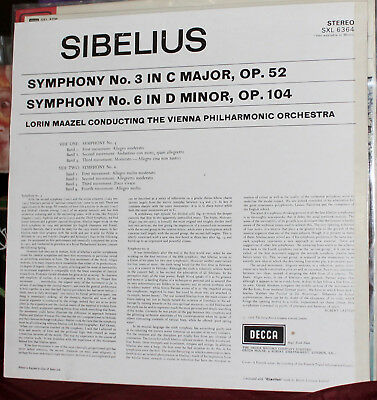
Record Catalog Number: SXL 6364
-
Record Labels are primarily BLACK & SILVER with inverse SILVER and BLACK lettering, featuring the earliest unboxed Decca logo on the record labels, with "Made in England" at the 11 o'clock position.
-
LABELS:
- Black/silver 'grooved wideband' labels
- "MADE IN ENGLAND BY" at 11 o'clock
- "? 1968" at bottom
- Tax code "J/T"
- Matrix numbers dead wax: ZAL-8344-1G (side 1) & ZAL-8345-1G (side 2) with "1" on both sides, 9 o'clock position and "B" on both sides at the 3 o'clock position
SLEEVE:
- Front laminated
- No flipbacks
- Bold "STEREO" on spine
- "© 1968, The Decca Record Company Limited, London"
- "Laminated with 'Clarifoil' made by British Celanese Limited"
- "Printed in England by Clout & Baker Ltd."
- Sleeve notes in English only on back
CATALOG NUMBERS:
- SXL 6364 on sleeve
- SXL.6364 on labels
OTHER INFORMATION:
- Recorded 20 March - 16 April 1968 in the Sofiensaal, Vienna
- Labelography code: ED2
- Corresponding mono issue has cat# LXT 6364
Sibelius // Lorin Maazel
LP title and Music on this rare LP -
Sibelius - Symphonies Nos. 3 & 6
1. Symphony no 3 in C major, Op. 52 by Jean Sibelius
Conductor: Lorin Maazel
Orchestra/Ensemble: Vienna Philharmonic Orchestra
Period: Romantic
Written: 1907; Finland
Date of Recording: 04/1968
Venue: Sofiensaal, Vienna
Length: 26 Minutes 10 Secs.
2. Symphony no 6 in D minor, Op. 104 by Jean Sibelius
Conductor: Lorin Maazel
Orchestra/Ensemble: Vienna Philharmonic Orchestra
Period: Romantic
Written: 1923; Finland
Date of Recording: 04/1968
Venue: Sofiensaal, Vienna
Length: 24 Minutes 11 Secs.
Performers -
CONDITION Details:
The LP jacket is in near mint minus condition. The jacket is tight and clean, with NO seam splits. It has "clarifoil" on the front of the jacket, not back. The corners are solid. The colors on the jacket are sharp with NO discoloration on the front or back. The corners and seams show very little shelf wear due to the age (see pictures with this listing for more detail as they are of the actual item).
The LP is in near mint minus condition! There are no serious marks on the vinyl. There may be some very light spider marks on the LP which are caused by sliding the LP in and out of the inner sleeve. Most of the time, these types of marks are not audible, but it really depends on the sensitivity of your audio gear. This is not a new audiophile LP....some extraneous sound is inevitable and should be expected for a vintage LP. A record from the 1960s is rarely perfect. The LP retains much of the original gloss and sheen! There are NO serious spindle marks on the record labels either. That said, acquiring a vintage LP like this is for the performance and rarity of the LP, not necessarily just for the sound quality.A Short Note About LP GRADING -
- Mint = Only used for sealed items.
- Near Mint = Virtually flawless in every way.
- Near Mint Minus = Item has some minor imperfections, some audible.
- Excellent = Item obviously played and enjoyed with some noise.
- Very Good Plus = Many more imperfections which are noticeable and obtrusive.
For best results, always thoroughly clean your LPs before playing them.
LPs can be audiophile quality pressings (any collector of fine MFSL, half speeds, direct to discs, Japanese/UK pressings etc., can attest to the difference a quality pressing can make to an audio system).
Don't let this rarity slip by!!!price rating