DECCA SXL-2060 LP: Mendelssohn - A Midsummer Night's Dream, Peter MAAG - 1960 UK
$
700

Favourite Auctions
To save auctions to your favourites, please login
If you don't have an account, please register
Description
****Welcome to our listing, thanks very much for looking!
****See our own website! We have lots of out of print LPs and CDs! Find us on the web at -
hearthedifference.net
****Please see our other listings - new items added daily!
****Shipping cost is only an estimate - it depends on the actual weight and size of the package as well as the service required. We do not profit from shipping costs, so if we overcharge, we will refund the difference back to you. It's always best to wait for our invoice before paying for your item. We will combine shipping for multiple items purchased.
Background -
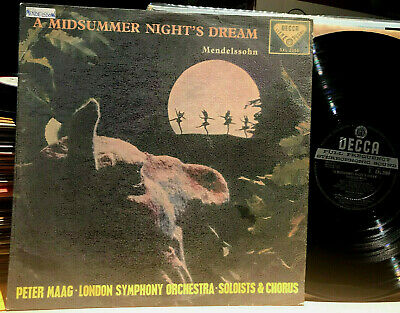
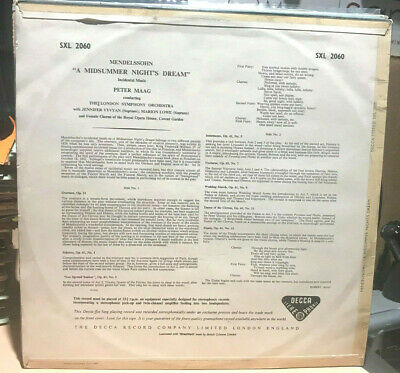
This is a very rare LP pressing on the UK DECCA record label (SXL 2060). The LP was made in the UK, with a date of issue indicated on the back of the LP jacket as July 1960. The record jacket is in excellent overall shape with NO seam splits, but does have a small sticker located on the front, top, left corner which can be removed, but we didn't want to risk it. The front of the jacket is laminated, but the colors on the front are fading, likely due to the age of the item - 60+ years! The jacket has the straight edge flipped over seams at the top and bottom. The vinyl itself appears in excellent plust overall shape, with a few very light spider marks evident, nothing serious at all (these are caused by sliding the LP in and out of the inner sleeve - most of the time these types of marks don’t sound, but it really depends on the sensitivity of your audio gear). A superb vintage example of a very collectible LP hotly sought after by serious music collectors and audiophiles alike.Mendelssohn's incidental music for A Midsummer Night's Dream, Op. 61, was completed 16 years after he wrote the Overture, Op. 21. The consistency of style and musical unity between them belie the disparate dates of composition. The overture was by an incredibly musically gifted youth of 17, and the incidental music was by the music director of Prussia's King Friedrich Wilhelm IV's Academy of the Arts and the Leipzig Gewandhaus Orchestra.
A Midsummer Night's Dream had always been a favorite of Felix and his sister, Fanny. The commission for the remaining music came from the King, for a Potsdam production of the play, one of several commissions for theatrical music Mendelssohn received while in this post. The producer of the play was Ludwig Tieck, one of the translators of the definitive German version of the play, the same version that the Mendelssohns had enjoyed and absorbed thoroughly as their own.
The incidental music consists of 14 sections, including the overture. There are vocal sections and instrumental movements. The vocal selections include the song "Ye spotted snakes" and the melodramas "Over hill, over dale," "The Spells," "What hempen homespuns," and "The Removal of the Spells." The melodramas served to enhance Shakespeare's text. The remaining sections are primarily cues. The music combines the traditional forms and structures of Classical music with the feeling and expression of the Romantic era. Throughout the sections, Mendelssohn sprinkles themes and motives pulled from the earlier overture to create coherence.
The instrumental movements, Scherzo, Intermezzo, Notturno, and the "Wedding March," are usually excerpted with the overture for orchestral concert performance. The Scherzo appropriately introduces the fairy-world of Act Two with rapid, running passages in the woodwinds, similar to the string passage in the opening of the overture, both set in a minor mode. The rest of the orchestra joins the woodwinds in a Classical sonata-form movement. Several small motives are repeated, up and down, then down and up the scale, to form the development section. The Intermezzo represents the confusion encountered as Hermia awakes, with a swirling melody buffeted about by the orchestra. The rustic players enter jauntily, represented by the bassoons and ending the Intermezzo in the major. A German Romantic horn melody is the theme of the Notturno. The music evokes the dreams of the couples as Puck puts right his previous mischief. The "Wedding March" opens with that oh-so-familiar trumpet fanfare, fitting for the Duke of Athens' wedding. Two trio sections are separated by the opening theme; the final occurrence of the main theme includes twittering flutes and strings, suggesting the fairies' part in the matchmaking. The "Finale" returns to the overture for most of its sparkling material, ending with the same four woodwind chords that begin the entire work.
Although some consider Mendelssohn's work to be lightweight and uninspired, the entirety of A Midsummer Night's Dream proves otherwise in its inventiveness in reviving his older material and in its expression. - Patsy Morita
A highly competent conductor whose repertory was extensive, Peter Maag made his reputation in Europe, but was a presence in American theaters as well. Although most of his life was devoted to opera, he made several recordings that honestly represented his eloquence in the symphonic literature and suggested that he might have made an even more appreciable impact there had he spent more time in concert work. After musical training in Zürich and Basel, Maag studied with Ernest Ansermet in Geneva and soon became an assistant to the elder conductor. He served first as coach and chorus master in Biel-Solothum beginning in 1943, two years later working his way to full conductor. He served as principal conductor at Düsseldorf from 1952 to 1954 before becoming music director at Bonn from 1954 to 1959. Maag's Covent Garden debut came in 1959 when he conducted Die Zauberflöte. From 1964 to 1968, Maag held the post of principal conductor at the Volksoper in Vienna. Meanwhile, Maag had made his American debut at the Lyric Opera of Chicago conducting a November 1, 1961, performance of Così fan tutte. For his Fiordiligi, Elisabeth Schwarzkopf was ill, likely contributing to the caution evident in the performance. Maag was even less fortunate with Don Giovanni when Schwarzkopf succumbed and Lisa della Casa had to be flown in to sing Donna Elvira. Still, the first performance was well regarded and subsequent performances were better still when Schwarzkopf returned as Elvira. Despite a wayward horn section, Maag did well with the Lyric's Fidelio, firing an intense performance with Birgit Nilsson and Jon Vickers. Making his Metropolitan Opera debut with Don Giovanni in September 1972, Maag conducted there for three seasons. Other assignments included Norma, Die Zauberflöte, and La Traviata. Critics found him supportive of his singers, but deficient in eliciting orchestral sheen in the Verdi. From 1982 to 1991, Maag served as music director of the Berne Municipal Opera. Among Maag's most notable recordings are those devoted to the symphonies of Beethoven (the complete cycle), Mendelssohn, Mozart, Schubert, and the piano and orchestra works of Schumann. For Decca, he led a Luisa Miller with Milnes, Caballé, and Pavarotti. Several other operas are available in recordings captured from stage performances. - Erik Eriksson
-
LP made by DECCA Records, in the UK / England / Great Britain
-
LP released: July 1960
-
LP is recorded in STEREO
-
Record Catalog Number: SXL 2060
Felix Mendelssohn // Peter Maag
LP Title -
Mendelssohn: A Midsummer Night's Dream - Incidental Music
Tracks -Incidental Music
A1. Overture Op. 21
A2. Scherzo, Op. 61 No. 1
A3. You Spotted Snakes, Op. 61 No. 3
B1. Intermezzo, Op. 61 No. 5
B2. Nocturne, Op. 61 No. 7
B3. Wedding March, Op. 61 No. 9
B4. Dance Of The Clowns, Op. 61 No. 11
B5. Finale, Op. 61 No. 12
Performers / Credits / Other Information -
• Recorded At – Kingsway Hall
• Mastered At – Decca Studios
• Pressed By – Decca Record Co. Ltd., Pressing Plant, UK.
• Record Company – The Decca Record Company Limited
• Engineer [Uncredited] – Cyril Windebank
• Mastered By [Side A] – Jack Law
• Mastered By [Side B] – Stanley Goodall
• Producer [Uncredited] – James Walker
• Sleeve Notes – Robert Boas
• Chorus – Female Chorus Of The Royal Opera House, Of The Covent Garden
• Composed By – Mendelssohn
• Conductor – Peter Maag
• Orchestra – The London Symphony Orchestra
• Soprano Vocals – Jennifer Vyvyan, Marion Lowe (tracks: A1 to A3)
• Matrix / Runout: Matrix: ZAL 3559-6D
• Matrix / Runout: Matrix: ZAL 3560-5E
• Matrix / Runout: (Mother / Stamper side 1): 1 at 9 o’clock, I at 3 o'clock
• Matrix / Runout: (Mother / Stamper side 2): 1 at 9 o’clock, N at 3 o’clock • Tax Code / Runout: KT on both sides
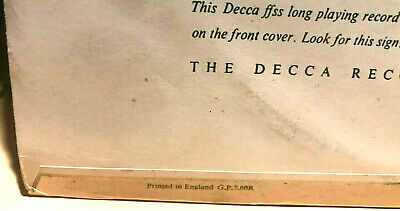
• Other (Printing company code on bottom flipback): Printed In England G.P.7.60R
LABELS:
As per original 1st issue
- Black/silver 'grooved wideband' labels
- "ORIGINAL RECORDING BY" at 11 o'clock
- "Made in England" at bottom
- "RECORDING FIRST PUBLISHED 1959"
- KT Tax code in runout groove, both sides
- 33 1/3 Speed indication on labels
- Matrix numbers printed upside-down
SLEEVE:
- Front laminated
- straight edged flip-backs, top and bottom seams
- Triangular "DECCA STEREOPHONIC" logo in a box on front and without a box on back
- Thin spine with no text on it
- No blue border on back
- "Laminated with 'Clarifoil' made by British Celanese Limited"
- "Printed in England"
- Printing date on sleeve is July 1960
- Liner notes in English on back
CATALOG NUMBERS:
- SXL 2060 on sleeve
- SXL.2060 on labels
OTHER INFORMATION:
- Recorded 27 - 28 February 1957 in Kingsway Hall, London
- Corresponding mono issue has cat# LXT 5344
- The two soprano singers are credited for an entire LP side on the labels, but actually perform on tracks A3 and B5 only
CONDITION Details:
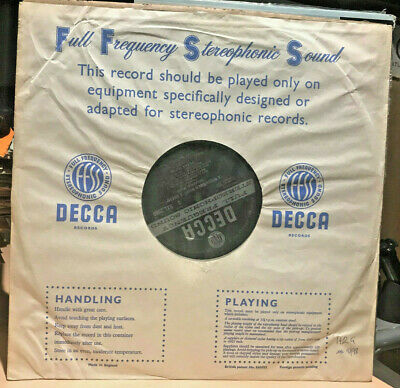
The LP jacket is in excellent overall condition. The early DECCA jackets were very delicate. Even though this is a delicate jacket, there are NO seam splits, NO cut out marks, NO significant issues. The corners are solid with slight shelf wear. The jacket has a small white sticker at the top, front, left corner, which, can be removed, but we will leave that to the next owner to deal with. The colors on the front of the jacket are fading due to age, this vintage LP is over 60 years old! The jacket has the straight edged flipped over seams, top and bottom and the front of the jacket is LAMINATED with Clarifoil and comes with the original inner sleeve - see pictures as they are of the actual item.
The LP is in excellent plus overall condition! There are NO serious marks on the vinyl, only some light spider marks on the LP (caused by sliding the LP in and out of the inner sleeve) and perhaps a finger print or two. Most of the time, spider marks are not audible, but it really depends on the sensitivity of your audio gear. The LP retains much of the original gloss and sheen. Considering the vintage of this LP, the vinyl looks superb, not like a perfect, brand new audiophile LP, but still a fine, top notch collectible item. As said, this is not a new audiophile LP....some extraneous sound is inevitable and should be expected for a vintage LP. There are NO serious spindle marks on the record labels either.A Short Note About LP GRADING -
- Mint = Only used for sealed items.
- Near Mint = Virtually flawless in every way.
- Near Mint Minus = Item has some minor imperfections, some audible.
- Excellent = Item obviously played and enjoyed with some noise.
- Very Good Plus = Many more imperfections which are noticeable and obtrusive.
For best results, always thoroughly clean your LPs before playing them.
LPs can be audiophile quality pressings (any collector of fine MFSL, half speeds, direct to discs, Japanese/UK pressings etc., can attest to the difference a quality pressing can make to an audio system).
Do not let this rarity slip by!price rating


