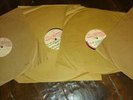
DGG 3-LP Box 138-931/33: VERDI - Rigoletto - Scotto, Kubelik, 1964 TULIP GERMANY
C$
60
$
43


Favourite Auctions
To save auctions to your favourites, please login
If you don't have an account, please register
Description
****Welcome to our listing, thanks very much for looking!
****See our own website! We have lots of out of print LPs and CDs! Find us on the web at -
hearthedifference.net
****Please see our other listings - new items added daily!
****Shipping cost is only an estimate - it depends on the actual weight and size of the package as well as the service required. We do not profit from shipping costs, so if we overcharge, we will refund the difference back to you. It's always best to wait for our invoice before paying for your item. We will combine shipping for multiple items purchased.
Background -
Rafael Jeroným Kubelík (29 June 1914 – 11 August 1996) was a Czech-born conductor and composer.Son of a well-known violinist, Jan Kubelík, he was trained in Prague, and made his debut with the Czech Philharmonic Orchestra at the age of 19. Having managed to maintain a career in Czechoslovakia under the Nazi occupation, he refused to work under what he considered a "second tyranny" after the Communist Czechoslovak coup d'état of 1948, and took refuge in Britain. He became a Swiss citizen in 1967.
Kubelík was music director of the Chicago Symphony Orchestra (1950–53), musical director of The Royal Opera, Covent Garden (1955–58), and music director of the Bavarian Radio Symphony Orchestra (1961–79), and was a frequent guest conductor for leading orchestras in Europe and America.
As a composer, Kubelík wrote in a neo-romantic idiom. His works include five operas, three symphonies, chamber music, choral works, and songs.
Kubelík was born in Býchory, Bohemia, Austria-Hungary, today's Czech Republic. He was the sixth child of the Bohemian violinist Jan Kubelík, whom the younger Kubelík described as "a kind of god to me". His mother was a Hungarian countess, Anna Julie Marie Széll von Bessenyö. Kubelík studied the violin with his father, and entered the Prague Conservatory at the age of 14, studying violin, piano, composition, and conducting. He graduated from the conservatory in 1933, at the age of 19; at his graduation concert he played a Paganini concerto and a composition of his own for violin and orchestra. Kubelík was also an accomplished pianist, and served as his father's accompanist on a tour of the United States in 1935.
In 1939, Kubelík became music director of the Brno Opera, a position he held until the Nazis shut the company down in November 1941. The Nazis allowed the Czech Philharmonic to continue operating; Kubelík, who had first conducted the orchestra when he was 19, became its principal conductor. In 1943 he married the Czech violinist Ludmilla Bertlová, with whom he had one son.
In 1944, after various incidents, including one in which he declined to greet the Nazi Reichsprotektor Karl Hermann Frank with a Hitler salute, along with his refusal to conduct Wagner during the War, Kubelík "deemed it advisable to disappear from Prague and to spend a few months undercover in the countryside so as not to fall into the clutches of the SS or Gestapo". Kubelík conducted the orchestra's first post-war concert in May 1945. In 1946, he helped found the Prague Spring Festival, and conducted its opening concert.
After the Communist coup of February 1948, Kubelík left Czechoslovakia, vowing not to return until the country was liberated. "I had lived through one form of bestial tyranny, Nazism," he told an interviewer, "As a matter of principle I was not going to live through another." He defected during a trip to Britain, where he had flown to conduct Mozart's Don Giovanni with the Glyndebourne company at the Edinburgh Festival. He had been engaged on the recommendation of Bruno Walter, whom Kubelík had assisted in this work at the 1937 Salzburg Festival. Kubelík told his wife of his decision to defect as their plane left Czechoslovakia.
In 1953, the Communist government convicted the couple in absentia of "taking illicit leave" abroad. In 1956, the regime invited him back "with promises of freedom to do anything I wanted," said Kubelík, but he refused the invitation. In a 1957 letter to The Times, Kubelík said he would seriously consider returning only when all the country's political prisoners were freed and all émigrés were given as much freedom as he would have possessed. He was invited back by the regime in 1966 but again refused; in 1968, after the Prague Spring had been ended by the Soviet invasion, he organised an international boycott, in which many of the major classical artists of the West participated.
In 1950, Kubelík became music director of the Chicago Symphony Orchestra, choosing the position over an offer from the BBC to succeed Sir Adrian Boult as chief conductor of the BBC Symphony Orchestra. He left the post in 1953. Some hold that he was "hounded out of the [Chicago] job" (to quote Time magazine) by the "savage attacks" (to quote the New Grove Dictionary of Music and Musicians) of the Chicago Tribune music critic Claudia Cassidy. But Chicago Sun-Times music critic Robert C. Marsh argued in 1972 that it was the Chicago Symphony trustees who were behind the departure. Their foremost complaint, and that of Cassidy as well, was that Kubelík introduced too many contemporary works (about 70) to the orchestra; there were also objections to his demanding exhaustive rehearsals and engaging several black artists. Many recordings made by Kubelík in Chicago for Mercury Records are available on CD, and have received critical praise.
After leaving Chicago, Kubelík toured the US with the Concertgebouw Orchestra, and, in the words of Lionel Salter in the Grove Dictionary, "had a brilliant success with Janáček's Kát'a Kabanová at Sadler's Wells in London in 1954". Kubelík became musical director of The Royal Opera, Covent Garden, from 1955 to 1958. Among his achievements there was, in 1957, the first practically complete production in any opera house of Berlioz's Les Troyens. Although Covent Garden sought to renew his contract, he chose to leave, partly because of a campaign by Sir Thomas Beecham against the engagement of foreign artists at Covent Garden. In 1961 Kubelík accepted the position of music director of the Bavarian Radio Symphony Orchestra (BRSO) in Munich. He remained with the BRSO until 1979, when he retired. Salter considers this 18-year association the high point of Kubelík's career, both artistically and professionally.
In 1961 Ludmilla Kubelík died after a car crash. Also in 1961, he premiered the concerto performance version of Schoenberg's Jakobsleiter-Fragment in Vienna, with the Cologne Radio Symphony Orchestra and choir.
In 1963 Kubelík married the Australian soprano Elsie Morison (1924-2016). In 1967 he became a Swiss citizen, and began an association with the Lucerne Festival, in addition to his work with the BRSO.
In 1971, Göran Gentele, the new general manager of the Metropolitan Opera, New York, asked Kubelík to accept the position of music director. Kubelík accepted partly because of his strong artistic relationship with Gentele. The first production he conducted as the Met's music director was Les Troyens. The death of Gentele in a road accident in 1972 undermined Kubelík's reasons for working at the opera house. He had prior conducting commitments away from the Met in his first season there, which diverted his attention. He resigned from the Met in 1974, after only six months in the post.
In his post-Czechoslovakian career, Kubelík worked with the Berlin Philharmonic, Boston Symphony, Chicago Symphony, Cleveland, Israel Philharmonic, London Symphony, New York Philharmonic, Vienna Philharmonic and Royal Concertgebouw orchestras, among others. His final concert was with the Czech Philharmonic.
In 1985, ill-health (notably severe arthritis in his back) caused Kubelík to retire from full-time conducting, but the fall of Communism in his native land led him to accept a 1990 invitation to return to conduct the Czech Philharmonic at the festival he had founded, the Prague Spring Festival. He recorded Smetana's Má Vlast live with the Czech Philharmonic for Supraphon, his fifth recording of the piece. He also recorded the Mozart "Prague" Symphony and Dvořák's "New World" Symphony at the festival. During the rehearsal of the "New World," he told the Czech Philharmonic, "It is my joy to hear this. I always wanted it to sound like this but never really found it with any other orchestra in the world. That eighth [note] is great!"
Kubelík died in 1996, aged 82, in Kastanienbaum, in the Canton of Lucerne, Switzerland. His ashes are interred next to the grave of his father in Slavín, Vyšehrad cemetery in Prague.
Rigoletto is an opera in three acts by Giuseppe Verdi. The Italian libretto was written by Francesco Maria Piave based on the play Le roi s'amuse by Victor Hugo. Despite serious initial problems with the Austrian censors who had control over northern Italian theatres at the time, the opera had a triumphant premiere at La Fenice in Venice on 11 March 1851.
It is widely considered to be the first of the operatic masterpieces of Verdi's middle-to-late career. Its tragic story revolves around the licentious Duke of Mantua, his hunch-backed court jester Rigoletto, and Rigoletto's beautiful daughter Gilda. The opera's original title, La maledizione (The Curse), refers to a curse placed on both the Duke and Rigoletto by a courtier whose daughter the Duke has seduced with Rigoletto's encouragement. The curse comes to fruition when Gilda falls in love with the Duke and sacrifices her life to save him from assassins hired by her father.
One of the best places to test a conductor's fitness for Rigoletto is the Duke's solo "E il sol dell'anima", and Kubelik passes with flying colours. Anybody can set the fire going and make the big noises; but to accompany the vocal line with orchestral parts that look on paper to be so utterly devoid of interest a conductor has to have a true feeling for the traditions of Italian opera. Kubelik and Bergonzi here are at one, fine exponents of the tradition and a pleasure to hear. So too in "Parmi veder" with its eloquently rounded cadenza... In other places there's too much gravims, too little bounce and joy. In the 30-year-old Renata Scotto they had a Gilda who no longer sounds young: her best singing is done after her crisis off-stage, with an unusually affecting "Tutte le feste" and, in the final duet, "V'ho ingannato". Rigoletto, on the other hand, sounds young enough to be almost anything but her father. Fischer-Dieskau jests pointedly, broods with bitter loathing, and runs the full range of emotions in his scene with the courtiers. "Miei signori" finds him lacking richness, but "Ah, veglia o donna" which brings so many to grief is beautifully done. In short, a recording of mixed merit, the best of it distinctly too good to miss. -- Gramophone
Renata Scotto – a Gilda? This was my first thought when I saw this recording advertised. My experience with Scotto's voice has been in the latter part of her career. I have found her tolerable though shrill at times. A full-bodied intense voice, it was one I never associated with coloratura roles. Boy was I wrong. In this recording, her top registers were anything but shrill. She shows an amazing flexibility and control. Her Caro nome is one to be heard many times. She reaches a high D and decrescendo's to an incredible ppp. I felt the aria drug a little in tempo, but the gorgeous sound more than made up for it. This recording makes me want to buy her Traviata if she has one available.
As Rigoletto, Dietrich Fischer-Dieskau has the vocal power demanded by the score. Too often he sounded as if he was delivering a recital of Leider. A smooth velvet sound was his mark throughout. In his duets with Gilda, this payed off handsomely. Even in his dealings with the courtiers after Gilda's abduction he showed us a rarely seen Dietrich blustery side. He picked up some of the visciousness for the final duet in the second act but the majority was too good to be true. Everywhere but his dealings with Gilda requires harsh almost crude sounds in keeping with his general character. Fischer-Dieskau gave a very solid performance. His voice at times, however, did not match the situation.
Carlo Bergonzi has a wonderful tenor although at times a little excessive on the vibrato. He captured the care-free nature of the Duke to an exact measure. At the end of Addio, speranza ed anima he ended it in a high D. This D is one of the most resonant vibrant notes ever captured on a recording. It is not that strong, but the quality is great. This recording makes me a Bergonzi fan.
Fiorenzo Cossotto made a formidable match for Sparafucile as sung by Ivo Vinco. The comprimario roles were well handled. The chorus and orchestra well directed. Kubelík kept a firm pace throughout. A performance worth purchasing. - Stephen L. Parker
This is an OPENED, in NEAR MINT condition 3-LP box set issued by "DGG - Deutsche Grammophon Gesellschaft" in 1964 - a super RARE title that is long out of print!
The 3-LP boxed set made by DGG Records is a highly collectible title from their catalog - a superb CLASSICAL title featuring the music of -
Giuseppe Verdi // Rafael Kubelik
3-LP Boxed Set Title -
Rigoletto (complete opera)
Performers / Credits -
• Baritone Vocals [Marullo, Cavaliere] – Virgilio Carbonari• Baritone Vocals [Rigoletto, Suo Buffone Di Corte] – Dietrich Fischer-Dieskau
• Bass Vocals [Il Conte Di Ceprano] – Alfredo Giacomotti
• Bass Vocals [Il Conte Di Monterone] – Lorenzo Testi
• Bass Vocals [Sparafucile, Bravo] – Ivo Vinco
• Bass Vocals [Usciere Di Corte] – Giuseppe Morresi
• Choir – Coro Del Teatro Alla Scala
• Chorus Master – Roberto Benaglio
• Composed By – Giuseppe Verdi
• Conductor – Rafael Kubelik
• Engineer [Recording] – Günter Hermanns
• Libretto By – Francesco Maria Piave
• Mezzo-soprano Vocals [Giovanna, Custode Di Gilda] – Mirella Fiorentini
• Mezzo-soprano Vocals [Maddalena, Sua Sorella] – Fiorenza Cossotto
• Orchestra – Orchestra Del Teatro Alla Scala
• Producer – Otto Gerdes
• Recording Supervisor – Hans Weber
• Soprano Vocals [Gilda, Sua Figlia] – Renata Scotto
• Soprano Vocals [La Contessa, Sua Sposa] – Catarina Alda
• Soprano Vocals [Paggio Della Duchessa] – Catarina Alda
• Tenor Vocals [Borsa Matteo, Cortigiano] – Piero di Palma
• Tenor Vocals [Il Duca Di Mantova] – Carlo Bergonzi
Track Listing -
1. Rigoletto by Giuseppe Verdi
Performer: Renata Scotto (Soprano), Ivo Vinco (Bass), Dietrich Fischer-Dieskau (Baritone), Carlo Bergonzi (Tenor), Fiorenza Cossotto (Mezzo Soprano), Mirella Fiorentini (Soprano), Virgilio Carbonari (Bass Baritone), Lorenzo Testi (Bass), Alfredo Giacomotti (Bass), Caterina Alda (Mezzo Soprano), Piero de Palma (Tenor), Giuseppe Morresi (Bass Baritone)
Conductor: Rafael Kubelik
Orchestra/Ensemble: Milan Teatro alla Scala Orchestra, Milan Teatro alla Scala Chorus
Period: Romantic
Written: 1851; Italy
Language: Italian
A2. Atto Primo, Parte Prima
B. Atto Primo, Parte Seconda
C. Atto Primo, Parte Terza
Atto Secondo
D. Atto Secondo, Parte Prima
E1. Atto Secondo, Parte Seconda
Atto Terzo
E2. Atto Terzo, Parte Prima
F. Atto Terzo, Parte Seconda
The title is from the rare DGG series of vintage LPs.
- DGG - Deutsche Grammophon Gesellschaft RECORDS
- LPs made in Germany
- Pressings are in STEREO, they have the TULIP label vintage (indicates earliest pressings)
- With 52-page booklet, printed in Germany 6/65.
Phonographic Copyright (p) – Polydor International GmbH - Comes in a luxurious linen covered boxed set
- Record vintage = made in 1964 (out of print)
- LP catalog # 138-931/933
CONDITION Details:
The 3-LP linen-like covered outer box is in excellent plus condition! The box has NO splits or crushed corners, but does show some light shelf wear, along the seams and corners. The colors on the box are sharp and clean (see pictures with this listing for more detail).
The set comes complete with a large format, 52 page paper insert/libretto.
The 3-LPs are in near mint minus condition! We found that the vinyl looked superb on this vintage LP set. There are no significant marks and the LPs retain much of the original gloss and sheen - obviously well taken care of! They do have a bit of dust and perhaps a finger print or two on them so they should be cleaned before playing. There are NO serious spindle marks on the record labels either. Just beautifully made vinyl! That said, acquiring a vintage LP like this is for the performance and rarity of the LP, not necessarily for the sound quality.A Short Note About LP GRADING -- Mint = Only used for sealed items.
- Near Mint = Virtually flawless in every way.
- Near Mint Minus = Item has some minor imperfections, some audible.
- Excellent = Item obviously played and enjoyed with some noise.
- Very Good Plus = Many more imperfections which are noticeable and obtrusive.
For best results, always properly clean your LPs before playing them.
The LP is an audiophile quality pressing (any collector of fine MFSL, half speeds, direct to discs, Japanese/UK pressings etc., can attest to the difference a quality pressing can make to an audio system).
Do not let this rarity slip by!
price rating