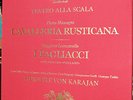
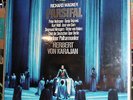
DGG 3-LPs 139-205/7: Cavalleria Rusticana / Pagliacci – KARAJAN - 1966 DEU TULIP
C$
80
$
58


Favourite Auctions
To save auctions to your favourites, please login
If you don't have an account, please register
Description
****Welcome to our listing, thanks very much for looking!
****See our own website! We have lots of out of print LPs and CDs! Find us on the web at -
hearthedifference.net
****Shipping cost is only an estimate - it depends on the actual weight and size of the package as well as the service required. We do not profit from shipping costs, so if we overcharge, we will refund the difference back to you. It's always best to wait for our invoice before paying for your item. We will combine shipping for multiple items purchased.
****Please see our other listings - new items added daily.
****To access our eBay store click on the little red door at the top right section of any of our eBay listings or, click on -
http://stores.ebay.com/Hear-The-Difference
Background -
Herbert von Karajan (born Heribert Ritter von Karajan; 5 April 1908 – 16 July 1989) was an Austrian conductor. He was principal conductor of the Berlin Philharmonic for 35 years. Generally regarded as one of the greatest conductors of the 20th century, he was a dominant figure in European classical music from the mid-1950s until his death. Part of the reason for this was the large number of recordings he made and their prominence during his lifetime. By one estimate he was the top-selling classical music recording artist of all time, having sold an estimated 200 million records.The Karajans were of Greek or Aromanian ancestry. His great-great-grandfather, Georg Karajan (Geórgios Karajánnis, was born in Kozani, in the Ottoman province of Rumelia (now in Greece), leaving for Vienna in 1767, and eventually Chemnitz, Electorate of Saxony. He and his brother participated in the establishment of Saxony's cloth industry, and both were ennobled for their services by Frederick Augustus III on 1 June 1792, thus adding the prefix "von" to the family name. The surname Karajánnis became Karajan. Although traditional biographers ascribed a Serbian or simply a Slavic origin to his mother, Karajan's family from the maternal side, through his grandfather who was born in the village of Mojstrana, Duchy of Carniola (today in Slovenia), was Slovene. By this line, Karajan was related to Austrian composer of Slovene descent Hugo Wolf. Karajan seems to have known some Slovene.
Herbert von Karajan was among the most famous conductors of all time -- a man whose talent and autocratic bearing lifted him to a position of unprecedented dominance in European musical circles. He was born on April 5, 1908 in Salzburg, Austria, to a cultured Austrian family of Greek descent (their original name was Karajannis). His musical training began at the Mozarteum Conservatory in Salzburg where he studied piano with Franz Ledwenke, theory with Franz Zauer, and composition with Bernhard Paumgartner, who encouraged Karajan to pursue conducting. Karajan graduated from the conservatory in 1926, and continued his studies at the Vienna Academy of Music and Performing Arts, where he studied piano with Josef Hofman and conducting with Alexander Wunderer and Franz Schalk. Karajan's conducting debut came on January 22, 1929, with the Mozarteum Orchestra in Salzburg. Consequently, the young maestro directed a performance of Strauss' Salome at the Salzburg Festspielhaus, and was named principal conductor of the Ulm Stadttheater, where he remained in that capacity until 1934.
The next fourteen years saw the young conductor's reputation grow rapidly. He was named music director of the Aachen Stadttheater (1934-1942), had his debut at the Vienna State Opera (1937), and accepted a position with the Deutsch Grammophon Gesellschaft (1938-1943). In 1939, Karajan was appointed conductor of the Berlin State Opera, and director of the Preussiche Staatskapelle Symphony concerts. In 1948, he was appointed for life, to the position of director of the Chorale Society at the Society of the Friends of Music, in Vienna.
In 1948, Herbert von Karajan also served at the Vienna Symphony Orchestra, the Philharmonia Orchestra, and La Scala, before succeeding Wilhelm Furtwängler as the music director of the Berlin Philharmonic Orchestra -- a union that would cement his reputation as one of the world's premier conductors. In 1955, Karajan brought that orchestra to the United States on the first of many international tours. The decade that followed saw Karajan accept several appointments, including those to the Salzburg Festival and the Vienna State Opera. In 1967, Karajan had his Metroplitan Opera debut, conducting a performance of Wagner's Die Walküre, and the same year, founded the Salzburg Easter Festival. In 1968, the Herbert von Karajan Foundation was founded to support the research of "conscious musical perception."
Herbert von Karajan was awarded the "Ring of the Province of Salzburg," Golden Grammophone, Arts Prize (Lucerne), Grand Prix International du Disque, Gold Medal of the Royal Philharmonic Society, German Golden Disc Prize, UNESCO International Music Prize, Olympia Prize of the Onassis Foundation, and multiple Grammophone awards, among others. He was elected to an honorary senate seat at the University of Salzburg. The maestro was also recognized with honorary degrees from a host of universities.
Karajan, along with Akio Morita and Norio Ohga (president and vice-president respectively, of Japanese Sony Group), unveiled and presented the Compact Disc Digital Audio System in 1981. In 1982, Karajan founded Telemondial S.A.M. with Uli Markle, in an effort to document the maestro's illustrious legacy on videotape and laser disc, and to help broaden the scope of "musical expression," through the use of modern technology. In 1984, Karajan recorded the complete Beethoven symphonies with film adaptation, made possible by his own Telemondial. In 1988, Deutsch Grammophone released a collection of one hundred "masterworks" recordings made by the conductor. Herbert von Karajan's discography is impressive to say the least, and will certainly endure in musical arenas, as some of the most valued interpretations of the repertoire available. Herbert von Karajan, often referred to as "general music director of Europe," died in Salzburg of heart failure July 16, 1989. - David Brensilver
Cavalleria rusticana (Italian for "rustic chivalry") is an opera in one act by Pietro Mascagni to an Italian libretto by Giovanni Targioni-Tozzetti and Guido Menasci, adapted from a play and short story written by Giovanni Verga. Considered one of the classic verismo operas, it premiered on 17 May 1890 at the Teatro Costanzi in Rome. Since 1893, it has often been performed in a so-called Cav/Pag double-bill with Pagliacci by Ruggero Leoncavallo.
Pagliacci (literal translation, Clowns) is an Italian opera in a prologue and two acts, with music and libretto by Ruggero Leoncavallo. It is the only Leoncavallo opera that is still widely performed.
Pagliacci premiered at the Teatro Dal Verme in Milan on 21 May 1892, conducted by Arturo Toscanini, with Adelina Stehle as Nedda, Fiorello Giraud as Canio, Victor Maurel as Tonio, and Mario Ancona as Silvio. Nellie Melba played Nedda in London in 1893, soon after the Italian premiere, and it was given in New York on 15 June 1893, with Agostino Montegriffo as Canio.
At last we have the second leg of the fine 'double bill' that Karajan exceptionally recorded with La Scala forces in the mid sixties. I retain a preference for this mercurially sleet, polished, but terribly exciting recording of Mascagni's unique drama. He brought a certain inhibited passion to Italian opera and you sense that every bar has been studied with painful detail culminating in a performance of superb architectural strength. The key points of the opera are suitably underlined such as the vastly expansive 'Easter Hymn' where the voices almost blow the roof off, Santuzza's vehement 'A te la mala pasqua' and the despair and wanton grief of 'Hanno ammazato compane Turiddu' shakes one to the veritable foundations. Karajan is also aided by a superb team of soloists who were amongst the leading verismo singers of their day. Fiorenza Cossott's 'Santuzza' is quite brilliant, her voice ranges from deep heartfelt passion to simmering anger with all controlled quite magically.
The same could go for Carlo Bergonzi's Turiddu, rather similar to Carreras with Muti but this version is far preferable on many counts. I greatly enjoyed Guelfi's 'Alfio', perhaps he has been underrated but he brings real mastery and art to his not inconsiderable contributions. Allegri's 'Lucia' and Martino's 'Lola' are essential components to a well-oiled cast that happens only once in a lifetime.
The whole passion of the orchestra is demonstrated in one of the most poignant Intermezzo's that I've ever heard. DG's presentation includes a full libretto and synopsis similar to 'I Pagliacci' before it. I'm sure that as they take their rightful place in many operatic lover's shelves these two recordings will make constant visits to the player both for excellence and for the magical Italian connection of Herbert von Karajan. - Gerald Fenech
This is an OPENED, in NEAR MINT condition 3-LP box set issued by "DGG - Deutsche Grammophon Gesellschaft" in 1966 - a super RARE title that is long out of print!
The 3-LP boxed set made by DGG Records is a highly collectible title from their catalog - a superb CLASSICAL title featuring the music of -
Pietro Mascagni / Ruggiero Leoncavallo // Herbert von Karajan
Title and tracks -
Mascagni: Cavalleria Rusticana
Leoncavallo: I Pagliacci
Performers / Credits -Cavalleria Rusticana: Pietro Mascagni Composer
Herbert von Karajan Conductor
Milan La Scala Chorus
Milan La Scala Orchestra
Fiorenza Cossotto (sop) Santuzza
Carlo Bergonzi (ten) Turiddu
Giangiacomo Guelfi (bar) Alfio
Adriane Martino (mez) Lola
Maria Garcia Allegri (cont) Mamma Lucia
Carlo Bergonzi (ten) Canio
Joan Carlyle (sop) Nedda
Giuseppe Taddei (bar) Tonio
Rolando Panerai (bar) Silvio
Ugo Benelli (ten) Beppe
Carlo Bergonzi (ten) Turiddu
Carlo Bergonzi (ten) Canio
Carlo Bergonzi (ten) Turiddu
Carlo Bergonzi (ten) Canio
I Pagliacci:
Ruggiero Leoncavallo Composer
Herbert von Karajan Conductor
Milan La Scala Chorus
Milan La Scala Orchestra
Harold Blackburn (bass) Old Adam
Richard Lewis (ten) Richard Dauntless
Owen Brannigan (bar) Sir Despard Murgatroyd
Joseph Rouleau (bass) Sir Roderick Murgatroyd
Elsie Morison (sop) Rose Maybud
George Baker (bar) Sir Ruthven Murgatroyd
Monica Sinclair (sop) Dame Hannah
Elizabeth Harwood (sop) Zorah
Track Listing -
A. Preludio E Sciliana Scena Prima - Scena Terza (Parte Prima)
Pagliacci
B. Intermezzo - Atto Secondo
Cavalleria Rusticana
C. Scena Terza (Parte Seconda) - Scena Settima
Pagliacci D. Atto Primo, Parte Seconda
Cavalleria Rusticana
E. Scena Ottava - Scena Decima
Cavalleria Rusticana
F. Prologo - Atto Primo, Parte Prima
The title is from the rare DGG series of vintage LPs.
- DGG - Deutsche Grammophon Gesellschaft RECORDS
- LPs made in Germany
- Pressings are in STEREO, they have the TULIP label vintage (indicates earliest pressings)
- With libretto.
- Comes in a luxurious linen covered boxed set
- Record vintage = made in 1966 (long out of print)
- LP catalog # SLPM 139-205 / 07
CONDITION Details:
The 3-LP linen-like covered outer box is in excellent plus condition! The box has NO splits or crushed corners, but does show some light shelf wear, along the seams and corners. It's virtually as new but we downgraded it because of the drill hole at the front, bottom, right corner that goes through the box and libretto only. The colors on the box are sharp and clean.
The set comes with a large format, multi page paper insert/libretto.
The 3-LPs are in near mint minus condition! We found that the vinyl looked superb on this vintage LP set. There are no significant marks and the LPs retain much of the original gloss and sheen - obviously well taken care of! They do have a bit of dust and perhaps a finger print or two on them so they should be cleaned before playing. There are NO serious spindle marks on the record labels either. Just beautifully made vinyl! That said, acquiring a vintage LP like this is for the performance and rarity of the LP, not necessarily for the sound quality. A Short Note About LP GRADING -- Mint = Only used for sealed items.
- Near Mint = Virtually flawless in every way.
- Near Mint Minus = Item has some minor imperfections, some audible.
- Excellent = Item obviously played and enjoyed with some noise.
- Very Good Plus = Many more imperfections which are noticeable and obtrusive.
For best results, always properly clean your LPs before playing them.
The LP is an audiophile quality pressing (any collector of fine MFSL, half speeds, direct to discs, Japanese/UK pressings etc., can attest to the difference a quality pressing can make to an audio system).
Don't let this rarity slip by!!!
price rating