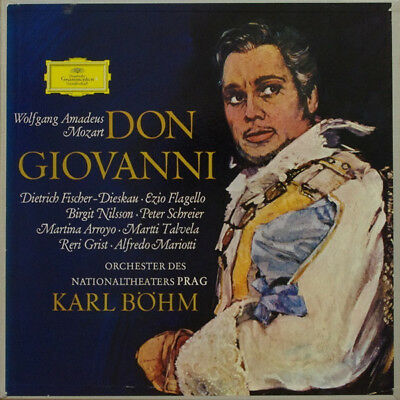
DGG 4-LPs 139-260/63: MOZART - Don Giovanni - Bohm - 1967 TULIPS Stereo GERMANY
C$
50
$
36

Favourite Auctions
To save auctions to your favourites, please login
If you don't have an account, please register
Description
****Welcome to our listing, thanks very much for looking!
****See our own website! We have lots of out of print LPs and CDs! Find us on the web at -
hearthedifference.net
****Please see our other listings - new items added daily!
****Shipping cost is only an estimate - it depends on the actual weight and size of the package as well as the service required. We do not profit from shipping costs, so if we overcharge, we will refund the difference back to you. It's always best to wait for our invoice before paying for your item. We will combine shipping for multiple items purchased.
Background -
Karl Böhm - Born: August 28, 1894 Died: August 14, 1981 Country: AustriaKarl Böhm was one of the greatest conductors of the twentieth century in the German tradition. He studied music as a child and continued to work and study in music while serving in the Austrian Army during World War I -- and while completing a doctorate in law. He coached singers at the Graz Opera and was permitted to conduct a performance of Nessler's Der Trompeter von Sackingen. He never had conducting lessons, but made close studies of the work of both Bruno Walter and Carl Muck.
In 1921 he was hired by the Bavarian State Opera in Munich, and then he became Generalmusikdirektor in both Darmstadt (1927) and Hamburg (1931-1933). He gained a reputation for his fine performances of Mozart, Wagner, and Richard Strauss, as well as his championing of modern German music, including operas by Krenek and Berg. Böhm debuted in Vienna in 1933, leading Wagner's Tristan und Isolde. In 1934 he became director of the Dresden State Opera, Richard Strauss's favorite theater. There, Böhm conducted premieres of Strauss's Die schweigsame Frau (1935) and Dafne (1938). He remained at the helm in Dresden through 1943, at which point he became director of the Vienna State Opera (1943-1945). Richard Strauss was not in official favor, and Joseph Goebbels banned any recognition of the great composer's 80th birthday in 1944. However, Böhm participated in a de facto observance, as a large number of Strauss's orchestral and operatic works "just happened" to be played about the time of the birthday.
After the war, Böhm was forbidden to perform until he underwent "de-Nazification," a procedure whereby prominent Austro-Germans were investigated for complicity in Nazi crimes. He was eventually cleared of any suspicion, and was permitted to resume work in 1947.
Böhm oversaw the German repertory at the Teatro Colón in Buenos Aires (1950-1953), and again served as director of the Vienna State Opera (1954-1956). He debuted in the USA at New York's Metropolitan Opera with Mozart's Don Giovanni in 1957, and took prominent German orchestras and opera companies on tour. The Vienna Philharmonic bestowed on him the title "Ehrendirigent," and he was proclaimed Generalmusikdirector of Austria. He left a legacy of many great recordings, including a complete Wagner Ring cycle considered by many critics to be the best. While his Wagner and Strauss were sumptuously Romantic, his Mozart was scrupulously Classical in approach. - Joseph Stevenson
In his lifetime, Austrian conductor Karl Böhm was acknowledged to be one of the greatest living Mozart conductors. This meant not only frequent appearances throughout the German-speaking world, but also frequent recordings of the standard orchestral and operatic works. In his career, Böhm made two official recordings of Don Giovanni for Deutsche Grammophon: an earlier recording made in Prague with the Orchester des Nationaltheaters Prag featuring German baritone Dietrich Fischer-Dieskau in the title role and a later recording made at the 1977 Salzburg Festival with the Wiener Philharmoniker featuring American baritone Sherrill Milnes. Unfortunately, Böhm's conducting (in the 1977 version) is no where near in the same league as his earlier performance: attacks and releases are less precise, balances and textures are less clear, rhythms and tempos are less cogent, and even the sumptuous playing of the Wiener Philharmoniker is less lovely than the playing of the Orchester des Nationaltheaters Prag. This is not to say that Böhm's conducting is anywhere near as disagreeable as Milnes' singing -- even at his weakest, Böhm is by far the greater musician -- but it is to say that, given the choice of his two official recordings of Don Giovanni, the earlier is much to be preferred. - James Leonard
-
LPs made by DGG (Deutsche Grammophon) Records, in GERMANY
-
LPs released in 1967
-
LPs are recorded in STEREO
-
Record Catalog Number: 139 260/63
-
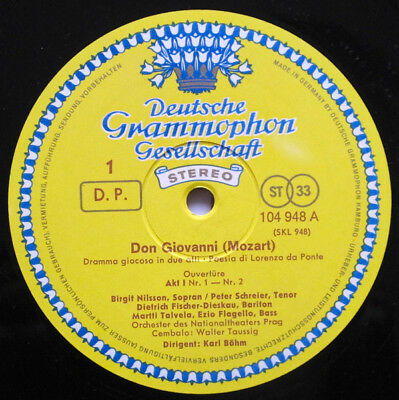
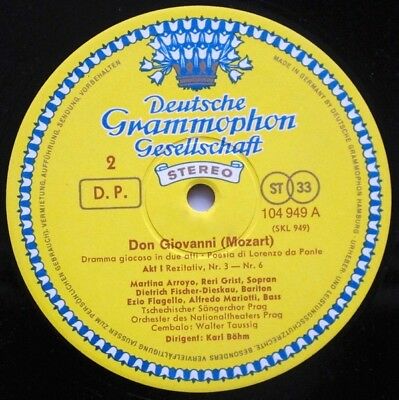
Record Labels are primarily YELLOW with RED & BLUE lettering, with the earliest TULIP labels and DGG logo.
Mozart // Karl Bohm
Don Giovanni
Track Listing -
Mozart: Don Giovanni OperaA. Akt I (1)
B. Akt I (2)
C. Akt I (3)
D. Akt I (4)
E. Akt II (1)
F. Akt II (2)
G. Akt II (3)
H. Akt II (4)
Performers / Credits -
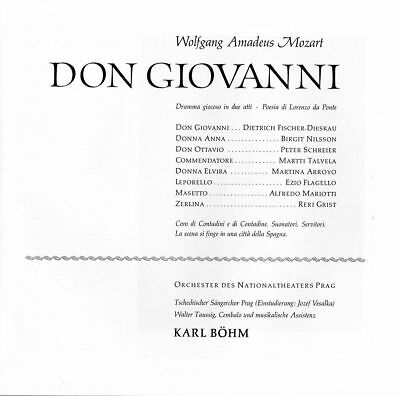
• Baritone Vocals [Don Giovanni] – Dietrich Fischer-Dieskau
• Bass Vocals [Commendatore] – Martti Talvela
• Bass Vocals [Leporello] – Ezio Flagello
• Bass Vocals [Masetto] – Alfredo Mariotti
• Chorus – Tschechischer Sängerchor Prag
• Composed By – W. A. Mozart
• Conductor [Dirigent] – Karl Böhm
• Engineer – Günter Hermans
• Harpsichord [Cembalo] – Walter Taussig
• Libretto By – Lorenzo da Ponte
• Orchestra – Orchester Des Nationaltheaters Prag
• Recording Supervisor – Wolfgang Lohse
• Soprano Vocals [Donna Anna] – Birgit Nilsson
• Soprano Vocals [Donna Elvira] – Martina Arroyo
• Soprano Vocals [Zerlina] – Reri Grist
• Tenor Vocals [Don Ottavio] – Peter Schreier
Other Information -
Face 1 and 8 on a record (104 948), face 2 and 7 on a second record (104 949), Face 3 and 6 on a third record (104950), and face 4 and 5 on a fourth record (104 951).
Recorded at the Supraphon Studios, Prague, in co-production with the Deutsche Grammophon Gesellschaft, 1967
Box contains booklet.
CONDITION Details:
The 4-LP linen-like covered outer box is in very good plus condition! The box has NO splits or crushed corners, but does show some shelf wear, especially along the seams and corners. As well, a tiny bit of the paint/color has been lifted off the front of the box, nothing serious. The colors on the box are sharp (see pictures with this listing as they are of the actual item).
The set comes complete with a large format paper insert/libretto.
The 4-LPs are in near mint minus condition! We found that the vinyl looked superb on this vintage LP set. There are no significant marks and the LPs retain much of the original gloss and sheen - obviously well taken care of! They do have a bit of dust and perhaps a finger print or two on them so they should be cleaned before playing. There are NO serious spindle marks on the record labels either. Just beautifully made vinyl! That said, acquiring a vintage LP like this is for the performance and rarity of the LP, not necessarily for the sound quality. A Short Note About LP GRADING -- Mint = Only used for sealed items.
- Near Mint = Virtually flawless in every way.
- Near Mint Minus = Item has some minor imperfections, some audible.
- Excellent = Item obviously played and enjoyed with some noise.
- Very Good Plus = Many more imperfections which are noticeable and obtrusive.
For best results, always properly clean your LPs before playing them.
The LP is an audiophile quality pressing (any collector of fine MFSL, half speeds, direct to discs, Japanese/UK pressings etc., can attest to the difference a quality pressing can make to an audio system).
Do not let this rarity slip by!
price rating


