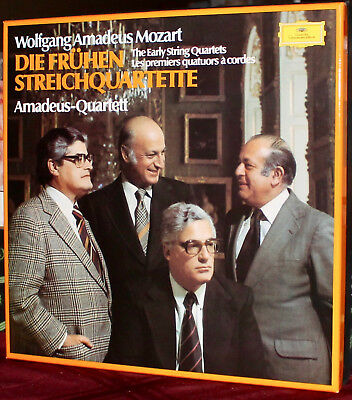
DGG 4-LPs 2740-165: MOZART - Early String Quartets, AMADEUS-QUARTET 1977 GERMANY
C$
60
$
43


C$ 60
Sold For
Feb 21, 2020
Sold Date
Oct 26, 2017
Start Date
1
Number Of Bids
Canada
Country Of Seller
eBay
Sold at
Favourite Auctions
To save auctions to your favourites, please login
If you don't have an account, please register
Description
****Welcome to our listing, thanks very much for looking!
****See our own website! We have lots of out of print LPs and CDs! Find us on the web at -
hearthedifference.net
****Shipping cost is only an estimate - it depends on the actual weight and size of the package as well as the service required. We do not profit from shipping costs, so if we overcharge, we will refund the difference back to you. It's always best to wait for our invoice before paying for your item. We will combine shipping for multiple items purchased.
****Please see our other listings - new items added daily!
****To access our eBay store click on the little red door at the top right section of any of our eBay listings or, click on -
http://stores.ebay.com/Hear-The-Difference
Background -
The Amadeus Quartet (formerly known as the Brainin Quartet) was one of the most famous string quartets of the 20th century. Founded in 1947, the quartet disbanded in 1987 upon the death of Peter Schidlof.The Amadeus Quartet was a world-famous string quartet founded in 1947 and disbanded in 1987, remarkable for having retained its founding members throughout its long history.
Because of their Jewish origin, the violinists Norbert Brainin (12 March 1923 – 10 April 2005), Siegmund Nissel (3 January 1922 – 21 May 2008) and Peter Schidlof (9 July 1922 – 16 August 1987; later violist) were driven out of Vienna after Hitler's Anschluss of 1938. Brainin and Schidlof met in a British internment camp at Prees Heath before being transferred on to the Isle of Man; many Jewish refugees had the misfortune of being confined by the British as "enemy aliens" upon seeking refuge in the UK. Brainin was released after a few months, but Schidlof remained in the camp, where he met Nissel. Finally Schidlof and Nissel were released, and the three of them were able to study with violin teacher Max Rostal, who taught them free of charge. It was through Rostal that they met cellist Martin Lovett, and in 1947 they formed the Brainin Quartet, which was renamed the Amadeus Quartet in 1948.
The group gave its first performance as the Amadeus Quartet at the Wigmore Hall in London on 10 January 1948, underwritten by British composer and conductor Imogen Holst. On 25 January 1983 the Quartet gave a 35th anniversary concert in the same concert hall with a programme which included Beethoven’s String Quartet in C major, op.59 no. 3 (3rd Rasumovsky Quartet). Touring extensively, the Amadeus performed throughout Europe, Canada, the United States, Japan, and South America. Noted for its smooth, sophisticated style, its seamless ensemble playing, and its sensitive interpretation, the quartet made some 200 recordings, among them the complete quartets of Ludwig van Beethoven, Johannes Brahms, and Wolfgang Amadeus Mozart. For concerts as well as recordings of string quintets (Mozart, Franz Schubert, Johannes Brahms, Anton Bruckner) and string sextets (Brahms) they regularly invited Cecil Aronowitz as second viola and William Pleeth as second cello. Though they emphasized a standard Classical and Romantic repertory, they also performed works by such 20th-century composers as Béla Bartók and Benjamin Britten who wrote his third quartet expressly for them.
The Amadeus was one of the most celebrated quartets of the 20th century, and its members were awarded numerous honors, including:
• The Order of the British Empire, presented by the Queen.
• Doctorates from the Universities of London, York, and Caracas.
• The highest of all German awards, the Great Cross of Merit.
• The Austrian Cross of Honour for Arts and Sciences.
The quartet disbanded in 1987 upon the death of the violist Peter Schidlof, who was regarded as irreplaceable by the surviving members. Brainin died on 10 April 2005[2] and Nissel on 21 May 2008. Only Lovett survives.
Norbert Brainin, OBE (12 March 1923 in Vienna – 10 April 2005 in London) was the first violinist of the Amadeus Quartet, one of the world's most highly regarded string quartets.
Because of Brainin's Jewish origin, he was driven out of Vienna after Hitler's Anschluss of 1938, as were the violinist Siegmund Nissel and violinist Peter Schidlof. Brainin and Schidlof met in a British internment camp. Like many Jewish refugees they had the misfortune to be confined by the British as "enemy aliens" after reaching the UK.
Brainin was released after a few months, but Schidlof remained in the camp, where he met Nissel. Finally Schidlof and Nissel were released, and the three of them were able to study with violin pedagogue Max Rostal, who taught them free of charge. It was through Rostal that they met cellist Martin Lovett, and in 1947 they formed the Brainin Quartet, which was renamed as the Amadeus Quartet in 1948.
The quartet disbanded in 1987 upon the death of Schidlof, who was regarded as irreplaceable by the surviving members. Norbert Brainin continued to perform as a soloist, often performing with pianists Günter Ludwig and Maureen Jones. In 1992, Brainin performed a benefit concert in Washington, D.C. for then-jailed presidential candidate Lyndon LaRouche.
His instruments included the "Rode" Guarnerius del Gesu of 1734, the "Chaconne" Stradivarius of 1725 and the "Gibson" Stradivarius of 1713.
Siegmund Walter "Sigi" Nissel OBE (3 January 1922, Munich – 21 May 2008, London) was an Austrian-born British violinist who played second violin in the Amadeus Quartet and served as its administrator.
Sigi Nissel was born in Munich to a Jewish family from Vienna. He began playing the violin at the age of 6. His mother died when he was 9. He was taken by his father to Vienna, where his teachers included Max Weissgärber. Nissel was evacuated from Vienna in 1938 to Great Britain.
During World War II, Nissel was interned as a "friendly enemy alien" in Onchan Camp on the Isle of Man where he met the violist Peter Schidlof and later the violinist Norbert Brainin. With the British cellist, Martin Lovett, they would form the Amadeus Quartet.
The Amadeus Quartet, informally known as the Wolf Gang, gave its first concert in London in 1948. The Amadeus Quartet made some 200 recordings, among them the complete quartets of Beethoven, Brahms, and Mozart and works by 20th-century composers such as Béla Bartók and Benjamin Britten (who wrote his third quartet for them).
Nissel played the "Payne" Stradivarius of 1731.
Following the death of Schidlof from a heart attack in 1987, the Amadeus Quartet disbanded. Nissel became a teacher of young quartets at the Royal Academy of Music.
Peter Schidlof OBE (9 July 1922 – 16 August 1987) was an Austrian-British violist and co-founder of the Amadeus Quartet.
Born in Vienna, Schidlof fled Austria for England following the Nazi Anschluss in 1938. He won a scholarship to Blundell's School in Devon. Following the start of World War II in September 1939 and enactment of Defence Regulation 18B, he was interned in Onchan Internment Camp on the Isle of Man as an enemy alien. It was while he was interned that he first met Norbert Brainin and Siegmund Nissel. After years of internment, like Brainin and Nissel, Schidlof became a pupil of Max Rostal, and it was Rostal who became the mentor of the Amadeus and persuaded Schidlof, who had been a violinist, to become a viola player. With Martin Lovett as cellist, the Amadeus gave their first concert at the Wigmore Hall in 1948. Schidlof’s separate contribution to the Amadeus is difficult to assess, so much were the four a team, although his nickname "Eagle ears" shows his particular insistence on technical accuracy. His calm, questing manner and his close knowledge of a wide range of music beyond the chamber music repertory, combined with his cultivated and kind manner as a person, were an important part of the quartet's alchemy.
Schidlof's playing was noted for its warm, sensitive and rich tone. This was also clear in his solo playing away from the Amadeus. Brainin and he often came together for Mozart's Sinfonia Concertante. Schidlof performed solos on many occasions in Harold en Italie, where he characterised the solo part with a keen sense of Berliozian romanticism. He was always ready and willing to tackle contemporary work, and gave several premieres.
The quartet gave their first performance as the Amadeus Quartet in London on 10 January 1948. Touring extensively, the Amadeus performed throughout Europe, Canada, the United States, Japan, and South America. The quartet made some 200 recordings, among them the complete quartets of Ludwig van Beethoven, Johannes Brahms, and W.A. Mozart. Though they emphasized a standard Classical and Romantic repertory, they also performed works by such 20th-century composers as Béla Bartók and Benjamin Britten (who wrote his third quartet expressly for them). The group disbanded upon the death of Schidlof in 1987.
He played for many years on the "MacDonald" Stradivarius of 1701 as well as owning fine examples by Testore and Bergonzi.
Schidlof died in 1987 in Cumbria, England.
Martin Lovett OBE (born 3 March 1927) is an English cellist, known as the cellist with the Amadeus Quartet.
When he was 11, his father, a cellist with the London Philharmonic Orchestra, gave him his first lessons. At 15, he won a scholarship to the Royal College of Music in London. He joined the Amadeus Quartet at the age of 19, in 1947. They remained together for 40 years, until the death of violist Peter Schidlof in 1987, when they decided to disband.
Since the end of the Amadeus Quartet, Martin Lovett has been much in demand for performances with various chamber music groups including the Amadeus Ensemble. He gives chamber music courses all over the world. The Amadeus Summer Course, held each year at the Royal Academy of Music in London, is a highlight of this activity.
A fellow of the Royal Society of Arts, he also acts as a judge in many international chamber music competitions.
In the stereo era, before digital, there were two great sets of recordings of Mozart's string quartets: the Quartetto Italiano's for Philips and the Amadeus Quartet's for Deutsche Grammophon. The Italian quartet's performances were rich and ripe, lush and lovely, sweet and sensual; the Austrian-English quartet's performances are sensitive but intense, controlled but soulful, intimate but objective. Where the Quartetto Italiano saw Mozart's music from one point of view, the Amadeus Quartet took a more nuanced view, showing more sides of the composer, and arguably more depth. Technically, the Amadeus' players are just as fine as the Italiano's but naturally quite different; their tone is more pungent, their balances less blended, and their rhythms more buoyant than their counterparts. The Amadeus set has a distinct advantages over the Italians, however: that set includes the three Divertimentos K. 136-138. Sonically, it's a toss-up; Philips gives the Italiano quartet its trademark opulent stereo sound, while DG gives the Amadeus players their trademark crystalline stereo sound. - James Leonard
-
LPs made by DGG (Deutsche Grammophon) Records, in GERMANY
-
LPs released in 1977
-
LPs are recorded in STEREO
-
Record Catalog Number: 2740-165
-
Record Labels are primarily YELLOW with BLACK lettering.
Mozart // Amadeus-Quartett
The Early String Quartets (Die Frühen Streichquartette)
Tracks -
String Quartet In G Major, K. 80A1 1. Adagio 4:52
A2 2. Allegro 3:10
A3 3. Menuetto - Trio 3:03
A4 4. Rondeau 2:10
Divertimento In D Major, KV 136
A5 1. Allegro 3:56
A6 2. Andante 4:35
A7 3. Presto 2:35
Divertimento In B Flat Major, KV 137
B1 1. Andante 4:15
B2 2. Allegro Di Molto 2:20
B3 3. Allegro Assai 1:41
Divertimento In F Major, KV 138
B4 1. (Allegro) 3:28
B5 2. Andante 3:07
B6 3. (Presto) 1:46
String Quartet In D Major, K. 155
C1 1. (Allegro) 3:45
C2 2. Andante 3:35
C3 3. Molto Allegro 1:15
String Quartet In G Major, K. 156
C4 1. Presto 2:53
C5 2. Adagio 3:44
C6 3. Tempo Di Menuetto 3:49
String Quartet In C Major, K. 157
D1 1. (Allegro) 3:33
D2 2. Andante 4:39
D3 3. (Presto) 1:50
String Quartet In F Major, K. 158
D4 1. Allegro 3:23
D5 2. Andante Un Poco Allegretto 4:15
D6 3. Tempo Di Menuetto 6:29
String Quartet In B Flat Major, K. 159
E1 1. Andante 4:51
E2 2. Allegro 5:52
E3 3. Rondò: Allegro Grazioso 2:24
String Quartet In E Flat Major, K. 160
E4 1. Allegro 3:06
E5 2. Un Poco Adagio 4:21
E6 3. Presto 2:38
String Quartet In F Major, K. 168
F1 1. Allegro 4:15
F2 2. Andante 5:04
F3 3. Menuetto - Trio 2:18
F4 4. Allegro 1:45
String Quartet In A Major, K. 169
F5 1. Molto Allegro 3:28
F6 2. Andante 5:15
F7 3. Menuetto - Trio 2:34
F8 4. Rondeaux: Allegro 1:27
String Quartet In C Major, K. 170
G1 1. Andante 4:31
G2 2. Menuetto - Trio 2:23
G3 3. Un Poco Adagio 3:26
G4 4. Rondeaux: Allegro 2:13
String Quartet In E Flat Major, K. 171
G5 1. Adagio – Allegro Assai – Adagio 5:14
G6 2. Menuetto - Trio 2:29
G7 3. Andante 4:06
G8 4. Allegro Assai 2:39
String Quartet In B Flat Major, K. 172
H1 1. Allegro Spiritoso 3:50
H2 2. Adagio 4:22
H3 3. Menuetto - Trio 2:45
H4 4. Allegro Assai 3:15
String Quartet In D Minor, K. 173
H5 1. Allegro Mà Molto Moderato 5:02
H6 2. (Andantino Grazioso) 3:46
H7 3. Menuetto - Trio 3:40
H8 4. (Allegro) 3:10
Performers / Credits -
• Artwork – Martin Engelbrecht, Saverio dalla Rosa
• Composed By – Wolfgang Amadeus Mozart
• Edited By – Wolfgang Toepffer
• Layout – Peter Schuppe
• Liner Notes – Hans Keller, Wolfgang Plath
• Liner Notes, Interviewer – Steven Paul
• Performer, Cello – Martin Lovett
• Performer, Viola – Peter Schidlof
• Performer, Violin [1.] – Norbert Brainin
• Performer, Violin [2] – Siegmund Nissel
• Photography By [Amadeus Quartet] – Reinhart Wolf
• Photography By [Box-Cover] – Werner Neumeister
• Producer – Günther Breest
• Recording Supervisor, Engineer [Recording] – Wolfgang Mitlehner
CONDITION Details:
The 4-LP box is in near mint minus condition! The box has NO splits or crushed corners - just gorgeous! The corners and seams are solid with just some light shelf wear. The colors on the box are sharp and clean (see pictures with this listing as they are of the actual item).
The set comes complete with a 14-page, large format color paper insert/libretto.
The 4-LPs are in near mint minus condition! We found that the vinyl looked superb on this vintage LP set. There are no significant marks and the LPs retain much of the original gloss and sheen - obviously well taken care of! They do have a bit of dust and perhaps a finger print or two on them so they should be cleaned before playing. There are NO serious spindle marks on the record labels either. Just beautifully made vinyl! That said, acquiring a vintage LP like this is for the performance and rarity of the LP, not necessarily for the sound quality. A Short Note About LP GRADING -- Mint = Only used for sealed items.
- Near Mint = Virtually flawless in every way.
- Near Mint Minus = Item has some minor imperfections, some audible.
- Excellent = Item obviously played and enjoyed with some noise.
- Very Good Plus = Many more imperfections which are noticeable and obtrusive.
For best results, always properly clean your LPs before playing them.
The LP is an audiophile quality pressing (any collector of fine MFSL, half speeds, direct to discs, Japanese/UK pressings etc., can attest to the difference a quality pressing can make to an audio system).
Don't let this rarity slip by!!!
price rating




![The Roulettes [UK] - Rhyme Boy, Rhyme / Airport People U.K. 7](https://www.popsike.mobi/php/thumbnail.php?url=https://www.popsike.pics/pix/20200731/224100844923.jpg)