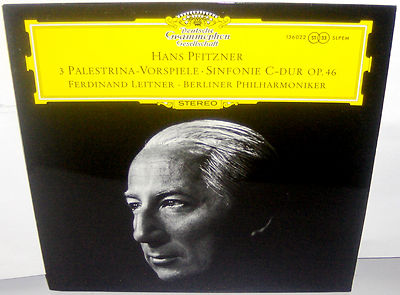
DGG LP 136 022: Hans PFITZNER - Palestrina & Sym. in C - Leitner - OOP, 1960s NM
$
50


$ 50
Sold For
Feb 28, 2013
Sold Date
Jan 11, 2012
Start Date
1
Number Of Bids
Canada
Country Of Seller
eBay
Sold at
Favourite Auctions
To save auctions to your favourites, please login
If you don't have an account, please register
Description
****Welcome to our eBay listing, thanks very much for looking!
****Free Shipping to the USA and CANADA - all other locations are subject to a reasonable shipping fee.
****Please check out our other eBay store listings and eBay auctions for more great LPs and CDs - new items added daily!
****To access our eBay store either click on the little red door at the top right section of any of our eBay listings or, click on -
http://stores.ebay.com/Hear-The-Difference
Background on this eBay item -
Hans Erich Pfitzner (5 May 1869 – 22 May 1949) was a German composer and self-described anti-modernist. His best known work is the post-Romantic opera Palestrina, loosely based on the life of the great sixteenth-century composer Giovanni Pierluigi da Palestrina.Pfitzner was born in Moscow, Russia, where his father played violin in a theater orchestra. The family returned to his father's native Frankfurt in 1872 when Pfitzner was two years old, and he always considered Frankfurt his home town. He received early instruction in violin from his father, and his earliest compositions were composed at age 11. In 1884 he wrote his first songs. From 1886 to 1890 he studied composition with Iwan Knorr and piano with James Kwast at the Hoch Conservatory in Frankfurt. (He later married Kwast's daughter Mimi Kwast, a grand-daughter of Ferdinand Hiller, after she had rejected the advances of Percy Grainger.) He taught piano and theory at the Koblenz Conservatory from 1892 to 1893. In 1894 he was appointed conductor at the Stadttheater in Mainz where he worked for a few months. These were all low-paying jobs, and Pfitzner was working as Erster (First) Kapellmeister with the Berlin Theater des Westens when he was appointed to a modestly prestigious post of opera director and head of the conservatory in Straßburg (Strasbourg) in 1908, when Pfitzner was almost forty.
In Strasbourg, Pfitzner finally had some professional stability, and it was there he gained significant power to direct his own operas. He viewed control over the stage direction to be his particular domain, and this view was to cause him particular difficulty for the rest of his career. The central event of Pfitzner's life was the annexation of Imperial Alsace - and with it Strasbourg - by France in the aftermath of World War I. Pfitzner lost his livelihood and was left destitute at age 50. This hardened several difficult traits in Pfitzner's personality: an elitism believing he was entitled to sinecures for his contributions to German art and for the hard work of his youth, notorious social awkwardness and a lack of tact, a sincere belief that his music was under-recognized and under-appreciated with a tendency for his sympathizers to form cults around him, a patronizing style with his publishers, and a feeling that he had been personally slighted by Germany's enemies (Kater, 146). His bitterness and cultural pessimism deepened in the 1920s with the death of his wife in 1926 and meningitis of his older son Paul, who was committed to institutionalized medical care.
Palestrina is an opera by the German composer Hans Pfitzner, first performed in 1917. The composer referred to it as a Musikalische Legende (musical legend), and wrote the libretto himself, based on a legend about the Renaissance musician Giovanni Pierluigi da Palestrina, who saves the art of contrapuntal music (polyphony) for the Church in the sixteenth century, through his composition of the Missa Papae Marcelli. The wider context is that of the European Reformation and the role of music in relation to it. The character of Cardinal Borromeo is depicted, and a General Congress of the Council of Trent is the centre piece of Act II.
The conductor of the premiere was Bruno Walter. On 16 February 1962, the day before he died, Walter ended his last letter with: "Despite all the dark experiences of today I am still confident that Palestrina will remain. The work has all the elements of immortality".
Ferdinand Leitner (4 March 1912 in Berlin – 3 June 1996 in Zürich) was a German conductor. Leitner studied under Franz Schreker, Julius Prüwer, Artur Schnabel and Karl Muck. He also was a composition student with Robert Kahn. Starting as a pianist, through the help of Fritz Busch, he became a conductor in the 1930s. He was conductor of the Nollendorfplatz Theater in Berlin from 1943 to 1945; in Hannover from 1945 to 1946; in Munchen from 1946 to 1947; and starting in 1947 the General Music Director of the Württemberg State Opera in Stuttgart.
He is famous as a conductor of opera. He succeeded Erich Kleiber in 1956 as conductor for the Teatro Colón in Buenos Aires. From 1976 to 1980, he worked in The Hague as principal conductor of Het Residentie Orkest.
-
DGG (Deutsche Grammophon) RECORDS LP item - YELLOW record labels with RED and Blue lettering. The labels have the famous Blue and White Tulips indicating that this record is of the earliest vintage DGG LPs possible.
-
Records Made in: GERMANY
-
Pressing is in STEREO
-
Record Speed: 33 1/3 rpm
-
Long out of print
-
Record Made / issued in the 1960's on high quality, very heavy vinyl.
-
Record Catalog Number: 136 022 SLPEM
Music Featured on this item:
Hans PFITZNER
Music on this LP Title:
Palestrina
Symphony in C Major, Op. 46
Performed By -Ferdinand Leitner, conductor
Berlin Philharmonic
CONDITION Details:
LP JACKET:-
The JACKET is in Near Mint minus condition!
-
The jacket is completely intact with NO seam splits! Have a close look at the pictures and you will see the outstanding condition of this item.
-
The jacket has NO drill holes or saw marks of any kind.
-
There is NO hand writing on the front, inside or the back of the jacket.
-
The cover has clean and sharp colors - see pictures with this listing for more detail.
-
The LP is in near MINT minus condition!! - A finer copy of this vintage LP would be very difficult to find.
-
The LP retains much of the original gloss and sheen!
-
The record has NO serious marks on it, obviously well taken care of.
-
The record labels have NO significant spindle marks on them.
-
This is the superb copy you have always wanted in your collection - any super picky audiophile should be happy with this one!
-
This LP does have some light marks (spider marks mostly) which are caused by sliding the LP in and out of the inner sleeve and are usually not audible on most audio systems - as for any record, even brand new ones, for best results we recommend a thorough record cleaning before playing!
A Short Note About LP GRADING -
- Mint = Only used for sealed items.
- Near Mint = Virtually flawless in every way.
- Near Mint Minus = Item has some minor imperfections, some audible.
- Excellent = Item obviously played and enjoyed with some noise.
- Very Good Plus = Many more imperfections which are noticeable and obtrusive.
price rating