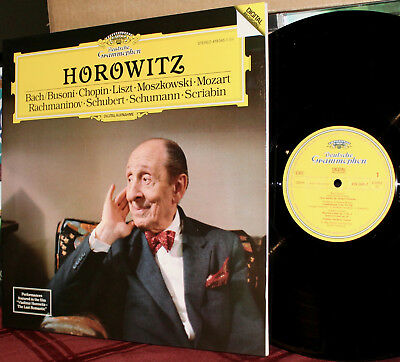
DGG LP 419-045-1: HOROWITZ - Bach/Busoni, Chopin, Liszt, Mozart, ++ 1985 GERMANY
$
50

$ 50
Sold For
Jan 23, 2021
Sold Date
Jan 17, 2018
Start Date
1
Number Of Bids
USA
Country Of Seller
eBay
Sold at
Favourite Auctions
To save auctions to your favourites, please login
If you don't have an account, please register
Description
****Welcome to our listing, thanks very much for looking!
****See our own website! We have lots of out of print LPs and CDs! Find us on the web at -
hearthedifference.net
****Shipping cost is only an estimate - it depends on the actual weight and size of the package as well as the service required. We do not profit from shipping costs, so if we overcharge, we will refund the difference back to you. It's always best to wait for our invoice before paying for your item. We will combine shipping for multiple items purchased.
****Please see our other listings - new items added daily!
****To access our eBay store click on the little red door at the top right section of any of our eBay listings or, click on -
http://stores.ebay.com/Hear-The-Difference
Background -
Vladimir Samoylovich Horowitz (October 1 [O.S. September 18] 1903 – November 5, 1989) was a Russian-born American classical pianist and composer. He was acclaimed for his virtuoso technique, his tone color, and the excitement engendered by his playing. He is recognized as one of the greatest pianists of all time.Vladimir Horowitz was born in Kiev the capital of Ukraine (at that time part of the Russian Empire). There are unsubstantiated claims that Horowitz was born in Berdychiv; however, his birth certificate unequivocally states Kiev as his birthplace.
Horowitz was the youngest of four children of Samuil Horowitz and Sophia Bodik, who were assimilated Jews. Samuil was a well-to-do electrical engineer and a distributor of electric motors for German manufacturers. Horowitz's grandfather Joachim was a merchant (and an arts-supporter), belonging to the 1st Guild. This status gave exemption from having to reside in the Pale of Settlement. Horowitz was born in 1903, but in order to make him appear too young for military service so as not to risk damaging his hands, his father took a year off his son's age by claiming he was born in 1904. The 1904 date appeared in many reference works during the pianist's lifetime.
Horowitz's uncle, Alexander, was a pupil and close friend of Alexander Scriabin. As a 10-year-old boy, it was arranged for Horowitz to play for Scriabin, who afterwards informed his parents that he was extremely talented.
Horowitz received piano instruction from an early age, initially from his mother, who was herself a pianist. In 1912 he entered the Kiev Conservatory, where he was taught by Vladimir Puchalsky, Sergei Tarnowsky, and Felix Blumenfeld. His first solo recital was in Kharkiv in 1920.
Horowitz's fame grew, and he soon began to tour Russia where he was often paid with bread, butter and chocolate rather than money, due to the country's economic hardships caused by the Civil War. During the 1922–1923 season, he performed 23 concerts of eleven different programs in Petrograd alone. Despite his early success as a pianist, Horowitz maintained that he wanted to be a composer and undertook a career as a pianist only to help his family, who had lost their possessions in the Russian Revolution.
In December 1925, Horowitz immigrated to the West, ostensibly to study with Artur Schnabel in Berlin. Privately intending not to return, the 22-year-old pianist had stuffed American dollars and British pound notes into his shoes to finance his initial concerts.
On December 18, 1925, Horowitz made his first appearance outside his home country, in Berlin. He later played in Paris, London, and New York City. Horowitz was selected by Soviet authorities to represent Ukraine in the inaugural 1927 International Chopin Piano Competition in independent Poland; however, the pianist had decided to stay in the West and thus did not participate.
Horowitz gave his United States debut on January 12, 1928, in Carnegie Hall. He played Tchaikovsky's Piano Concerto No. 1 under the direction of Sir Thomas Beecham, who was also making his U.S. debut. Horowitz later commented that he and Beecham had divergent ideas regarding tempos, and that Beecham was conducting the score "from memory and he didn't know" the piece. Horowitz's rapport with his audience was phenomenal. Olin Downes, writing for The New York Times, was critical about the metric tug of war between conductor and soloist, but Downes credited the pianist with both a beautiful singing tone in the second movement and a tremendous technique in the finale, referring to Horowitz's playing as a "tornado unleashed from the steppes". In this debut performance, Horowitz demonstrated a marked ability to excite his audience, an ability he maintained for his entire career. As Downes commented, "it has been years since a pianist created such a furor with an audience in this city." In his review of Horowitz's solo recital, Downes characterized the pianist's playing as showing "most if not all the traits of a great interpreter." In 1933, he played for the first time with the conductor Arturo Toscanini in a performance of Beethoven's Piano Concerto No. 5 Emperor. Horowitz and Toscanini went on to perform together many times, on stage and in recordings. Horowitz settled in the U.S. in 1939, and became an American citizen in 1944. He made his television debut in a concert taped at Carnegie Hall on February 1, 1968, and broadcast nation wide by CBS on September 22 of that year.
Despite rapturous receptions at recitals, Horowitz became increasingly unsure of his abilities as a pianist. On several occasions, the pianist had to be pushed onto the stage. Several times, he withdrew from public performances – during 1936 to 1938, 1953 to 1965, 1969 to 1974, and 1983 to 1985.
A pianist of legendary fame and stature, Vladimir Horowitz was born in Kiev, Ukraine. His mother, herself a professional pianist, provided his first instruction at the piano and was the first to recognize his extraordinary talents; he studied further at the Kiev Conservatory. His first public appearance was a recital in Kiev on May 30, 1920, and in 1922 he gave a series of 15 concerts in Kharkov for which he was paid in food and clothing. Although Russia was still reeling from the revolution of 1917, Horowitz fashioned successful concert tours in major cities such as Moscow, Leningrad, and Kiev -- marking the beginning of a performing career of unflagging and spectacular success.
His first international appearance came with his 1926 trip to Berlin, soon after which followed concerts in Paris, London, and New York. Further appearances in the United States solidified his reputation as an exceptional virtuoso, and the country which was to become his adopted home embraced him warmly. He was invited to the White House to play for President Hoover in 1931, and in 1933 he married Wanda Toscanini -- the daughter of the famous conductor Arturo Toscanini, who would soon conduct Horowitz and the New York Philharmonic Orchestra in performances of the Beethoven piano concertos. Horowitz permanently settled in the United States in 1940 and achieved citizenship in 1944.
Wanda Toscanini assumed a gentle stewardship of her new husband, who was in fragile physical and emotional health. Often seized with an irrational fear of failure, Horowitz found the life of touring threatening to his equilibrium. He withdrew from the concert stage for several periods during his life, and made only rare appearances after 1970. When Horowitz did schedule a concert, it often took the persuasive powers of his wife and friends to keep him from canceling at the last minute. His nagging, and often overpowering, insecurity led him to seek shock therapy in 1973, but though he seemed to achieve some benefit from treatment, he was never free of anxiety when playing in public. The one exception to this trend was when he appeared as accompanist to another artist, which he often did with baritone Dietrich Fischer-Dieskau, cellist Mstislav Rostropovich, and violinist Isaac Stern. Because of his long absences from the concert stage, Horowitz's popularity was largely sustained by his recordings.
Perhaps the most significant single event in Horowitz's long career was his long-overdue return to the Soviet Union (his first since his departure in the 1920s) for a series of concerts in 1986. The resulting tour became a major political event, coinciding as it did with an era of new understanding between the United States and the Soviet Union, and it resonated powerfully with Soviet audiences. Revitalized by the Soviet tour, Horwowitz signed a new contract with Sony; the contract included provisions for recording him at home on his favorite piano. He made his last such recording on November 1, 1989; on November 5 he died of a massive heart attack.
As a performer, Horowitz had huge resources of speed and power, and a clean articulation. His performances were brilliant, exciting, and often mystifying to those who found his technique enigmatic (he played, for instance, with unusually straight fingers, laying them nearly flat on the keys). Though his performances were frequently criticized for their willfulness and self-indulgent nature, there was an undeniable charisma to his playing that endeared him to most everyone who heard him. - Rovi Staff
The Last Romantic is a documentary filmed within the home of concert pianist Vladimir Horowitz. The film contains mainly performances of classical works, but also provides an intimate look into Horowitz's private life.
The Last Romantic is a documentary filmed at Vladimir Horowitz's townhouse on the Upper East Side of New York. It features many performances of some of the pieces of Horowitz's favorite repertoire and sheds light on his thoughts and opinions on music.
During the film Horowitz often jokes and talks about his favorite composers: his friend Sergei Rachmaninoff, Frédéric Chopin, and Alexander Scriabin. Horowitz's wife, Wanda, also contributes her share to the discussions; she shows photo albums and reminisces about their past.
Much of the mystique surrounding the name of Vladimir Horowitz is due to his well-publicized withdrawals from the public arena, but to date, unlike Garbo, he has always reappeared, and playing much the same repertoire, as this disc testifies. This release marks the first of a series of recordings for DG and it is taken from the sound-track of a video on Horowitz, which was recorded at his Manhattan home in April 1985. In an immaculate recording that tends to expose the thin and rather uneven quality of the treble register on Horowitz's pet old Steinway, one can hear all of those familiar pianistic tricks, the highly idiosyncratic and illusionary pedallings and the fleet fingerwork that amounts almost to a sleight-of-hand. Whilst it is true that the 80-year-old pianist cannot avoid moments of technical clumsiness, especially in the two larger Chopin pieces, the overall effect is one of a nervous youthful brio combined with introspective sensitivity. His old-school approach to the piano ensures that the broad lines of the music are always preserved.
There are only two items here that Horowitz has not previously recorded: the Mozart sonata and the Schumann. It is especially the Mozart that highlights the deficiencies of his much-travelled instrument, but perhaps the magically light passagework of the finale could not have been achieved on a more modern grand. Schumann's Novellette can be classed as vintage Horowitz; the grandiloquent majesty of the opening chords comes across without the slightest affectation, and there is more in the way of emotional involvement here than in the larger Chopin works with their melodramatically extravagant climaxes.
It is nice to hear Horowitz reviving the Bach/Busoni arrangement, which he last recorded in 1947 (RCA DM1284—nla); here we have a melody phrased with that joinless type of legato that eludes the majority of today's pianists. The Schubert Impromptu (the one in descending broken chords) may set off at rather a deliberate pace and be undermined by various bars being played out of time, but Horowitz's poise allows the interpretation to achieve a transparency that heightens the effect of innocence. From the stylistic point of view it is certainly the two Russian pieces and the Liszt that are the prize items.
Having praised the superb quality of the sound, I must voice a reservation: at the beginning of the infamous left-hand octave episode in the Polonaise the timbre of the piano alters radically, and I suspect this could be due to some less-than-expert editing—it is a temporary disturbance that I could have done without. The recital ends with the Moszkowski Etude (not the one in A flat that he has also recorded) and it is a little unrhythmical, but contains enough of the Horowitz diablerie and wit to leave one amazed at his wholly unique artistry, and the extent to which this has been preserved. After all, how many major pianists are there active today who were born in the pre-First-World-War era? Perlemuter, Horszowski and Arrau spring to mind, but none of these has quite the same legendary status as Horowitz. -- James Methuen-Campbell, Gramophone [5/1986]
The career of Vladimir Horowitz had many ups and downs. When he retired after a series of disastrous concerts in 1983, very few thought he would ever play again. It was learned that Horowitz was off his game during that time due to anti-depressant medication which affected his memory and coordination. Horowitz dropped the medications in 1984, and spent much of that year enduring withdrawal symptoms. He didn't begin practicing again until late-1984.
By 1985, he felt well enough to begin performing again, but didn't want to immediately face a live audience. It was decided that a documentary would be made, and thus "Vladimir Horowitz: The Last Romantic," filmed in the pianist's townhouse, came to fruition. The performances in this CD are taken from that film, although in some cases different takes were used.
Horowitz, 81 years young at the time, plays well here - although his performance is not quite on the same level it would be one year later at his legendary Moscow recital. The Bach-Busoni Chorale, Mozart Sonata, and Schumann Novelette reveal the playing of a grand master in sovereign command of his resources. The Bach-Busoni is especially noteworthy for Horowitz's ability to separate musical lines. The Chopin Mazurka and Liszt Consolation are wonderfully poetic, and the Rachmaninoff Prelude is appropriately brooding.
It must be admitted however, some of the more bravura pieces do not match his best playing from earlier years. The Chopin Scherzo betrays hints of frailty (although some of the tempos are astonishing), and the "Heroic" Polonaise is taken at a rather cautious tempo. Any doubt about the coordination of Horowitz's fingers, however, will be banished by the Moszkowski Etude. Lightning fast, with very little pedal, the pianist reportedly did it in one take. The sound is rather airless and confined, but clean and focused. - T. Drake
-
LP made by DGG (Deutsche Grammophon), in GERMANY
-
LP released in 1985
-
LP is recorded in STEREO (Digital)
-
Record Catalog Number: 419 045-1
-
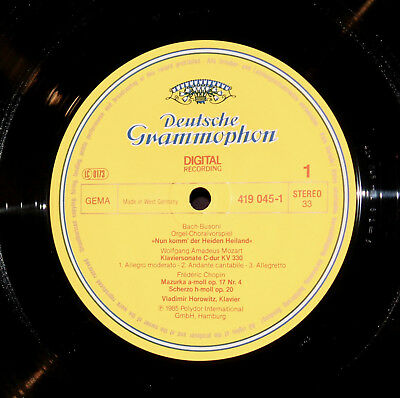
Record Labels are primarily YELLOW with RED, BLUE & GOLD lettering, featuring the DGG Records logo on the record labels, with "Made in West Germany" at the 9 o'clock position.
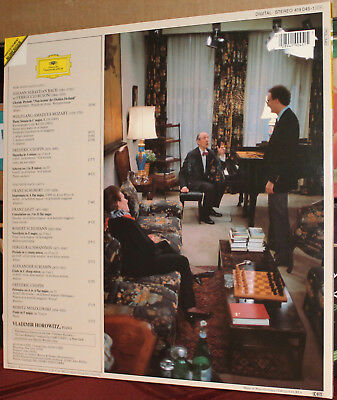
- ——Sleeve Info——
Performances featured in the film "Vladimir Horowitz — The Last Romantic" (released by Cami Video — a Peter Gelb presentation of a Maysles Brothers film)
Digital Recording - Digital-Aufnahme
Recording: New York, 4/1985
Publisher: A. Gutheil / Boosey & Hawkes (Rachmaninov)
? 1985 Polydor International Gmbh, Hamburg · © 1985 John Pfeiffer
Photos: Copyright 1985
Printed in West Germany by / Imprimé en RFA par Münstermann-Druck KG, Hannover
Made in West Germany / Fabriqué en RFA
-—
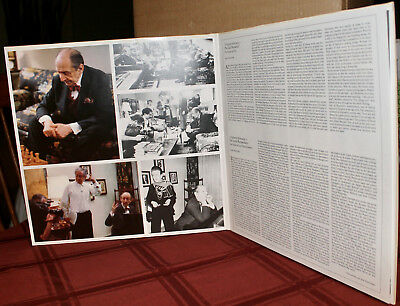
Gate-Fold sleeve, liner notes in English, translated in German, French and Italian
Spine: Digital · Stereo Horowitz 419 045-1 GH
——Center Labels info——
Made in West Germany
-—
Label Design: Yellow Labels, with Blue, Red and Gold lettering - straight borders; German / English copyright message in gold, at 1-12 o'clock 'Alle Urheber-"; no star on bottom; flat borders (not embossed)
• Bar code: 0 28941 90451 5
• Label Code: LC 0173
• Rights Society: GEMA
• Matrix / Runout (Runout side A): 419 045 — 1 S 1 = 3 320 ??? (Can’t read)
• Matrix / Runout (Runout side B): 419 045 — 1 S 2 = 4 320 2·1A
• Other (Distribution code (France)): POL 640
• Other (Distribution code): GH
• Printed By – Münstermann-Druck KG, Hanover
• Phonographic Copyright (p) – Polydor International GmbH
• Copyright (c) – John Pfeiffer
• Published By – Ed. A. Gutheil
• Published By – Boosey & Hawkes
• Lacquer Cut At – PRS Hannover
Vladimir Horowitz
LP Title and Music on this rare LP -Horowitz - Performances Featured In The Film "Vladimir Horowitz - The Last Romantic"
1. Sonata for Piano no 10 in C major, K 330 (300h) by Wolfgang Amadeus Mozart
Performer: Vladimir Horowitz (Piano)
Period: Classical
Written: 1781-1783
2. Nun komm, der Heiden Heiland, BWV 659 by Johann Sebastian Bach
Performer: Vladimir Horowitz (Piano)
Period: Baroque
Written: by 1723; ?Weimar, Germany
Notes: Transcribed: Ferruccio Busoni
3. Mazurkas (4) for Piano, B 77/Op. 17: no 4 in A minor by Frédéric Chopin
Performer: Vladimir Horowitz (Piano)
Period: Romantic
Written: 1832-1833; Paris, France
4. Scherzo for Piano no 1 in B minor, B 65/Op. 20 by Frédéric Chopin
Performer: Vladimir Horowitz (Piano)
Period: Romantic
Written: 1831-1832; Poland
5. Polonaise for Piano in A flat major, B 147/Op. 53 "Heroic" by Frédéric Chopin
Performer: Vladimir Horowitz (Piano)
Period: Romantic
Written: 1842; Paris, France
6. Impromptus (4) for Piano, D 899/Op. 90: no 4 in A flat major by Franz Schubert
Performer: Vladimir Horowitz (Piano)
Period: Romantic
Written: 1827; Vienna, Austria
7. Consolations (6) for Piano, S 172: no 3 in D flat major, Lento placido by Franz Liszt
Performer: Vladimir Horowitz (Piano)
Period: Romantic
Written: 1849-1850; Weimar, Germany
8. Novelletten (8) for Piano, Op. 21: no 1 in F major by Robert Schumann
Performer: Vladimir Horowitz (Piano)
Period: Romantic
Written: 1838; Germany
9. Preludes (13) for Piano, Op. 32: no 12 in G sharp minor, Allegro by Sergei Rachmaninov
Performer: Vladimir Horowitz (Piano)
Period: Romantic
Written: 1910; Russia
10. Pieces (3) for Piano, Op. 2: no 1, Etude in C sharp minor by Alexander Scriabin
Performer: Vladimir Horowitz (Piano)
Period: 20th Century
Written: 1887-1889; Russia
11. Etudes (15) de virtuosité, Op. 72 "Per aspera ad astra": no 6 in F major by Moritz Moszkowski
Performer: Vladimir Horowitz (Piano)
Period: Romantic
Written: by 1903; Germany
A1. Chorale Prelude "Nun Komm' Der Heiden Heiland" - Adagio
Arranged By – Ferruccio Busoni, Composed By – J.S. Bach - 4:54
Piano Sonata In C Major, K. 330 (300h)
Composed By – Wolfgang Amadeus Mozart
A2 1. Allegro Moderato - 4:33
A3 2. Andante Cantabile - 5:09
A4 3. Allegretto - 3:38
A5. Mazurka In A Minor, Op. 17 No. 4 - Lento, Ma Non Troppo
Composed By – Frédéric Chopin - 3:57
A6. Scherzo No. 1 In B Minor, Op. 20 - Presto Con Fuoco
Composed By – Frédéric Chopin - 8:22
B1. Impromptu In A Flat Major, D 899 No. 4 (Op. 90 No. 4) - Allegretto
Composed By – Franz Schubert - 7:48
B2. Consolation No. 3 In D Flat Major - Lento Placido
Composed By – Franz Liszt - 4:12
B3. Novellette In F Major, Op. 21 No. 1 - Markiert Und Kräftig
Composed By – Robert Schumann - 5:51
B4. Prelude In G Sharp Minor, Op. 32 No. 12 - Allegro
Composed By – Sergei Rachmaninov - 2:52
B5. Etude In C Sharp Minor, Op. 2 No. 1 - Andante
Composed By – Alexander Scriabin - 2:58
B6. Polonaise No. 6 In A Flat Major, Op. 53 - Maestoso
Composed By – Frédéric Chopin - 7:17
B7. Etude In F Major, Op. 72 No. 6 - Presto
Composed By – Moritz Moszkowski - 1:27
Performers / Credits on this disc include -
• Engineer [Recording Engineer] – William King
• Engineer [Supervising Engineer] – Larry Loewinger
• Liner Notes [Traduction] – Carole Boudreault
• Photography By [Photos] – Henry John Corra
• Piano – Horowitz
• Producer – John Pfeiffer
CONDITION Details:
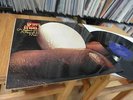
The GATE-FOLD LP jacket is in near mint minus condition. The jacket is tight and clean, with NO seam splits. It is laminated on the front and back of the jacket, and has a few informational pages stapled into the middle seam, inside the jacket. The corners are solid. The colors on the jacket are sharp with NO discoloration on the front or back. The corners and seams show very little shelf wear due to the age (see pictures with this listing for more detail as they are of the actual item).
The LP is in near mint minus condition! There are no serious marks on the vinyl. There may be some very light spider marks on the LP which are caused by sliding the LP in and out of the inner sleeve. Most of the time, these types of marks are not audible, but it really depends on the sensitivity of your audio gear. This is not a new audiophile LP....some extraneous sound is inevitable and should be expected for a vintage LP. A vintage record is rarely perfect. The LP retains much of the original gloss and sheen! There are NO serious spindle marks on the record labels either. That said, acquiring a vintage LP like this is for the performance and rarity of the LP, not necessarily just for the sound quality.A Short Note About LP GRADING -
- Mint = Only used for sealed items.
- Near Mint = Virtually flawless in every way.
- Near Mint Minus = Item has some minor imperfections, some audible.
- Excellent = Item obviously played and enjoyed with some noise.
- Very Good Plus = Many more imperfections which are noticeable and obtrusive.
For best results, always thoroughly clean your LPs before playing them.
LPs can be audiophile quality pressings (any collector of fine MFSL, half speeds, direct to discs, Japanese/UK pressings etc., can attest to the difference a quality pressing can make to an audio system).
Don't let this rarity slip by!!!price rating