DR JOHN 'GRIS GRIS' 1968 MONO FIRST PRESSING RARE CAJUN VOODOO PSYCH MASTERPIECE
$
28
Favourite Auctions
To save auctions to your favourites, please login
If you don't have an account, please register
Description
DR JOHN 'GRIS GRIS' 1968 MONO FIRST PRESSING RARE CAJUN VOODOO PSYCH MASTERPIECE
Dr. JOHN "GRIS GRIS" RARE ORIGINAL 1968 'MONO' FIRST PRESSING LABEL: ATCO RECORDS – 33-234 RELEASED: JANUARY 22, 1968 RECORD COMPANY: ATLANTIC/ATCO RECORD COMPANY PRESSING: COLUMBIA RECORDS PRESSING PLANT ~ TERRE HAUTE ('T' IN MATRIX) MASTERED AT LONGWEAR PLATING NY ('LW' IN MATRIX) PRODUCER/ARRANGER: HAROLD BATTISTE MATRIX (SIDE A): C-12693-B LW RXG T MATRIX (SIDE B): C-12694-B LW RXG T
CONDITION: VINYL: VG++ JACKET: VG+ INNER SLEEVE: EX-
★★★★★★★★★★★★★★★★★★★★★★★★★★★★★★★★★★★★★★★★★★★★★
I've been going thru my large vinyl record collection the past few months and pulling out some LPs that I thought that someone else would like for their collection. I've been collecting records for nearly 50 years and it's time to pass some of them on to the next generation of collectors.
After all, we are just temporary 'caretakers' of these musical gems until the next owner and next collection takes them in.
This week on EBay I'm offering up this beautiful, clean, original, rare mono, first pressing of Dr John's debut album 'Gris Gris' from 1968, pressed on the early steel blue and yellow mono Atco label.
This copy is from my personal collection and I've owned this record for at least 40 years now.
I recently found a very nice reissue, which sounds fine to my old ears, so, knowing that some collectors are looking for the true 'original' pressing of this grail, I decided to let this copy go.
Please read the full description of this album's content, the story behind it's concept and creation, the musicians involved, and more details on the record's condition below.
★★★★★★★★★★★★★★★★★★★★★★★★★★★★★★★★★★★★★★★★★★★★★
The Big Easy is renowned for two things: music and voodoo. And no human being has ever combined the two with such funky finesse as Mac Rebennack, aka Dr. John the Night Tripper.
This is the Night Tripper’s 1968 debut album 'Gris Gris', the album that put Dr. John on the map and into the ears and minds of music enthusiasts the world over.
It's one the most haunting, psychedelic-tinged, trance-inducing albums ever recorded and rightfully considered a psychedelic masterpiece.
Every element of this album; spiritual, tribal, rhythmic and psychedelic, are perfectly combined and woven together as a whole, yet every track is its own creative journey evoking ghostly musical sounds heard from the other side of the bayou.
Rebennack's vocals are masterful and he inhabits his character fully, delivering his Creole 'slanglish' effortlessly with his half-spoken, half-sung lyrics.
There’s nothing else that sounds quite like this record; swampy, funky voodoo tribal rhythms set to soulful backing vocals all wrapped up in a psychedelic haze. The precision and multiple layers of production are exquisite.
Gris Gris is weird, heavy, psychedelic, and soulful. The atmosphere is thick, smoky, heavy, foreboding, and there's no denying it's seductive and addictive, swampy, quintessentially New Orleans vibe. A masterpiece of spooky, weird, and downright catchy voodoo drenched grooves.
This is not really like any other album. The whole record is just unique, different and marvelous. It has those raw, addictive r&b/soul grooves that are very danceable, but somehow also very entrancing and hypnotizing. It's challenging, yet at the same time, completely accessible.
I can guarantee you’ve never heard anything like it
★★★★★★★★★★★★★★★★★★★★★★★★★★★★★★★★★★★★★★★★★★★★★
This is a beautiful, clean, original, mono, first pressing from 1968 on the early steel blue and yellow Atco label. ~~~~~~~~~~~~~~~~~~~~~~~~~~~~~
THIS RARE MONO PRESSING OF 'GRIS GRIS'
This Mono pressing is the definitive version of this crazy, swamp-psych-blues record. Clear, clean, tight, dynamic and punchy.
The Mono mix was a dedicated mix, not a fold-down, and the mono mix has less echo and reverb. The mono mix, supervised by the album's producer Harold Battiste, dials back some of the multiple layers of sound, some of the intrusive horns and flute, and focuses more on the rhythm section; drummer John Boudreaux, Battiste's deep bass, and both Dr. John's voice and the backing vocals, making it more of a rhythmic R&B record than a sprawling Psych record.
The excellent backing vocalists are more pronounced and can be distinguished from each other, even in Mono. On the stereo mix they are too distant, too soft and get physically lost and separated from the music.
Despite Mono, this mix and pressing is crisp and clean and preserves the many layered details and the good Doctor's overall sound and genius.
The deep bass, the layers of odd percussion, the bells and sound effects on this album really sound best; full rich, natural, textured and clear, on this early, Mono, all analog pressing.
Although I'm typically a fan of late 60's Psych albums in stereo, to get the full 3-d effect, critics of the Stereo mix of 'Gris Gris' say it's too wide, too spread out, too 'smeared', which ruins the tight, cohesive, rhythmic sounds of the music.
These OG Mono pressings easily beat the re-issues. The later reissues suffer from the use of older tapes or generations of tape. The recent Kevin Gray Mono remaster from a few years ago IS taken from the original mono tapes, and on cool green swirl vinyl, but is a digital file, not analog, and you can hear how 'old' the tape sounds, with some drop-outs and obvious 'crinkled' tape at the start of 'Danse Fambeaux'. There's some compression, limiting and filtering applied to the digital mastering as well.
This OG dedicated Mono mix was made when the tapes were fresh, the 'Night Tripper' vibe was still strong and present in the studio, and the whole concept of the album was fresh in everyone's mind.
If you want to hear the full psychedelic weirdness and experience of this album, nothing beats a Stereo OG pressing, but if you want to hear the cohesiveness, the musicianship, the flow, groove and genius of this great album, then an OG Mono pressing, like this, is the way to go. I own and like them both.
★★★★★★★★★★★★★★★★★★★★★★★★★★★★★★★★★★★★★★★★★★★★★
THE BACKSTORY OF MAC REBENNACK ("DR JOHN") AND THE STORY OF THE CREATION OF THIS 1968 DEBUT ALBUM, 'GRIS GRIS'
Dr John was a visionary artist who took local New Orleans and Louisiana traditions and transformed them into music that sounded like nothing else on Earth.
The future Dr John was born Malcolm John “Mac” Rebennack Jr, in 1940, in New Orleans. He grew up in the sketchy, shady East End of the Crescent City, in the Third Ward, where his father John ran a small shop that sold televisions, small appliances and radios. His father's shop also sold many records and 'Mac' grew up surrounded by music.
Over time, Mac learned how to play guitar and piano, and thru his father’s "contacts" in the local music business and scene, the young Mac Rebennack snuck into local recording sessions and was soon playing small gigs around town, meeting and sitting in with local legends like Guitar Slim and Little Richard.
By his early teens, he had met and played with Professor Longhair. who took Mac under his wing and introduced him to the world of the recording studio.
Mac was instantly impressed by the Professor's flamboyant mix of blues, boogie-woogie and Afro-Cuban rhythms. Rebennack would later claim that Professor Longhair “put the funk into music and the Professor's sound and style became a life-long influence on Mac's music.
The Crescent City was ripe with night clubs, bars and other joints where a wide variety of music styles, old and new, were intermixed and there were lots of backroom opportunities for the talented young Mac. He even played organ in a Strip club, but to play the bigger and better clubs, you had to be part of the Musician’s Union, so with the help of a friend, he joined the Union, turning 'professional' in the mid-50's.
By the time he was sixteen, Mac had been hired by Johnny Vincent at Ace Records as a songwriter, arranger, A&R guy, and producer. This led to him writing, arranging, recording, and running sessions by day, and playing at night in clubs and bars with many different legendary New Orleans artists.
Rebennack was mainly a guitar player then, honing his skills in a steady stream of live gigs and recording dates. This was all great experience for the young, up-and-coming musician.
By the late-fifties, Mac Rebennack was in his first band, 'The Dominoes', but soon started writing more of his own songs, which led to fronting his own group, 'Mac Rebennack and The Skyliners'. The Skyliners performed Mac's original music, as well as the standard covers of the day, at small clubs in and around New Orleans.
In 1957 Mac Rebennack co-wrote his first ever rock ’n’ roll song 'Lights Out'. It was recorded by New Orleans based singer Jerry Byrne, and released on Specialty Records. 'Lights Out' give him his first big regional hit.
Two years later, in 1959, Mac Rebennack also enjoyed another regional hit single when he released 'Storm Warning', a dark, stormy & brooding Bo Diddley inspired instrumental on Rex Records. The sound and style of 'Storm Warning' anticipated the 'garage rock' sound of the early 1960s.
'Lights Out' and 'Storm Warning' were the first 'hits' the young Mac Rebennack would have in his long, illustrious, and strange, nearly 60 year career.
After the success of 'Storm Warning', Mac Rebennack teamed up with his friend Charlie Miller and started writing songs and recording singles for various local New Orleans based labels, including Ace, Rex, Ron, and others, all based out of Cosimo Matassa's newly opened Cosimo Studios in the French Quarter. Mac Rebennack put his formidable instrumental chops and signature gravelly vocals on endless session dates and records.
In addition to spending time in the recording studio, Mac continued to play live gigs and tour with his own group around the south, constantly working on his guitar skills and the presentation of his live act.
Things were going well for the young Mac Rebennack, but things would take a drastic, career altering turn one night in 1961, while playing a show in Jacksonville, Florida.
On Christmas Eve 1961, during an 'altercation' with an irate promoter, in a Florida motel, Mac was shot, seriously injuring the ring finger on his left hand.
As Mac tells it; "I walk into the dressing room, and the promoter’s pistol whippin’ Ronnie Baron, our vocalist. I start beatin’ his hand off the wall, but my fingers are over the gun barrel, and it goes off...."
The encounter ended with Mac's finger severely damaged and hanging by a thread. "When they sewed my finger back on, it was dead..."
Overnight, his career as a guitarist ended and Mac was no longer the Crescent City’s go-to session guitarist. This was a potential career ending disaster for a guitar player, but Mac was musically gifted enough, and determined enough, to not let the injury stop him from pursuing and performing music.
He initially made the switch to bass guitar, but that was also hard to play, so after a while, Mac switched to the instrument that he made his name and career with, the piano. Soon, Mac Rebennack developed his own piano style that was heavily influenced by his hero, Professor Longhair.
After the accident, the early 60's were a rough time for Mac. Due to his injury, he stopped touring extensively, returned to the East side of New Orleans, and ended up getting involved in the dark underbelly of The Big Easy.
He became a heroin addict and dealer, got involved in other shady activities, and at one point, he was involved in running a brothel. It was almost inevitable that Mac Rebennack was going to have a brush with the law.
In 1963, Mac Rebennack was arrested on drug charges and sentenced to two years in the Federal Correctional Institution, in Fort Worth, Texas.
While he was in prison, New Orleans elected a new District Attorney, Jim Garrison, who's campaign promised to 'clean up the city'. The new DA came down hard on vice and the illicit activities happening in the seedy night clubs, brothels and juke joints of the Crescent City.
By the time his sentence ended and Mac was released in 1965, New Orleans had become a very different place. The familiar vibe and many of the opportunities for a musician like Mac, legal and otherwise, were gone. Well paying gigs were hard to find, and the urge to succumb to the dark side of the Crescent City was strong, so in 1965, he followed the path of many other New Orleans musicians and moved to L.A., the city of angels, to pursue his musical career. Mac knew he could at least find work as a session musician in the city's busy music scene.
Making a new start and moving to L.A. turned out to be a good decision for Mac.
Shortly after his arrival in LA, Mac Rebennack was taken under the wings of Harold Battiste. Battiste was a respected multi-instrumentalist session musician and an arranger and producer for various labels.
The two knew each other well from New Orleans. Battiste managed the local branch of Specialty records, and the pair had collaborated on a number of hit singles.
Harold Battiste ran a group called NOMA (the New Orleans Musicians Association), where Crescent City musicians exiled in LA plied their trade and kept in contact. Mac joined the club and met many of the musicians that appear on this album.
Through Battiste’s connections Rebennack got himself into many local studio sessions. With his talent and experience, it wasn’t long before he was one of the 'first call' session musicians in LA, becoming a member of the legendary 'Wrecking Crew', the most in-demand Hollywood session group of all.
Mac did session work and played with some of the biggest names in music at the time, everyone from Sonny & Cher to Frank Zappa.
The session work paid well, but the work wasn't deeply satisfying and it wasn't how Mac wanted to spend his life and career. He missed New Orleans and it's culture, and was homesick. ~~~~~~~~~~~
In the summer of 1967 Mac Rebennack decided it was time to realize a project he was dreaming about for some time. With the help and encouragement from his new old pal Harold Battiste, Mac Rebennack hatched his new idea.
Living in L.A., where it seemed that everybody had an idea for a film, play, or stage show, Mac started to formulate the idea of forming his own band and creating a unique stage act around the idea of presenting authentic vintage, New Orleans music and sounds, wrapped in the folklore, mythology and traditions of the Crescent City.
Harold Battiste liked the idea and encouraged Mac to pursue his dream.
Mac had been interested in the tales and traditions of his native Louisiana since his youth. Stories of voodoo and mysterious swamp legends intrigued and mesmerized him, ever since his sister gave him rare books on Haitian voodoo as a teen.
For his idea of a live stageshow, Mac wanted it to be musically based around a central mysterious character who represented the rich culture and mystique of New Orleans.
Mac was aware of the famous New Orleans mythological character from the 1840s named Dr. John Montaigne, a huge black man, a Senegalese freed slave turned witch doctor, herbalist and spiritual healer, who passed thru Haiti, learned powerful Voodoo skills, and then settled in New Orleans.
The legends and myths surrounding the real Dr John claimed that he lived out in the swamps of the Bayou and was said to have astonishing Haitian VooDoo powers and strong sexual prowess.
Legend claimed that he had 15 wives, over fifty children, and had made a fortune by offering and selling herbal remedies, potions, concoctions and Gris-Gris amulets to the locals to protect them from evil, heal them, lift curses, give them verility, and bring them good luck.
Mac felt that this 'Dr John' mythology would be the perfect story and character to develop his new stage show around.
He discussed the idea with his friend Harold Batiste, who was totally supportive and on board with the idea. ~~~~
Mac and his new L.A. musician friends could supply the music, Mac knew the story and legend of Dr John, and knew enough about the culture and folklore of New Orleans to develop the stage show, all he needed was a strong front man to play the part of "The Doctor".
He tried to get his old friend, bandmate and singer from New Orleans, Ronnie Baron, to front the band as the Dr. John character, but Baron's manager advised him against it, claiming it to be a bad career move.
Although Mac initially never considered himself as the lead character, thinking of himself as more of a 'producer', musician, and spiritual advisor of the project, he was forced to consider taking on the leading roll of 'Dr John' himself.
After learning more about the real Dr John, Mac then discovered that Dr. John had been thrown in jail, along with his partner, a woman with the last name of Rebennack(!), for their strange beliefs, behaviors, and for practicing voodoo in the swamps of New Orleans.
Feeling a "spiritual kinship", if not a real genetic kinship with them, and learning that Dr John's life story had many parallels to his own, those last tidbits of information sealed the idea in Mac's mind of taking on the Dr. John persona himself.
Mac decided that the mythical "Dr John" was the perfect character and story to model his band, music and live show after so he dove into the character, transforming himself into "Dr John".
Mac began to act, speak, live and dress the part. He wore hip, old traditional clothing, decorated himself with facepaint and sparkling gris-gris dust, and donned flamboyant Mardi Gras costumes and headdresses.
Dr John even started dabbling in Voodoo and selling his own forms of 'Gris Gris' around L.A.
Mac managed to totally incorporate the strange, eerie, but proud and powerful personality of the mythical 'Dr. John Montaigne' from the 1850's into his own new 'Dr. John Creaux' persona.
Based on the strong Psychedelic vibe in the air on the west coast in the summer of 1967, and his own drug use experiences, Mac added the “Night Tripper” title to his moniker. It was an odd lysergic honorific that nodded to the Beatles recent hit 'Day Tripper', but Mac's 'Dr John - The Night Tripper' image and music bore no relation to the Beatles nor anything else in rock music at the time. ~~~~~~~~~~~~~~~~~~
In the late summer of 1967, with help, support, and encouragement from his buddy Harold Battiste, who agreed to be 'producer' and 'advisor' for the project, Mac started writing new music and songs based on the "Dr John" vibe and mythology.
Rebennack worked hard to create a whole 'package' around the Dr John character and the mythology surrounding him, not just the music but a whole unique stage show and production that incorporated the legend, folklore and story of Dr John.
Mac developed a very innovative theatrical stage show around the strange voodoo hoodoo universe of his 'Dr. John' character.
The live show Rebennack devised to support his new music was a theatrical sensation, full of spooky weirdness, strangeness, and voodoo excesses. The shows were created in the best New Orleans tradition, with a sense of Mardi Gras and Carnival revelry, and elements of colorful costumes, pageantry, smoke, incense, and moody lighting.
Late 1967 was a period of various love-ins, be-ins and freak scenes. Dr John's Voodoo infused stage shows were very intense, spiritual and powerful gatherings and just an extension of that sense of community, with like-minded people coming together to share an experience.
Mac successfully put together and pulled off popular stage performances, based on his Dr John character. The shows perfectly complemented the powerful strange new music he was writing.
Mac Rebennack had his plan all figured out. His "Dr John" concept was coming together and his live shows were becoming a local Los Angeles sensation.
All he needed was a record deal and some studio time to make a recording that would bring it all together. That's where Harold Battiste comes back into the picture.
Harold Battiste is the unsung hero of this debut album and the Dr John story. Without him, this album, and possibly his whole career, would never have happened.
Battiste was good friends with the heads of Atlantic Records, Ahmet Ertegun and Jerry Wexler, after saving their ATCO subsidiary from bankruptcy with his arrangements and production work on top selling Sonny and Cher’s hits and albums.
Because of this, Ahmet Ertegun gave Battiste some level of freedom to come up with recording projects of his own and Battiste was a strong advocate for Mac Rebennack's new 'Dr John' project.
In late 1967, Battiste seized an opportunity when some free 'open' studio time at Gold Star Studios popped up while Sonny and Cher were away filming.
He was able to sneak Mac and a bunch of ex-pat New Orleans musicians from NOMA into the studio for a few late night sessions to record their brew of musical voodoo.
The all-night sessions for 'Gris Gris' featured a studio packed full of New Orleans musicians who grew up around this unique type of R&B and knew what Mac was trying to capture.
"those guys from New Orleans, they all just really put they whole spirit into it.''
Battiste acted as 'Producer', arranger, recording engineer, mixer and mastering engineer. He also played Bass, percussion and clarinet on the sessions.
Battiste, well versed in Louisiana folklore and spirituality, helped Mac arrange the songs, added some studio tricks and wizardry, and gave the music a modern sound, all while respecting the traditional sounds and style of the music.
It was then Mac and Battiste's job to take the rough tapes of the quickly arranged recording sessions at Gold Star and create an album out of them.
Battiste’s exceptional production and arranging skills saw him use Gold Star studios as an additional instrument, fading, blending, and layering the different instruments, voices, percussion and sound effects into an amazing tape of the session. Fusing the inspired playing and voices with post-Spector LA studio trickery and electronic treatments.
The result was this unique debut album. This album wasn’t made with mass market appeal in mind. "Gris-Gris" was Dr John's unique vision and personal project, a concept album, which resembled nothing else.
The album was made almost in secret and Ertegun only found out about it after the recording was complete.
When 'Dr John' and Battiste submitted the album to Atco for approval and potential release, the strange sounds Ertegun heard did not sit well with him.
In Rebennack’s retelling; “I was doing a session for Bobby Darin when Ahmet Ertegun walked into the studio looking for me. He called me a “boogaloo motherfu*ker” and said ‘Why did you give me this shit? How can we market this boogaloo crap?‘
Mac tried to reassure him, but Ertegun was not pleased. Battiste had to remind Ertegun that Atlantic records 'owed him a favor', and ATCO reluctantly released 'Gris-Gris' in January 1968.
Ertegun was right. Atlantic couldn't and didn't promote 'Gris Gris' and the album tanked, making original first pressings, especially the rare Mono first pressings like this copy, quite rare and sought after today.
Upon release, although sales were slow, the album and Dr John's live shows appealed to the underground counter-culture scene happening in Los Angeles at the time. Rock audiences embraced the album along with Dr John's whole psychedelic 'Night Tripper' character and voodoo mythos. With late-night airplay on early FM radio stations, the album grew in notoriety and became a cult classic, initiating what’s now regarded as the 'golden era' for Mac Rebennack as "Dr Jonhn - the Night Tripper".
After it's release, the minor success of 'Gris Gris' secured a long term deal for Dr John and he was signed to a four album deal with Atlantic, but this debut album and Dr John's career almost never happened.
★★★★★★★★★★★★★★★★★★★★★★★★★★★★★★★★★★★★★★★★★★★★★
THE SONGS AND MUSIC ON 'GRIS GRIS'
The music on 'Gris Gris' combined the various styles of southern Louisiana music Mac loved; blues, R&B, and soul, but he flavored it with the various strains of traditional Cajun, African, Creole, Zydeco and Cuban sounds he heard growing up on the streets of the Crescent City. He also added some elements of modern Rock and Psychedelia that were prevalent on the streets of L.A. at the time.
Mac's lyrics and the overall vibe and feel of the songs were shaped not only by the mythology surrounding the Dr John character, but by Mac's deep knowledge and understanding of New Orleans folklore and culture, learned and passed down from the elders and others in the oral tradition and from the many books he read.
The music and lyrics were also shaped by Mac's own personal experiences on the streets, in spiritual ceremonies, in churches in the Lower Ninth Ward, and in the back alley stalls and shops he frequented, like the 'Cracker Jax' drug store on Rampart Street that carried all kinds of potions, powders and mysterious remedies for a variety of maladies.
The result was that the music on 'Gris Gris' was a unique type of New Orleans flavored psychedelic Freak Folk and Swamp Rock that sounded like nothing else before it, or since.
Rebennack loved to play with words, creating his own Cajun 'slanguage' of sorts, and some very cryptic vibes. The Doctor's dark, eerie, growly voice has this rough around the edges feel, that has yet to be duplicated nor matched, that compliments the music incredibly. He does a great job of creating a thick swampy atmosphere.
The material on Gris Gris would have seemed like a joke if done by any other LA rock musician, but Mac packed a lifetime’s worth of Louisiana culture, musical experience and hard living into his character, making Dr John totally authentic, believable and sounding ominous and disturbing. On 'Gris Gris', Mac is very convincing as The Night Tripper and certainly sounds like he's serious and knows exactly what he's singing about.
'Gris Gris' was Lysergic and Psychedelic in many ways, but was also a different kind of psychedelic than what was happening in the Bay area. 'Gris Gris' was more earthy and spiritual, more rootsy, more Americana, along the lines of The Band’s 'Music from Big Pink' released the same year.
★★★★★★★★★★★★★★★★★★★★★★★★★★★★★★★★★★★★★★★★★★★★★
THE SONGS
Gris-Gris Gumbo Ya Ya Danse Kalinda Ba Doom Mama Roux Danse Fambeaux Croker Courtbullion Jump Sturdy I Walk On Guilded Splinters ~~~~
Dr. John opens 'Gris Gris' with the slow groove of “Gris-Gris Gumbo Ya Ya,” which is essentially an introduction to the Doctor that paints a picture of who his character is, and what the theme of the album is all about.
Gris-Gris starts with some of the best album opener lyrics of all time: "They call me Dr. John, The Night Tripper ~ Got my satchel of gris-gris in my hand ~ Daily trippin’ up, and back down the Bayou...."
The slow paced incantation is a perfect introduction to the style, story, mystique, and myths of Dr John, The Night Tripper.
Dr John's sinister, gritty, bayou drawl lures you in as he boasts of his powers and declares what abilities and skills he has, what magical acts he can perform. and what his magical gris-gris powders and potions can do for you.
He is both high priest and trickster, capable of blessing, cursing, and conning in the same sentence. By the time Mac gets to the line “I got my medicine to cure all y’all’s ills” you're a believer and totally hooked.
The song has no verses, no choruses -- just an unrelenting groove and flow that sends you into a trance, and puts you under the Doctor's spell.
After the first introductory verse, the distant, tender & angelic, but haunting, female backing singer's voices float in, as if from the depths of the bayou, repeating “Gris-Gris gumbo ya ya/Hey now” to the accompaniment of the swampy and bluesy instrumentation.
The music blurs the lines between gospel/soul and afro/cajun with it's groove and textured rhythms. The distant thunder of pounding toms & percussion blends with eerie strummed mandolins, bluesy harmonica, a bubbling bassline, stabbing electric guitar riffs, various hand drums, fleeting horn passages, and a swaying backing chorus.
The song has a rather surreal, pulsating, eccentric and psychedelic atmosphere, and perfectly sets the mood for the rest of the album. ~~~~~~~~~~~~
After the introductory 'Gris Gris', the Doctor then moves on to 'Danse Kalinda Ba Doom', an exciting, fast-paced, wonderfully bizarre and mostly instrumental, African Voodoo incantation and celebration, clearly meant for dancing.
The song has a very eerie, foreboding, ritualistic, chant-like feel and sounds like something that would’ve been sung around a large bonfire out in the swamp during a late night voodoo ceremony or sacrifice.
The song opens with pounding primal percussion, four heavy thumps of the drum, and some tambourine. This is followed by the female backup singers going, “Yea yea yea yea yea yea yea, yah yah yah....”
'Danse Kalinda Ba Doom' is an odd and powerful dance piece, led by distant eerie female voices hypnotically repeating the title “Danse kalinda ba boom/Danse Kalinda ba boom ba boom” over and over again, in four-part chant harmony, growing increasingly frenzied as they go along, before the song shifts into a terrific conga/drum breakdown.
The percussion on this track is absolutely intense and lively.
While the rhythmic, hand-played congas, claves, bells and drums are the focus and drive of this piece, the music also contains a calliope-sounding organ, beautiful Middle Eastern-tinged flute, Spanish-tinged mandolins & guitars, and saxophone, all of which add some very nice textures. There's an outstanding bass/tuba part at the core of the track and an electric guitar that adds a definitive Rock n Roll bite and vibe to the piece as well.
An amazing, dense, layered and powerful song.
The song then returns to it's rhythmic dance groove and after some more “Yea yea yea yea yea yea yah yah yahs” from the backup singers, the song slowly fades out. ~~~~~~~~~~~~~~~~
After two intense voodoo infused tracks, things get a little more 'normal' with the smooth New Orleans rhythms and irresistible Southern groove of 'Mama Roux'.
Most of the songs on ‘Gris Gris’ are intense and put more of a focus on creating an 'atmosphere' than on tight song structures and melody, but ‘Mama Roux’ shines with its fantastic display of breezy latin-infused Brazilian-styled jams, a killer soul groove, and a catchy melody.
“Mama Roux”, a standard soulful Cajun tune, was one of the few songs on the album that had any 'friendly' radio-play qualities, so it was chosen for one of it's singles.
It's the perfect antidote and voodoo cure for all the other heavier, Bayou hoodoo filled songs on this album.
Like most of the songs on this album, the tune is heavy on the drums, congas, and percussion, but Mac gets to show off his amazing, melodic keyboard talents, playing some catchy, bouncy organ riffs.
The song has a nice melody and a terrific R&B groove, but Dr. John's lyrics are as odd and cryptic as any on this album; “If you see a spy boy, sittin’ in the bush/Mess ’em on the head, give him a push...Oh he’s a pheasant for the medicine man.”
Towards the end of the track, the excellent backup singers commence chanting, “Chica chica chica chica/Chica chica chica chica,” which the good doctor follows with some more inspired nonsense: “Wham bam thank you ma’am/Come on boy now follow me/Singin’ wham bam hangin’ ham/Come on boy now follow me". The groove continues to slide along as the song slowly fades out. ~~~~~~~~~~~~~~~~~~~~~~~~~
“Danse Fambeaux” is a great, short track. An extended groove which opens with some cool rock guitar riffs, mandolin, tambourine, and a little whistling.
After that things get really strange; a church bell tolls and female backup singers vie with male backup singers as Dr. John sings, “Never do a limbo behind red beans and rice”.
Dr. John and the male backup singers go back in forth, singing in Creole, with Dr. John spitting out the same word six or seven times in a row as the song marches on and tambourines rattle away.
The song churns away until the final fade out which features more funereal church bells, more whistling, Dr John making pig noises, and the backup singers chanting “Steak a la gris gris” over and over again.
A very strange song to finish off side one of this strange album. ~~~~~~~~~~~~~~
Side two of the album leads off with 'Croker Courtbullion'
This may be the oddest, most experimental track on the album, instrumentation wise.
The long, 6 minute song is very energetic and spastic, with slinky, frenetic guitar solos, eerie flutes, clarinet riffs, and clattering, chaotic percussion, but somehow it all works, and the music is very intriguing and satisfying as it descends into madness.
Dr John adds some unusual, almost baroque sounding, trippy harpsichord, punctuating the madness, while layered, disembodied clusters of background vocalists float in and out of the mix.
'Croker Courtbullion' was co-written with Harold Battiste and moves along at a sprightly clip, driven by his loud prominent bass playing. It sounds like it was just improvised 'on the spot' at Goldstar studios, deep in the middle of the recording session, and put together and assembled later.
The song has an incredibly fascinating, dense, rich, layered and intense atmosphere, showing off Battiste's mastery of studio techniques and mixing, as the instruments and voices all drift in and out of the spacy mix of ghostly tribal dance music.
Through the musical haze Battiste adds a weird assortment of animal-like noises; squawks, hissing, croaking sounds and other strange noises that sound like a Louisiana bayou full of wildlife.
To my mind, the song has the feeling of a soundtrack to a spooky, uneasy journey into the swampy, Loiuisiana bayou at night and feeling the presence of the ghosts of the areas ancient tribal ancestors.
After hearing 'Croker Courtbullion' you definitely realize that 'Gris Gris' is not a normal typical album from the late 60's, and it's just the first track on side two. There's much more strange, spooky, intense music to come. ~~~~~~~~~~
Next up we get a bit of relief to the madness and a well deserved break with the fantastic 'Jump Steady', a brilliant, bouncy, single-worthy song and a definite highlight of the album.
'Jump Sturdy' is the shortest track on the album but brings a lighter edge and has a fun, more conventional and traditional style.
The song opens with the rattlesnake shaking of a tambourine and a male/female chorus singing, “Jump Sturdy/Jump Sturdy/Was her name/She came out the swamps like a crazy fool.”
The song features a powerful rhythm section, great mandolin and banjo playing, a bluesy melody, and a perky, upbeat, almost Fats Domino bounce and vibe that makes you want to get up and dance.
'Jump Sturdy' celebrates a powerful, if sinister, woman who “raised her hand and created an electrical storm.”
The doctor's vocals are full of life and energy, like an old 9th Ward drunk who has suddenly remembered his favorite story. Mac's gravely, growling vocals flawlessly tell the story, which has a strange uneasiness to it.
Although an upbeat, danceable song, the lyrics don't end well for poor Jump Sturdy, who “Got tangled up with Queen Julia Jackson/Down on Melba, meeting near Rattle Street/Queen Julia Jackson dropped a Zozo Labrique/And Jump Sturdy died with her soul in defeat.”
Jump Sturdy and Queen Julia Jackson were real people in New Orleans at the time, and the song is a tragic true story. Queen Jackson was not pleased with Mac's accusation of her causing Jump Sturdy's death and confronted him about it shortly after this album's release in early 1968. ~~~~~~~~~~~~~~
The album concludes with the astonishing otherworldly, 8-minute trance vamp 'Walk on Guilded Splinters'. 'Guilded Splinters' has the heaviest, spookiest, swampiest vibe of all, captures all the essence of Dr John, and is the best track on 'Gris-Gris'.
It's the definitive and perfect conclusion for an album like this. Hypnotic, tribal, and timeless. This music could be from the beginning of time or from the end of the world.
At the time, everyone assumed the title "Gilded Splinters" was a reference to hypodermic needles. Not a bad guess. The song certainly sounds drug induced and it's strange, trance-like vibe was interpreted as a strange Cajun cousin of Velvet Underground’s song 'Heroin', popular at the same time this album was released.
Like the drug heroin, this song has a way of getting under your skin, sticking to, and deeply affecting your brain, and is just as addictive.
The songs instrumentation is organic and unique, quite impressive. An incessant bass groove pushes the trance-like feel along, accentuated by finger snaps, congas, slinky, snaky, syncopated guitar chords, and harmonica.
The sprawling African percussion and conga rhythms help carry the track.
A ghostly and vaguely Middle Eastern-sounding horn wafts and weaves itself sinuously through the song underscoring the juju.
One of this song's highlights is the creepy, recurring Gris-Gris chant that runs throughout the piece. It affirms Dr John's powers, and is sung to perfection by a host of male and female backing singers.
The call and response of the backing vocals seem to drift in from nowhere and trail off for miles, as if their voices are being transmitted through the swampy bayou.
Dr. John's vocals are masterful, and do a great job of creating a thick swampy voodoo filled atmosphere. His incredible lyrics are a brazen boast about the strength and effectiveness of his various spells, potions, and dark powers.
Near the end of the song, Dr. John, echoed by female backup singers, repeats, “Til I burn up” and “Come Get It, Get It, Come, Come/Walk on guilded splinters”.
'Guilded Splinters' finally fades out to the sound of Dr. John repetitively singing “Til’ I burn up!” then slipping seamlessly into strange Creole patois as the backup singers repeat the chorus over and over in a near whisper.
A masterpiece of a song, creative, majestic, and full of mystique. The atmosphere and awesome tribal groove of this song is infectious and unbeatable.
An outstanding track, ending an absolutely perfect album.
The extended, laid back groove of this song made it one of Dr. John’s popular signature songs in his live shows at the time. It's power is undeniable, which is probably why Atlantic chose this 8 minute hypnotic jam 'Gilded Splinters' as the unlikely single from this record.
The amazing 'Walk On Guilded Splinters' has been covered by many artists over the years. The Allman Brothers, Cher, Paul Weller, The Neville Brothers, and it was the centerpiece of Steve Marriott and Peter Frampton's Humble Pie classic 'Rockin’ The Fillmore'.
★★★★★★★★★★★★★★★★★★★★★★★★★★★★★★★★★★★★★★★★★★★★★
THE ALBUM JACKET FOR 'GRIS GRIS'
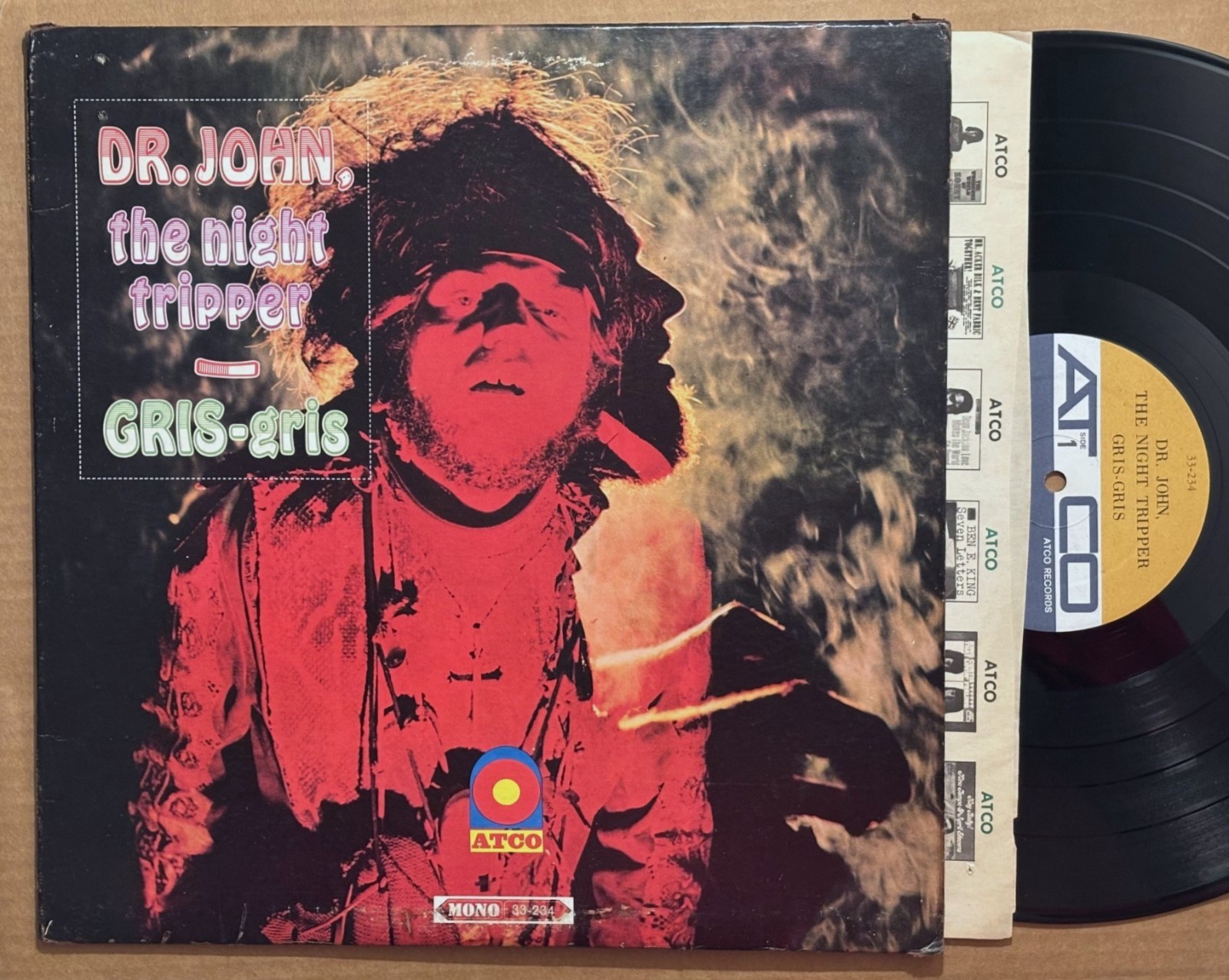
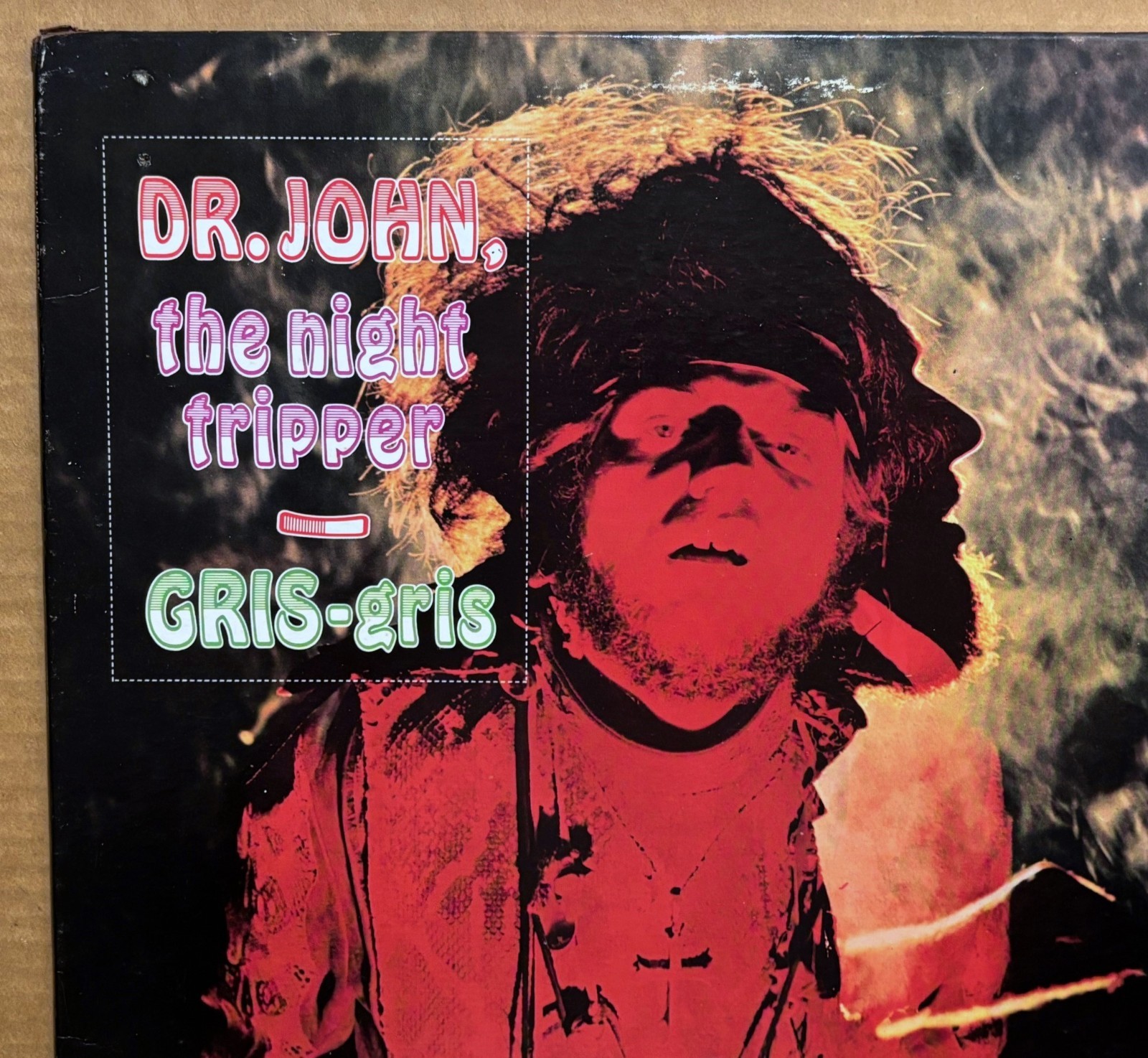
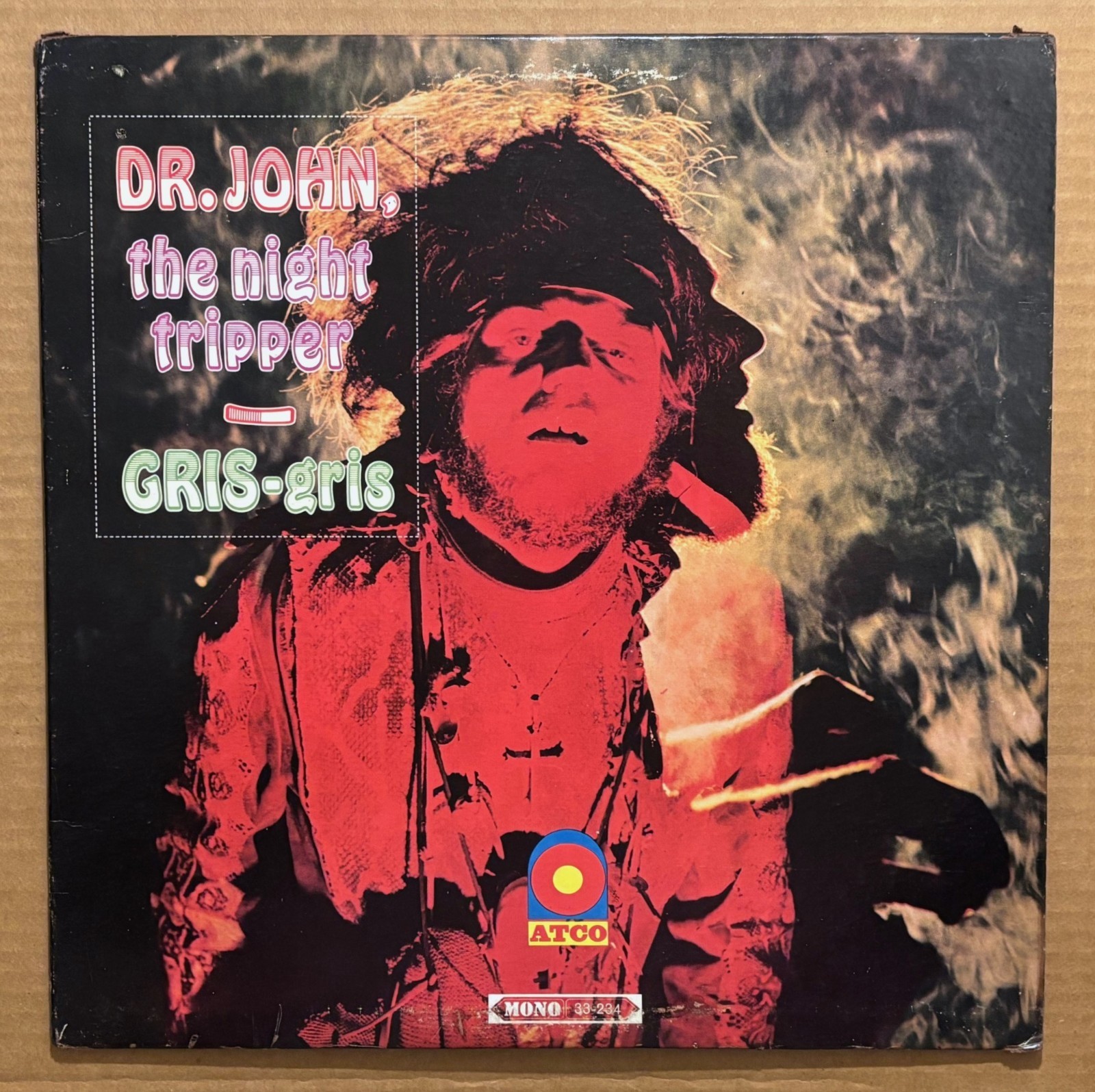
The album jacket is very strange and trippy. The front cover has an eerie dual image of the Doctor, the Night Tripper himself, basking in red light and surrounded by swirls of smoke.
You could immediately tell that ‘Gris Gris’ was going to be a thoroughly weird record, full of strange psychedelic eccentricities and atmosphere.
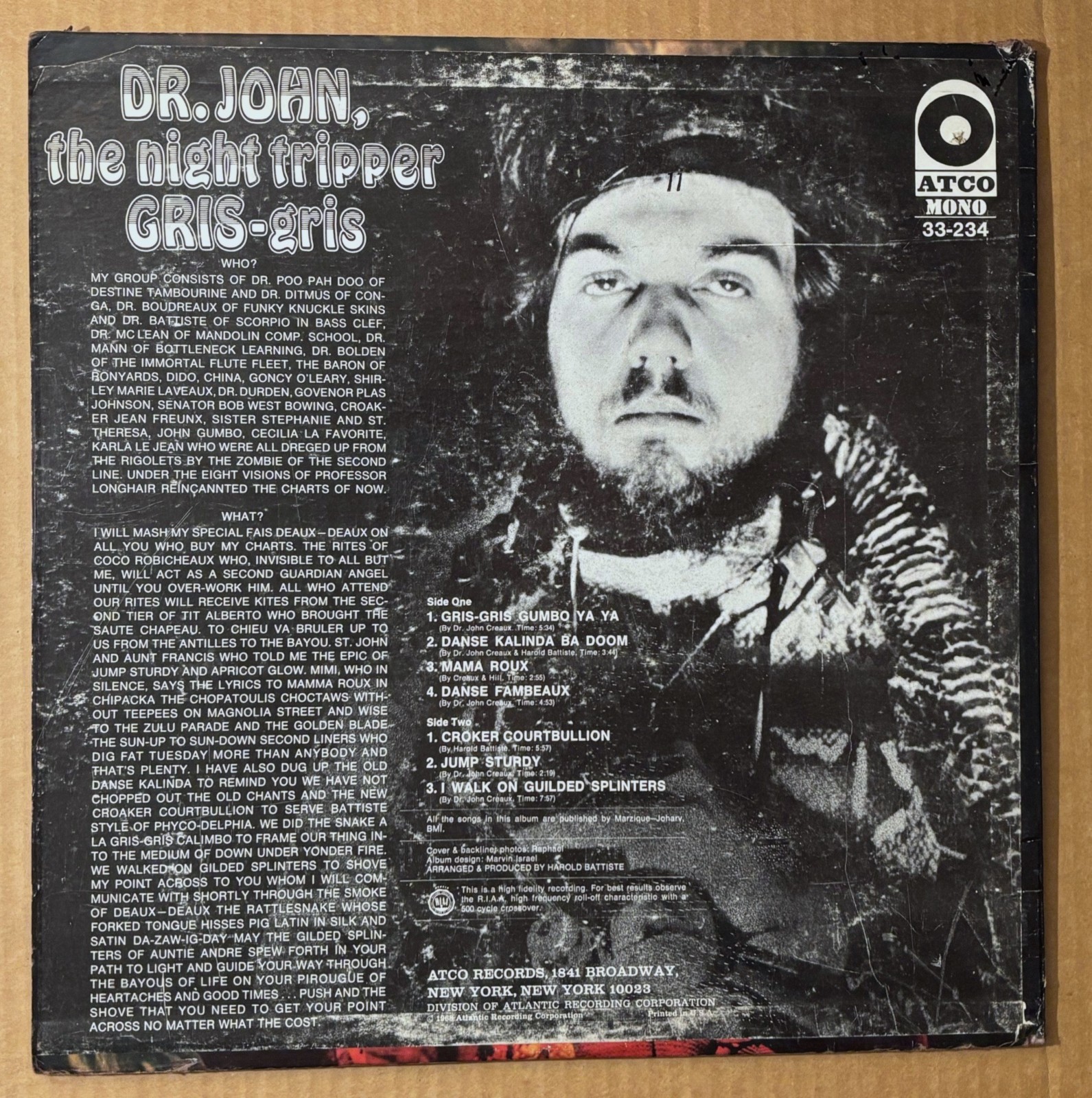
Flipping the album cover over, you see an equally strange picture of the good doctor, this time in simple black and white, but looking even more bizarre and more 'under the influence' than the cover shot.
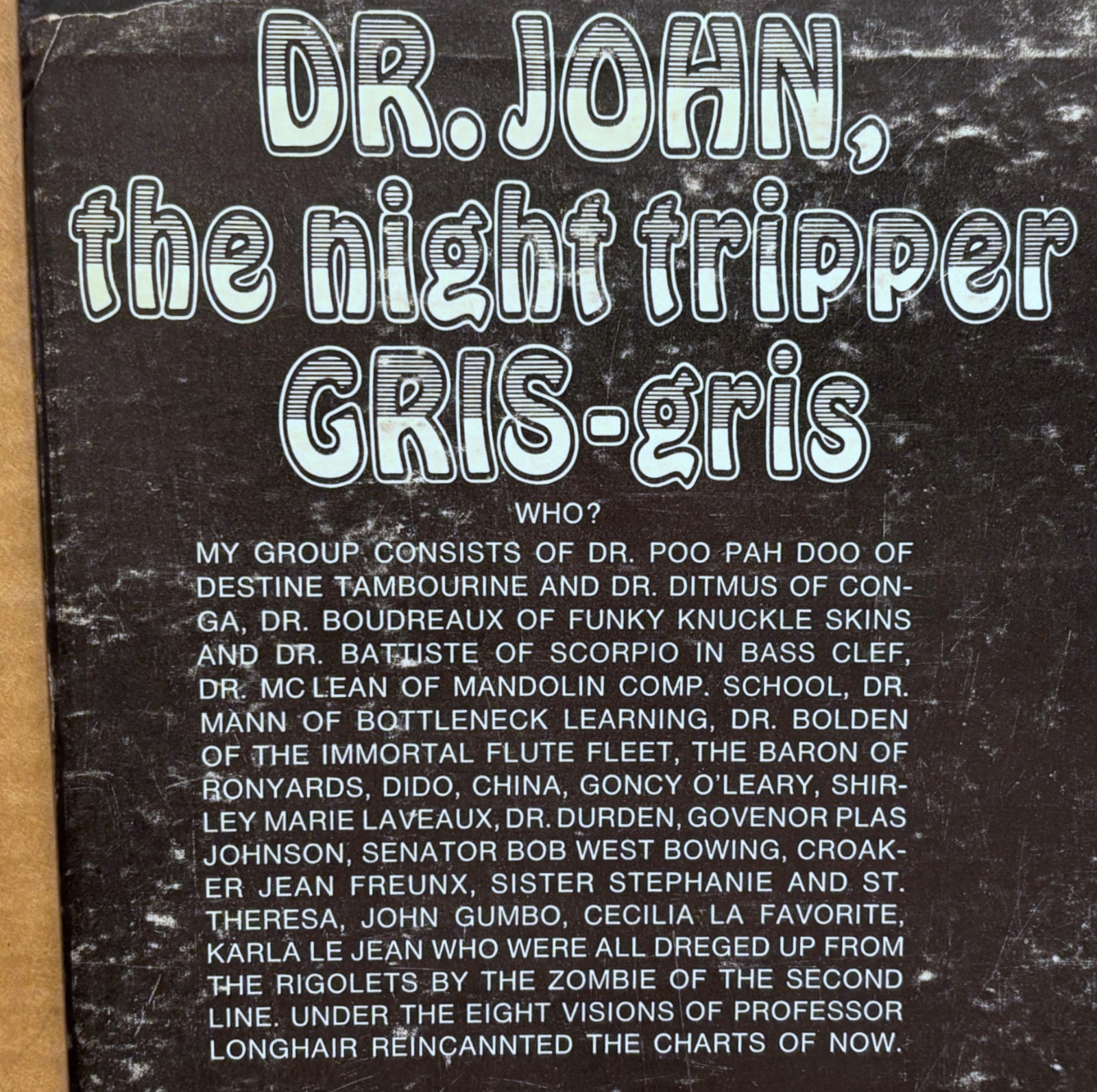
You then start to read the Doctor's strange cryptic liner notes, written in an odd Cajun dialect, describing his band and the album's concept.
You come away amazed and confused. You're stll not sure who actually plays on the album, or what it's all about, but you know the musicians sound interesting, the concept unique, and that it's going to be a wild listening experience.
★★★★★★★★★★★★★★★★★★★★★★★★★★★★★★★★★★★★★★★★★★★★★
THE MUSICIANS ON 'GRIS GRIS'
The all-night sessions for 'Gris Gris' featured a studio packed full of New Orleans musicians who grew up around this unique type of R&B and knew what Mac was trying to capture.
"those guys from New Orleans, they all just really put they whole spirit into it.''
There were several guitarists/ mandolin/ banjo players, eight percussionists playing a battery of nine percussion instruments, a varied assortment of horn players, and eight backup singers assembled.
Rebennack played keyboards and percussion. Actually most everyone played some sort of percussion on this album.
Mac was just mainly a studio musician before this session and initially didn't want to sing vocals on this record.
Mac was clearly knowledgeable and versed in all different types of Louisiana music through his vast experience, so Batiste convinced him that he was the obvious choice to do vocals despite his lack of vocal prowess. Batstiste told him “just talk, you don’t need to sing.”
Thus, the classic Dr John vocal style was born and Mac was able to 'sing' in a wide variety of styles in these songs.
Together the musicians created a unique Voodoo-infused, New Orleans/Cajun/Afro-Caribbean soundscape behind the Doctor's growls, mutters and chants.
At the at forefront and controls of ‘Gris Gris’ was legendary black composer Harold Battiste who acted as co-producer with Mac and played Bass, some percussion and Clarinet.
The musicians were mostly improvising during the sessions, but each tune flows and holds together – the musicians were pro’s and, while loose, maintained their focus and gave the music an extremely unique and intriguing sound.
'Gris-Gris' sounds like a late-night voodoo ceremony recorded in the bayou swamp instead of at L.A.'s Gold Star Studio where Phil Spector cut his polished hits.
There are so many wonderful musical passages and contributions on this album, played by musicians who do not get sufficient credit for their work.
In his cryptic liner notes on the back of the album, Dr. John reveals the musicians, but really doesn't tell you who's actually playing on the album. Here's a list of some of the major New Orleans musicians featured on tis album:
Bottleneck Slide Guitar, Banjo – Steve Mann Bass - Harold Battiste Drums – John Boudreaux Percussion - Jessie "Dr. Poo Pah Doo" Hill Mandolin, Guitars – Ernest McLean Percussion – Richard "Dr. Ditmus" Washington Bass – Bob West Congas – Mo "Dido" Pedido Flute – Lonnie Boulden Tenor Saxophone – Plas Johnson Backing Vocals - Ronnie "The Baron of Ronyards" Barron, Dave Dixon, Backing Vocals - Joni Jonz, Prince Ella Johnson, Shirley Goodman, Tami Lynn
★★★★★★★★★★★★★★★★★★★★★★★★★★★★★★★★★★★★★★★★★★★★★
Mac was the real deal; an authentic, charismatic 'Shaman', gifted with not only musical talent and extensive knowledge of New Orleans & Cajun history & folklore, but he also had the intelligence and determination to take that culture he grew up around and share it with a modern audience. He was a very sleek and sly individual who knew exactly what he was doing when he created this masterpiece.
Gris Gris was a unique record, one of those lightning-in-a-bottle albums, never to be replicated. A trip that could only be taken once. Dr John's hip-ness and cool-ness definitely shine through on this debut album.
For all of Dr. John's extensive output he never did match the raw primal intensity of this album. It's among the most enduring recordings of the psychedelic era. It's one-of-a-kind psychedelic vibe sounds as mysterious and spooky in the 21st century as it did in 1968. It still feels so unique and fresh, even by today's standards.
A must-own record for any Dr. John fan or those who dig the voodoo that he do. Essential.
★★★★★★★★★★★★★★★★★★★★★★★★★★★★★★★★★★★★★★★★★★★★★
CONDITION: I tried to show good hi-resolution photos of the jacket, labels, inserts, and vinyl in my pictures.
This is my original Mono copy of 'Gris Gris' from my personal collection. This record has been sleeved and stored properly for decades and is still in terrific condition.
VINYL: The vinyl is fantastic. Clean and bright, with a nice glossy sheen. No obvious flaws, scratches, dings or damage. It looks terrific, sounds great, and I'm sure you'll be happy with it.
This record is all analog and beautifully pressed on thick, heavy, high quality vinyl, with super sound to match. You can see from my photos how terrific it looks.
LABELS. This pressing has the early steel blue and yellow Atco mono labels. The labels are clean and bright; no dings, scuffs, writing or damage. The spindle holes are mostly clean and sharp, suggesting infrequent playing and my careful handling over the years.
This comes with it's original Atco mono inner sleeve, which is also in nice, clean condition.
JACKET: As you can see from my pictures, this still looks fantastic for a 55+ year old copy. I tried to show details in my pictures.
This has fantastic cover art and is one of those 'classic' album covers.
People didn't know who Dr John was in 1968, but one look at this cover, you knew it was different, psychedelic and weird.
This dark jacket is notorious for showing dings, scuffs, ringwear and fingerprints and it's rare to find this record without some mild cover damage, but this one still looks terrific.
There's some light edgewear, some early ringwear, and general wear, but not too bad. This jacket has some mild, corner, 'bumping', from being stored and shifted around in my collection for decades, but as you can see it otherwise still looks quite nice.
The spine is straight, and there are no seam splits or other issues.
Very nice, all original, and a real gem. a rare original 1968 Mono pressing. I'm sure you'll be very happy to add it to your collection. It would make a great addition to any Classic Rock, Psych or vintage vinyl record collection. ~~~~~~~~~~~~~~~~~~~
** NOTE: I'm selling this rare Dr John record "AS IS" and "NO RETURN". It's rare, and as described, and I'm sure you'll be very happy with it. A great, rare, original, excellent sounding mono copy.
★★★★★★★★★★★★★★★★★★★★★★★★★★★★★★★★★★★★★★★★★★★★★
I’m recently retired and downsizing and letting go some gems and rarities from nearly 50 years of vinyl record collecting.
Over the next few months I'll be offering an assortment of these rare and collectable LP’s. Many of these records have been in my personal collection for decades. Some of them are quite rare and seldom come up for sale. Limited pressings, European imports, promos, fan club releases, live recordings, first pressings and other general rarities.
Keep an eye on my Ebay page, 'jjrbyrne' for more of these great rare collectible albums, EPs and 45 singles. All records have been carefully evaluated and graded by me. I visually inspect all records under bright light, personally gently clean them with a soft cloth and then, if unsure, play them on a modern high-end turntable and system to get a true picture of condition.
Please look at all the high-resolution pictures I added. They are all my own and are of the actual record being sold. The pictures are part of the description and can show small details, label variations, and condition better than I can put into words.
My grading is fair and honest. I have had over 3,700 happy and satisfied EBay customers over the years, with 100% positive feedback, and I have been buying/selling on EBay for nearly 30 years, so please bid with confidence!
I'm a One-man operation, this is a hobby, not my job. I do this for fun. I do this because I love music, love collecting vinyl and want others to share in that same experience. I take my time listening, researching, grading, listing and packaging. I will NOT sell any record that I personally would not want in my collection.
As you well know, packing and shipping rare records requires special care and attention, therefore, shipping cost within the lower 48 states is $5.00 on this item. If you would like insurance, or anything faster than Media/Economy Mail, please let me know and I can arrange it for you. I’ll work with you to make sure you’re happy!
I will gladly combine multiple records, or other items on my page, and make the shipping much less for you. I don’t inflate the shipping costs; they are what they are. I strive to keep them as low as possible. See my feedback for comments on my quality packing and shipping.
All items are packaged with sturdy cardboard mailers and appropriate padding. I take pride in my packaging and shipping and package all my records as if I were sending them to myself. I treat the records you win as if they were my own, and mail them the same way.
All orders are processed and shipped within 2 business days of receipt. We package and ship our vinyl records with the greatest care, using proper packaging to ensure that your rare and collectible vinyl records arrive in pristine condition.
Payments can be made by any of the multiple options that Ebay offers.
I will be happy to exchange feedback with anyone I complete a transaction with.
THANK YOU for looking and reading if you got this far. I know I rambled on a bit, but can't help it. I have a passion for records. I hope this listing was entertaining and informative. -- JOHN
price rating