David Bowie "The Man Who Sold the World" RCA LSP 4816 1E/1E + poster 1973
£
69
$
91



Favourite Auctions
To save auctions to your favourites, please login
If you don't have an account, please register
Description
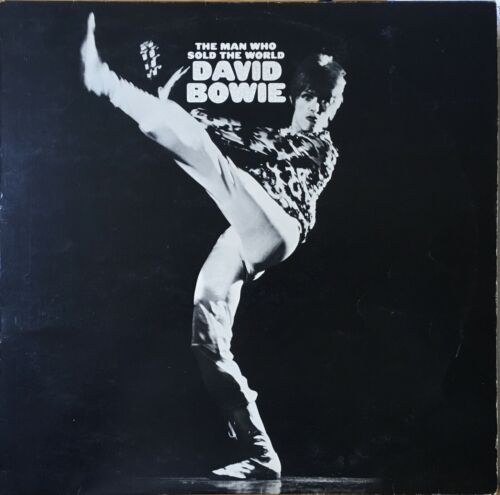
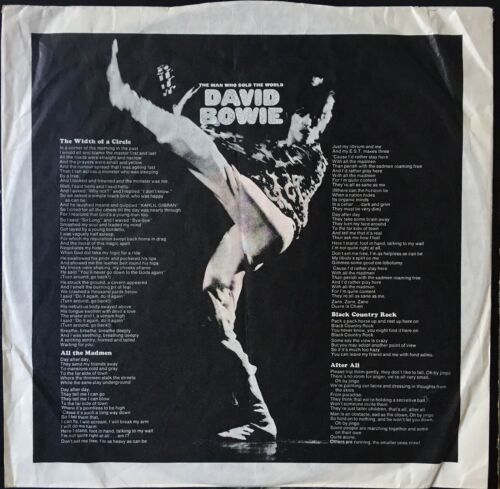
David Bowie ? "The Man Who Sold The World" RCA Victor ?LSP-4816 Vinyl, LP, housed in a printed inner sleeve and reissued in 1972. The LP included a fold-out poster of the album's artwork. This is a pre-Mainman issue, with Titanic credits on the label.
The vinyl appears to have been lightly played and is in great shape. It played through beautifully on my elderly stereo - no hop, stick or jump. It is housed in its original printed inner sleeve, which, although a little creased, is generally in good condition - no rips or writing. The sleeve, similarly, is in good shape, again with no rips or writing. The spine is intact and legible. The poster is in good condition, although a previous owner has written a song-list on the back. Matrix / Runout Side 1 : BPRS 4512-1E Matrix / Runout Side 2 : BPRS 4513-1E
"The Man Who Sold the World" is David Bowie's third studio album. It was originally released in the United States by Mercury Records on 4 November 1970, and then in April 1971 in the United Kingdom. He recorded the album with producer Tony Visconti at Trident Studios in London and Advision Studios in central London.
The album's hard rock style was a departure from the largely acoustic music of Bowie's previous self-titled album. Author David Buckley has described that record as "the first Bowie album proper." NME critics Roy Carr and Charles Shaar Murray have said of "The Man Who Sold the World", "this is where the story really starts".
"The Man Who Sold the World" was generally more successful commercially and critically in the US than in the UK when it was first released. Music publications Melody Maker and NME found it "surprisingly excellent" and "rather hysterical", respectively. John Mendelsohn of Rolling Stone called the album "uniformly excellent" and commented that producer Tony Visconti's "use of echo, phasing, and other techniques on Bowie's voice ... serves to reinforce the jaggedness of Bowie's words and music", which he interpreted as "oblique and fragmented images that are almost impenetrable separately but which convey with effectiveness an ironic and bitter sense of the world when considered together". Sales were not high enough to dent the charts in either country at the time, however it made No. 26 in the UK and No. 105 in the US following its re-release on 25 November 1972, in the wake of Bowie's commercial breakthrough "The Rise and Fall of Ziggy Stardust and the Spiders from Mars".
In a retrospective review for AllMusic, senior editor Stephen Thomas Erlewine cited "The Man Who Sold the World" as "the beginning of David Bowie's classic period" and complimented its "tight, twisted heavy guitar rock that appears simple on the surface but sounds more gnarled upon each listen". Erlewine viewed its music and Bowie's "paranoid futuristic tales" as "bizarre", adding that "Musically, there isn't much innovation ... it is almost all hard blues-rock or psychedelic folk-rock – but there's an unsettling edge to the band's performance, which makes the record one of Bowie's best albums". In a review upon the album's reissue, Q called it "a robust, sexually charged affair", while Mojo wrote, "A robust set that spins with dizzying disorientation ... Bowie's armoury was being hastily assembled, though it was never deployed with such thrilling abandon again".
price rating


