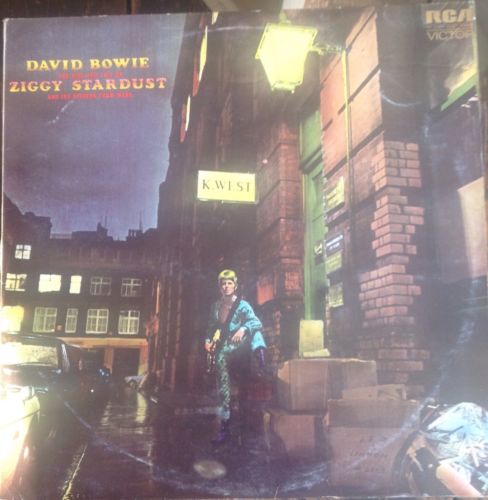
David Bowie "Ziggy Stardust" RCA Victor SF 8287 1972 1st Press 1E/1E + inner
£
17
$
23


Favourite Auctions
To save auctions to your favourites, please login
If you don't have an account, please register
Description
David Bowie ? "The Rise And Fall Of Ziggy Stardust And The Spiders From Mars" RCA Victor ? SF 8287
First UK issue, released in 1972. Includes printed lyric inner. Identifying features include Titanic Music publishing credit and no Mainman logo on the back of the sleeve. Track A1 to A4, B1 to B6 - Titanic Music/Chrysalis Music Track A5 - Rondor Music A Gem Production
The outer sleeve has some slight ring-wear to the front and rear but is in great condition generally, with no tears or writing. The spine is intact and totally legible. The printed inner sleeve is in good condition apart from a 1" tear at the bottom middle. The vinyl is in great shape. It does have a few surface scuffs but plays through really well on my Dansette - no sticks or jumps. Matrix / Runout (A-side, variation 1): BGBS 0864 - 1E Matrix / Runout (B-side, variation 1): BGBS 0865 - 1E
"The Rise and Fall of Ziggy Stardust and the Spiders from Mars" (often shortened to "Ziggy Stardust) is David Bowie's fifth studio album. It is a concept album telling the story of a fictional rock star named Ziggy Stardust. It peaked at No. 5 in the United Kingdom on the UK Albums Chart and No. 75 in the United States on the Billboard 200, then improved to a No. 21 position in the wake of Bowie's death.
The album tells the story of Bowie's alter ego Ziggy Stardust, a rock star who acts as a messenger for extraterrestrial beings. Bowie created Ziggy Stardust while in New York City promoting Hunky Dory and performed as him on a tour of the United Kingdom, Japan and North America. The album, and the character of Ziggy Stardust, was known for its glam rock influences and themes of sexual exploration and social commentary. These factors, coupled with the ambiguity surrounding Bowie's sexuality and fuelled by a ground-breaking performance of "Starman" on Top of the Pops, led to the album being met with controversy and since hailed as a seminal work.
In 1987, as part of their 20th anniversary, Rolling Stone magazine ranked it No. 6 on "The 100 Best Albums of the Last Twenty Years." In 1997, Ziggy Stardust was named the 20th greatest album of all time in a Music of the Millennium poll conducted in the UK by HMV Group, Channel 4, The Guardian and Classic FM. In 1998, Q magazine readers placed it at No. 24 and Virgin All-time Top 1000 Albums ranked it at No. 11, while in 2003 the TV network VH1 placed it at No. 48. It was named the 35th best album ever made by Rolling Stone on their list of the 500 Greatest Albums of All Time. In 2000 Q placed it at No. 25 in its list of the 100 Greatest British Albums Ever. In 2004 it was placed at No. 81 in Pitchfork Media's Top 100 Albums of the 1970s. In his 1995 book, "The Alternative Music Almanac", Alan Cross placed the album at No. 3 on the list of '10 Classic Alternative Albums'. In 2006, the album was chosen by TIME magazine as one of the 100 best albums of all time.
The album cover photograph was taken outside furriers "K. West" at 23 Heddon Street, London, W1., looking south-east towards the centre of the city. Bowie said of the sign, "It's such a shame that sign went [was removed]. People read so much into it. They thought 'K. West' must be some sort of code for 'quest.' It took on all these sort of mystical overtones." The post office in the background (now "The Living Room, W1" bar) was the site of London's first nightclub, The Cave of the Golden Calf, which opened in 1912. As part of street renovations, in April 1997 a red "K series" phonebox was returned to the street, replacing a modern blue phonebox, which in turn had replaced the original phonebox featured on the rear cover.
price rating


![Arlo Parks - My Soft Machine [New Vinyl LP]](https://www.popsike.mobi/php/thumbnail.php?url=https://www.popsike.pics/pix/20230606/364289557606.jpg)


