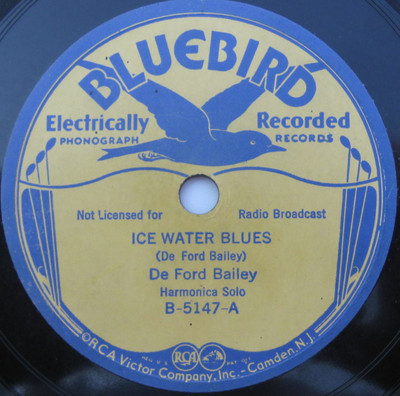
DeFORD BAILEY - harp blues 78 "ICE WATER BLUES"
$
50


Favourite Auctions
To save auctions to your favourites, please login
If you don't have an account, please register
Description
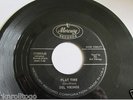
DeFORD BAILEY harp blues 78 rpm on BLUEBIRD 5147 in VG+ condition.
The tunes are "ICE WATER BLUES" and "DAVIDSON COUNTY BLUES."
Here's an article on DeFords life:
DeFord Bailey (December 14, 1899 - July 2, 1982) was a harmonica virtuoso, a blues singer, a guitarist, a banjoist, a composer and a founding member of the WSM Grand Ole Opry. Bailey performed on WDAD, the first significant Nashville radio station, in 1925. Soon afterwards Dr. Humphrey Bate took him to play his harmonica on the new and much more powerful WSM station. At his first appearance on the "Barn Dance" DeFord immediately impressed the announcer, "the Solemn Old Judge" George Hay, who threw his steamboat whistle high in the air and declared that he was henceforth going to be a regular part of the show. According to Judge Hay, DeFord was both the inspiration for the naming of the Opry, and the very first performer to play on the newly named show. This occurred in 1927 following a network program with a classical rendition of a locomotive by composer Dr. Walter Damrosch. After hearing the classical version of the train, Hay opened the program by telling the audience that they had been listening to "Grand Opera," but would now hear "Grand Ole Opry" and introduced DeFord Bailey to play his harmonica version of the Pan American train.
Hay called Bailey the "Harmonica Wizard" and arranged for him to be in the very first recording session in the city that later became Music City USA. That was in the fall of 1928 when Victor came to Nashville at Judge Hay's request. DeFord recorded eight tunes in this session that was held in the YMCA building. He had previously recorded tunes in Atlanta and New York City sessions arranged by Hay.
The "Harmonica Wizard" performed virtually every Saturday night on the Opry from 1926 until 1941, a record none of the other performers could match, and he was clearly one of the most popular performers on the show. During this time he also traveled extensively over the South and Mid-West with various Opry performers. These included Uncle Dave Macon, Alton and Rabon Delmore, Arthur Smith, Sam and Kirk McGee, Sarie and Sally, Lasses White and Honey Wilds, Paul Warmack and the Gully Jumpers, the Fruit Jar Drinkers, Curt Poulton and the Vagabonds, Clayton McMichen, Ken Hackley, and later Roy Acuff and Bill Monroe.
DeFord was always well received by the audiences when he performed out on the road; but traveling in the 1920 and 1930s, the hey day of Jim Crow, with the all white groups was exceedingly difficult. In the winter he always carried a wool blanket with him in case he had to sleep in the car when the other performers could not find a place for him to stay. Virtually none of the hotels or restaurants would knowlingly allow him to eat or sleep inside as a guest. Uncle Dave Macon would claim that DeFord was his valet in order to get him inside his room and then bring in a seat from the car for DeFord to sleep on. Some restaurants would let him eat in the kitchen, but usually he would eat outside or in the car.
A victim of the licensing battle between ASCAP and the newly formed BMI in 1941, Bailey was told he could no longer play on WSM the tunes that he had played on the air for over 15 years and had made him famous. Instead he would have to play completely new ones on WSM. He did not fully understand what was going on and his simple reaction was that he would leave the show if he could no longer play his tunes. As a result he was terminated from the program; and although the licensing battle between the two groups was resolved a few months later, this effectively ended his performing career. He continued to play his harmonica on a daily basis and enjoyed entertaining friends and patrons of his shoe shine shop, but he seldom performed publicly after this.
Bailey lived out his later life in a high rise Public Housing building for the elderly in the Edgehill neighborhood of Nashville. This was just blocks from Music Row, headquarters of the entertainment industry he helped to create. While he did not want to dwell on the negative, he was somewhat bitter about his departure from the Opry, and turned down television, film and recording offers in the 1960s and 1970s.
POSTAGE & HANDLING: (I pack 78's very carefully in oversized boxes surrounded by styrofoam pellets.)
U. S. - US Priority Mail - $9.79 for 1st 78, 2 - 78's is $13.95 (Priority Mail recommended for 78's)
U.S. Media Mail - $4.00
CANADA - AIRMAIL - $13.50 for 1st 78
EUROPE & ASIA AIRMAIL - $22.25 for 1st 78, 2 - 78's is $24.50
GRADING:
M-
A like new record with virtually no imperfections. Any evident inferfections would be minor and noted. Labels are great and should show no wear. Any imperfections will be noted.
VG++
In our grading, a VG++ is similar to an E+ grade. The record will be close to M- except for a few light scuffs or minor imperfections. A very pleasing record for any collection that looks and sounds excellent.
VG+
The record has signs of use, but the wear should not be too visually or audibly distracting. Minor light scratches or scuffs would be present and if there are audible pops, they should be minimal. Any unusual imperfections will be noted.
VG
A record that has been obviously well played, yet audibly still sounds okay. Background pops or hiss should be minimal and anything unusual will be noted.
VG-
A worn record that has significent wear and/or imperfections. The record plays through but pops and hiss is likely evident. Sound quality varies on VG- records, some can still sound okay and I will usually note anything unusual.
G
A record that is visually and probably audibly distracting.
Check out my other ebay listings!
price rating