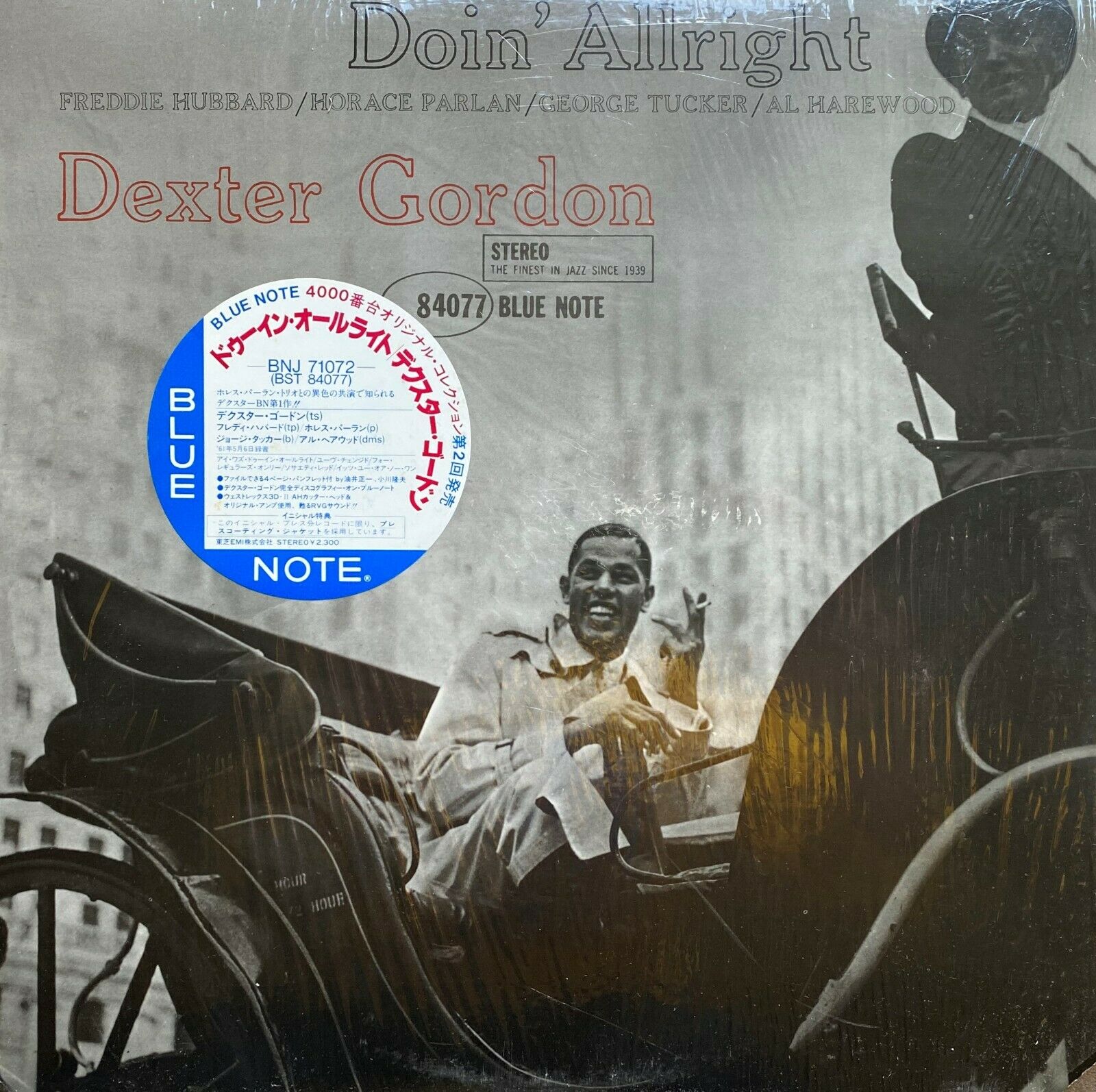
Dexter Gordon: Doin' Allright-1970s Blue Note Japanese Import Stereo 12" Record
$
35


Favourite Auctions
To save auctions to your favourites, please login
If you don't have an account, please register
Description
1970's Japanese Import Stereo Reissue of Classic 1961 Blue Note Release of Bandleader/Composer/Tenor Saxophone Master Dexter Gordon Entitled Doin' Allright, Produced by Alfred Lion, Recording by Rudy Van Gelder, Liner Notes by Ira Gitler - "As one of the great tenors to emerge from Los Angeles' Central Avenue scene, Dexter Gordon led a colorful and eventful, sometimes tragic life that included three triumphant comebacks in a four-plus-decade career. As a beloved, influential member of the bebop generation, his story (and Bud Powell's) inspired French director Bertrand Tavernier to tell a portion of it in the 1986 drama 'Round Midnight, and cast him in a lead role. Gordon was the top tenor saxophonist during the bop era, the possessor of his own distinctive sound, he created a large body of superior work and could successfully battle nearly anyone at a jam session. His years as a leader and co-leader at Dial, Savoy, and Blue Note were enough to make him a legend. Living in Europe for more than a dozen years, he recorded equally fine albums for Prestige, Steeplechase, and other labels, and his return to the U.S. resulted in several offerings for Columbia and Blue Note. Gordon was born to renowned parents in Los Angeles in 1927. His father, Dr. Frank Gordon, was among the first African American doctors in the city after graduating from Howard Medical School in Washington, D.C. in 1918. (His patients included Duke Ellington and Lionel Hampton.) His mother, Gwendolyn Baker, was the daughter of Captain Edward Baker, one of the five African American Medal of Honor recipients during the Spanish–American War. Gordon began playing clarinet at age 13 and switched to saxophone two years later. While at school, he played in bands with Chico Hamilton and Buddy Collette. His first important gig was with Lionel Hampton (1940-1943) although, due to Illinois Jacquet also being in the sax section, Gordon did not get any solos. In 1943, he did get to stretch out on a recording session with Nat King Cole. Short stints with Lee Young, the Fletcher Henderson Orchestra, and Louis Armstrong's big band preceded his move to New York in December 1944 where he was hired for Billy Eckstine's Orchestra, trading off with Gene Ammons on Eckstine's recording of "Blowin' the Blues Away." Gordon recorded with Dizzy Gillespie ("Blue 'N' Boogie") and as a leader for Savoy before returning to Los Angeles in the summer of 1946. He was a major part of the Central Avenue scene, trading off with Wardell Gray and Teddy Edwards in many legendary tenor battles; studio recordings of "The Chase" and "The Duel" helped to document the atmosphere of the period. After 1952, drug problems resulted in jail time and periods of inactivity during the rest of the '50s (although Gordon did record two albums in 1955). By 1960, he had recovered sufficiently to cut a core series of dates for Blue Note including Doin' Alright, Dexter Calling, Swingin' Affair and Go). After reestablishing his reputation, he moved to Europe in 1962 and remained there until 1976. While on the continent, he was in peak form -- Gordon's many SteepleChase recordings rank with the finest work of his career and include four dates with altoist Jackie McLean. Gordon returned to the U.S. on an occasional basis, recording in 1965, 1969-1970, and 1972, but by then he was almost forgotten in his native land though he remained a major attraction in Europe. Given this status, it proved an odd yet welcome surprise that his return to America in 1976 was treated as a major media event, illustrated by the double-live Homecoming from his American tour and the studio date Sophisticated Giant in 1977. A great deal of interest was suddenly shown in the living legend, with long lines of people waiting at clubs to see him. In 1978, appearing with Johnny Griffin, he sold out Carnegie Hall. Gordon remained a popular figure until his gradually worsening health made him only semi-active by the early '80s. His third comeback occurred when he was picked to star in the motion picture 'Round Midnight. Gordon's acting was quite realistic and touching. He was nominated for an Academy Award four years before his death. In the 21st century, several important live finds have been issued including the Dutch Archives' In the Cave: Live at Persepolis, Utrecht, 1963, Rhino's vinyl-only Live at the Playboy Jazz Festival, and Elemental's At the Subway Club 1973." - "The title of this Blue Note set, Doin' Allright, fit perfectly at the time, for tenor saxophonist Dexter Gordon was making the first of three successful comebacks. Largely neglected during the 1950s, Gordon's Blue Note recordings (of which this was the first) led to his rediscovery. The tenor is teamed with the young trumpeter Freddie Hubbard, pianist Horace Parlan, bassist George Tucker, and drummer Al Harewood for a strong set of music that is highlighted by "You've Changed" (which would become a permanent part of Gordon's repertoire), "Society Red" (a blues later used in the film Round Midnight), and "It's You or No One." - Spectacular Personnel for the Quintet Features Legendary Composer Dexter Gordon on Tenor Saxophone, the Great Freddie Hubbard on Trumpet, the Talented Horace Parlan on Piano, George Tucker on Bass and Al Harewood on Drums! - Selections on Side One Are the George Gershwin/Ira Gershwin Standard I Was Doing All Right at 9 Minutes 22 Seconds, the Bill Carey/Carl Fischer Classic You've Changed & Original Dexter Gordon Composition for Regulars Only - Tracks for Side Two Consist of the Dexter Gordon Penned Society Red at 12 Minutes 25 Seconds and the Sammy Cahn/Jule Styne Standard It's You or no One - Used Copy, Cover Near Mint Still in Plastic Sealant Wrapper, Record Mint- - Japanese Import, With Insert, Stereo Recording, Product Code BST-84077 - California Residents Add 9.75% Sales Tax - International S & H Extra -
price rating