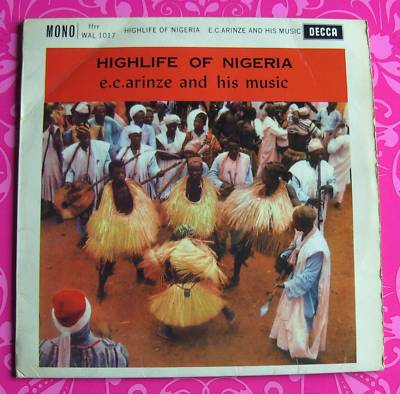
E C ARINZE Highlife Of Nigeria 10"LP DECCA 50s VG+ 5***
£
36
$
47


Favourite Auctions
To save auctions to your favourites, please login
If you don't have an account, please register
Description
10” DISC
ARTIST: E. C. ARINZE
TITLE: HIGHLIFE OF NIGERIA
LABEL + YEAR: Decca WAL 1017, yellow with silver lettering label, Decca unboxed logo; 1950s recording UK Press Mono
CONDITION VINYL: VG+, play grade VG+/Ex
CONDITION SLEEVE: Excellent
DESCRIPTION:
Side One:
NNE BU NNE in Ibo
SATURDAY NIGHT in Pidgin English
CHUKWU FULUM NANYA in Ibo
NGWO NGWO in Ibo
YADIBA in Ibo
Side Two:
FREEDOM HIGHLIFE in Ibo
OGBUEFI NNAMDI AZIKWE in Ibo
OZO EMENA in Ibo
LUMUMBA CALYPSO in Pidgin English
SISI SISI in Yoruba
Nigerian popular music can be traced back to the early 20th century when a variety of performance styles were being blended together in its southern cities. There were indigenous ethnic praise-singing and drumming styles, Yoruba "agidigbo" hand-piano music and the waka, were and later sakara music of Muslim festivals. Outside influences were already widespread, from the marches of local syncopated brass bands and the samba and carnival of freed Brazilian slaves who had settled in Lagos to the goombay and ashiko frame-drum music styles of Sierra Leone and later low-class Ghanaian or "konkoma" street parade highlife. The Liberian guitar songs of visiting Kru mariners playing at dockside joints heavily influenced the emerging "palm wine" or "native blues" music of the Lagos Jolly Orchestra, Ambrose Campbell, Julius Araba, Irewolede Denge and S.S. Peters. These guitar and mandolin styles gave way to Yoruba "juju" music by the early ‘30s, pioneered by Tunde King, Ojoge Daniels, Tunji Banjo and Ayinde Bakare; "ju-ju" itself used as an onomatopoeic word for the low-high tones of the local tambourine used as a key part of the rhythm syncopations. All of these low-class Nigerian dockside, palm wine and juju street-music styles became the catalyst for the booming "native records" industry developed by Zonophone, HMV and Odeon in 1920's/30's English-speaking West Africa.
HIGHLIFE DANCE BAND EXPLOSION
The Second World War brought many British and American soldiers to Nigeria who introduced ballroom dance crazes such as the rumba, calypso and, perhaps most importantly, American big-band "swing" music. A thriving local nightlife scene consequently sprang up featuring bands like the Deluxe Swing Rascals, Harlem Dynamites and Bobby Benson's band that took residence at high-class venues across Lagos. These ballroom-cum-swing jazz bands considered themselves modern and prestigious and consciously distanced themselves from indigenous juju music and native blues that they associated with the city streets and rough drinking dives. The term "highlife" signified high-class, a clear musical and cultural statement. The contrast was marked in Ghana, Nigeria's next-door neighbour, whose ballroom dance orchestras, like the Cape Coast Sugar Babies (who toured Nigeria in 1937) had begun orchestrating Ghanaian street-songs as early as the mid-1920s. The most important of the wartime Ghanaian ballroom dance bands was the Tempos who, by 1948 and under the leadership of the trumpeter E.T. Mensah, developed an infectious blend of highlife and swing that became the musical symbol or "spirit of the age" for West Africa as it moved towards independence. The Tempos toured extensively across Nigeria between 1950-7, which resulted directly in Nigerian dance bands, like Bobby Benson's band and E.C Arinze's Empire Band, developing their own version of highlife using local languages and dialects. Victor Olaiya and Eddie Okonta both left Bobby Benson to form their own Cool Cats and Lido highlife bands respectively, whilst Rex Lawson broke away from the Empire Band to found the Riversmen. Other pioneering Nigerian highlife musicians included Sammy Akpabot, Bill Friday, Agu Norris, Enyang Henshaw, Charles Iwegbue, as well as Zeal Onyia and "Baby-Face" Paul Isamade who both joined the Tempos in Accra for a while. A young Victor Uwaifo from the Mid-Western (now Edo) State drew influence from the Tempos to create a unique Benin style of highlife with his Melody Maestroes band in 1965.
During the ‘50s, a healthy record industry grew up in Nigeria for the expanding crop of highlife bands as well as the juju music and percussive apala music that had evolved out of the earlier Yoruba Islamic sakara style. In 1947, Decca launched its prolific West Africa record series and, by the late ‘50s, was pressing a quarter of a million singles a year. Shortly afterwards, Phillips/Phonogram (later PolyGram) and EMI built pressing plants in Nigeria. Reflecting this music boom, the Nigerian Musicians Union (NUM) was formed in 1958 by Bobby Benson, Chris Ajilo of the Afro-Cubanos, trumpeter Zeal Onyia and Amaefule Ikoro. Its Ghanaian Treasurer, Stan Plange, remembers the NUM organising a huge demonstration in 1960 around Nigeria's independence celebrations, when the Nigerian government slated the Latin American bandleader Edmundo Ros (a favourite with Britain's visiting Princess Margaret) to come and play at the event. The NUM protest succeeded, with Prime Minister Tafawa Balewa agreeing to feature a mass Nigerian NUM band instead.
price rating



![The Infamous by MOBB DEEP [VINYL]](https://www.popsike.mobi/php/thumbnail.php?url=https://www.popsike.pics/pix/20250612/177185030920.jpg)
![The Infamous by MOBB DEEP [VINYL]](https://www.popsike.mobi/php/thumbnail.php?url=https://www.popsike.pics/pix/20250901/376519996509.jpg)
