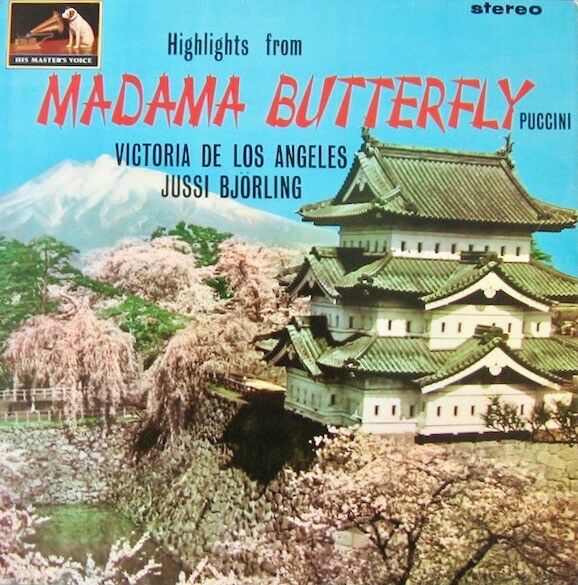
EMI LP ASD-609: PUCCINI - Madama Butterfly Hi-Lites - SANTINI - 1964 UK Half Dog
C$
100
$
72



Favourite Auctions
To save auctions to your favourites, please login
If you don't have an account, please register
Description
****Welcome to our listing, thanks very much for looking!
****See our own website! We have lots of out of print LPs and CDs! Find us on the web at -
hearthedifference.net
****Please see our other listings - new items added daily!
****Shipping cost is only an estimate - it depends on the actual weight and size of the package as well as the service required. We do not profit from shipping costs, so if we overcharge, we will refund the difference back to you. It's always best to wait for our invoice before paying for your item. We will combine shipping for multiple items purchased.
Background -
Victoria de los Angeles was one of the finest lyric sopranos in the decades after World War II. She was born Victoria Gómez Cima. She learned to sing and play piano and guitar while still in school. She entered the Conservatorio de Liceo in Barcelona to study piano and singing, completing the six-year program in three, and graduating with full honors at the age of 18. Her membership in the Conservatory's Ars Musicae gave her wide exposure to the art song repertory and Baroque and Renaissance music.De los Angeles debuted in a song recital at the Palau de la Música Catalana. Her operatic debut was also in Barcelona, at the Gran Teatro del Liceo, singing the Countess in Mozart's Marriage of Figaro.
Her national and international breakthroughs occurred after she won the Geneva International Singing Competition in 1947. She was immediately booked for performances in Madrid, singing in Manon and La Bohème opposite Beniamino Gigli before returning to Barcelona. There she moved into Germanic roles, adding Freischütz, Lohengrin, and Tannhäuser to her portrayals. The Geneva Competition had also brought her to the attention of the BBC, which brought her to London to sing the part of Salud in Manuel de Falla's La Vida Breve in 1948, when she signed an exclusive contract with EMI. This association lasted 30 years and included at least 21 full-length opera recordings, 25 solo recitals, and appearances on 40 other EMI releases.
Her first Paris appearance was in 1949, as Marguerite in Gounod's Faust, a role she repeated as her Metropolitan Opera debut in 1951. She debuted in Covent Garden in 1950, once again singing Mimì in La Bohème, which was one of the roles most closely associated with her. She sang regularly at both the Met and Covent Garden. Wieland Wagner asked her to sing in a new production of Tannhäuser opening the Bayreuth Festival for 1961.
She sang in most of the major houses of the world, touring in South Africa, the Middle East, Australia, East Asia, and Latin America (where she was a frequent guest artist at the Teatro Colón in Buenos Aires). She performed with such great conductors as Thomas Beecham, Herbert von Karajan, Georg Solti, Pierre Monteux, Carlo Maria Giulini, Charles Münch, Zubin Mehta, and Rafael Frühbeck de Burgos.
She had a wide vocal and dramatic range, singing in operas as diverse as Carmen, The Barber of Seville, Acis and Galatea, Pelléas et Mélisande, Die Meistersinger, Simon Boccanegra, Dido and Aeneas, La Traviata, and Madama Butterfly. In one evening, she sang both the roles of Nedda in I pagliacci and Santuzza in Cavalleria rusticana. As a recitalist, her vast and wide repertory embraced not only the central German and French Romantic and 20th century eras, but had a strong representation of early music. In addition, she often added Spanish and Catalan folk songs to her solo recitals.
Besides having a lovely, warm, and dark tone, she was always noted for the intelligence of her portrayals and musical choices. She closely monitored her own singing. She retired from the operatic stage in 1969, after an exceptionally successful portrayal of Verdi's Desdemona in Dallas, though she returned to Covent Garden as Carmen in 1978.
However, she continued singing recitals. As time passed, she lowered the number of her appearances, yet reviews continued to stress the purity of her voice. She was heard to say that the moment she heard a wobble in her voice she would "shut up the shop." One of her last appearances was in connection with the 1992 Olympic Games in Barcelona, where she still exhibited characteristic vocal purity. - Joseph Stevenson
Jussi Björling was one of the most admired tenors of the twentieth century. He was never an effective actor on stage nor was he particularly handsome, but his excellent technique, scrupulous musicianship, and beautiful voice, with its powerful and focused top, made him one of the most-demanded stars of his day. Those with a fondness for such comparisons consistently called him "the second Caruso" or "the Swedish Caruso." Some found his rather smooth timbre inexpressive, particularly those used to Gigli's frequent use of sobs and other extra-musical effects, but others found that its directness, combined with his sensitivity to phrasing, made the music all the more expressive. At times he did have a tendency to sing slightly sharp, but to listeners without an acute sense of pitch it was almost undetectable.
Björling came from a musical family and began his career early -- his singing debut came at the age of five. His father, David, was a fine singer who formed the Björling Male Quartet with the older three boys, Olle, Jussi, and Gosta. They performed world-wide, made some recordings for American Columbia (including Jussi's first solo recordings), and settled in the United States in 1920. While they were wildly popular, they had financial problems, and when David Björling died in 1926, the quartet broke up.
In 1928, Jussi succeeded in getting an audition with Karl-Martin Oehmann. Oehrmann was so impressed that he recommended Björling to the Royal Opera in Stockholm, where he was given a stipend for room, board, studies at the conservatory, and a new suit. Two years later, Björling made his operatic debut as the Lamplighter in Puccini's Manon Lescaut and took on his first leading role a month later as Don Ottavio in Mozart's Don Giovanni. In 1933, he first sang the role of Romeo in Gounod's Romeo et Juliette, a role with which he would later become strongly associated. He met Anna-Lisa Berg, a lyric soprano, while at the Swedish Music Academy and Royal Opera school, and their marriage lasted until his death, despite the alcoholism that troubled his entire adult life.
He made his Vienna debut in 1936, his United States debut in a Carnegie Hall concert in 1937 (his United States operatic debut was a short time later that same year, as the Duke of Mantua, in Chicago), and his Salzburg debut as Don Ottavio in Don Giovanni. In 1936, he also began a long recording association with HMV. He made his Met debut in 1938 in La Bohème and in 1939 his Covent Garden debut as Manrico. Like those of most other opera singers, his international career was limited by World War II, but when the war was over, he again sang all over the world. In 1950, he took the title role in the famous Met production of Verdi's Don Carlo that inaugurated Rudolf Bing's administration. As his career expanded and he was able to be more selective about his stage roles, he began to limit his repertoire to the major Italian and French lyric roles, with a few forays into the lyrico-spinto repertoire. However, he recorded and performed in concert excerpts from many roles he had never explored on stage, as well as lieder and his beloved Swedish songs.
In March of 1960, Björling had a heart attack before a performance at Covent Garden. While he chose to finish the performance, his symptoms became still more serious, and he and his family returned to Sweden, where he died that September. - Anne Feeney
-
LP made by EMI (His Master's Voice) Records, in the UK / England / Great Britain
-
LP released in 1964
-
LP recorded in STEREO
-
Record Catalog Number: ASD 609
-
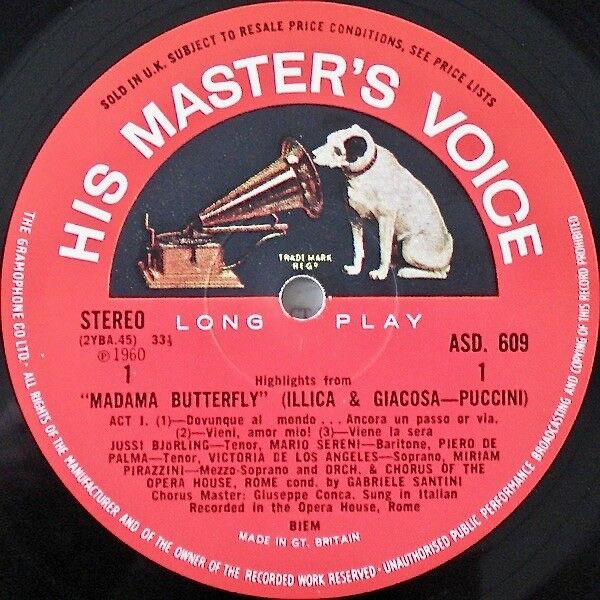
Record Labels are primarily RED with BLACK & WHITE lettering, and has the "HALF DOG" logo on the record labels - earliest pressing.
Puccini // Santini / De Los Angeles / Bjorling
Puccini: Highlights from Madama Butterfly
Track Listing -
Act IA1. Dovunque Al Mondo... Ancora Un Passo Or Via
A2. Vieni, Amour Mio!
A3. Viene La Sera
Act II
B1. Un Bel Di, Vedremo
B2. Scuoti Quella Fronda
B3. Humming Chorus
B4. Addio Fiorito Asil
B5. Come Una Mosca Prigioniera... Con Onor Muore
Performers / Credits -
• Baritone Vocals [Sharpless Consul] – Mario Sereni
• Chorus – Chorus Of The Opera House, Rome
• Chorus [Master] – Giuseppe Conca
• Conductor – Gabriele Santini
• Mezzo-soprano Vocals [Suzuki] – Miriam Pirazzini
• Orchestra – Orchestra Of The Opera House, Rome
• Soprano Vocals [Cho-cho-san, Butterfly] – Victoria De Los Angeles
• Tenor Vocals [Goro] – Piero De Palma
• Tenor Vocals [Pinkerton] – Jussi Bjorling
Other Information -
Original flap-back sleeves, front of jacket has clarifoil
Recorded In The Opera House, Rome. Sung in Italian
A leaflet giving the Italian text and an English translation is enclosed within this record.
1st label is red with white lettering and the HMV semi-circle logo
• Matrix / Runout (Label Matrix: Side A): 2YBA.45 • Matrix / Runout (Label Matrix: Side B): 2YBA.46
• Matrix / Runout (Runout: Side A): 2YBA 45-1
• Matrix / Runout (Runout: Side B): 2YBA 46-2
CONDITION Details:
The LP Jacket is in near mint minus condition! The jacket has NO seam splits or crushed corners! The corners and seams are solid with just some light shelf wear evident. The front of the jacket is laminated with "clari-foil" (not the back). The jacket has the flipped over or "clam-shell" seams at the top, bottom and spine. The colors on the jacket are sharp and clean (see pictures with this listing for more details).
Paper insert is included and is in near mint condition.
The LP is in near mint minus condition! We found that the vinyl looked superb on this vintage LP. There are no significant marks and the LP retains much of the original gloss and sheen - obviously well taken care of! There may be a bit of dust and perhaps a finger print or two on the vinyl so the LP should be cleaned before playing. There are NO serious spindle marks on the record labels either. Just beautifully made vinyl! That said, acquiring a vintage LP like this is for the performance and rarity of the LP, not necessarily for the sound quality.
A Short Note About LP GRADING -- Mint = Only used for sealed items.
- Near Mint = Virtually flawless in every way.
- Near Mint Minus = Item has some minor imperfections, some audible.
- Excellent = Item obviously played and enjoyed with some noise.
- Very Good Plus = Many more imperfections which are noticeable and obtrusive.
For best results, always properly clean your LPs before playing them.
The LP is an audiophile quality pressing (any collector of fine MFSL, half speeds, direct to discs, Japanese/UK pressings etc., can attest to the difference a quality pressing can make to an audio system).
Do not let this rarity slip by!
price rating