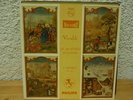
ESOTERIC ESLD-10010 Vivaldi : Le quattro stagioni I Musici Vinyl Record
$
92


Favourite Auctions
To save auctions to your favourites, please login
If you don't have an account, please register
Description
Click here to see all products in our store!
* Description
The most Italian of all, filled with beautiful cantabile and rich singing, this work sparked the Baroque music boom of the late 20th century.
The I Musici Ensemble's bright yet lustrous tone, lively rhythm and clarity, exquisite legato technique, and the uniformity of each performer make this recording ideal for recreating Vivaldi's masterpiece. It is no exaggeration to say that this recording became the original image of this piece in the latter half of the 20th century.
The I Musici has recorded The Four Seasons over half a century, but this 1959 stereo recording was the starting point.
The violin solo was performed by Felix Ayo, one of the founding members of I Musici, who served as concertmaster for 17 years until 1968 and helped establish the ensemble's first golden age.
This album, which brings out the charm of the violin as a singing instrument to the utmost, has been reissued on analog for the first time in 33 years in Japan.
Antonio Vivaldi (1678-1741)
Concerto for Violin and Orchestra “The Four Seasons”
[Side A]
Concerto No. 1 in E major, RV 269 “Spring”
1st movement: Allegro
- Second Movement: Largo
- Third Movement: Allegro (Danza pastorale)
Concerto No. 2 in D minor, RV 315 “Summer”
- First Movement: Allegro non molto – Allegro
- Second Movement: Adagio - Presto – Adagio
- Third Movement: Presto (Tempo impetuoso d'estate)
[Side B]
Concerto No. 3 in F major, RV293 “Autumn”
- 1st Movement: Allegro (Ballo, e canto de'villanelli)
- 2nd Movement: Adagio molto (Ubriachi dormienti)
- 3rd Movement: Allegro (La caccia)
Concerto No. 4 in F minor, RV297 “Winter”
- 1st Movement: Allegro non molto
- Second Movement: Largo
- Third Movement: Allegro
Felix Ayo (violin)
I Musici Ensemble
[Recording] April 29–May 6, 1959, Vienna
[LP debut] Philips 835 030 AY (1961)
With the arrival and spread of LP records in the mid-20th century, interest in Baroque music accelerated rapidly.
Formed in 1952 by students of the Santa Cecilia Music Academy in Rome, the I Musici Ensemble, whose name means “the musicians” in Italian, sensed this growing interest in Baroque music and began performing with the aim of restoring the authentic expression of Italian Baroque music, including Vivaldi and Corelli, which had been distorted by 19th-century Romanticism.
The ensemble adopted a compact formation of 12 members, including 11 string players (3 first violins, 3 second violins, 2 violas, 2 cellos, and 1 double bass) and 1 harpsichordist. They established a consensus-based decision-making system for all members regarding repertoire and performance policies. With the academic legitimacy gained from post-World War II research and the publication of scores on Baroque music, the ensemble embarked on the exploration of a new genre within classical music.
The I Musici ensemble debuted in 1952 and achieved great success within a few years, gaining worldwide popularity not only in Europe but also in South America.
The legendary conductor Arturo Toscanini, who heard the ensemble's performance, praised it enthusiastically, exclaiming, “Bravo! Bravissimo! Music is not dead!” This endorsement further solidified the ensemble's growing popularity.
The bright yet lustrous tone, lively rhythm and clarity, superb legato technique, and uniformity of the individual players of the I Musici ensemble were ideal for recreating this masterpiece by Vivaldi, and it is no exaggeration to say that they became the origin of the image of this piece in the latter half of the 20th century.
Without emphasizing the descriptive qualities found in the sonnets accompanying the piece or adding improvisational embellishments, the ensemble maintains a natural tempo with appropriate accelerations and decelerations, faithfully reproducing the score in an extremely orthodox approach that allows listeners to enjoy the pure beauty of the piece.
Lee Mu-ji has recorded “The Four Seasons” four more times for Philips over the course of more than half a century leading up to the CD era (with a seventh recording released on a different label in 2012), but the foundation for all of these recordings was this first stereo recording from 1959 (the second overall).
The violin solo was performed by Felix Ayo, the concertmaster (born in 1933 in Cestao, Basque Country, Spain).
He was one of the founding members of I Musici and remained with the ensemble for 17 years until 1968, helping to establish its first golden age.
Ayo's distinctive features were his ability to produce a rich, polished tone from his instrument and his exquisite phrasing achieved through masterful bowing.
This brought out the violin's charm as a singing instrument to its fullest extent.
Many of I Musici's recordings were made at the Sal de Música in La Chaux-de-Fonds, Switzerland, renowned for its exceptional acoustics, but this recording of “The Four Seasons” was made in Vienna (venue unknown).
While it lacks the reverberation of later I Musici recordings, it offers a balanced blend of spaciousness and clarity, with rich resonance in the mid-to-low registers, showcasing the full-bodied sound of the string section.
The producer, Vittorio Negri (1923-1999), was a renowned scholar of Vivaldi and was involved in editing the scores used by I Musici. From the late 1950s, he worked as a producer for Philips, overseeing numerous recordings by I Musici and other artists.
He was also a professional conductor who served as an assistant to Bernhard Baumgartner, a renowned Mozart scholar, and in his later years, he left recordings of his conducting of Vivaldi's religious works and the opera “Tito Manlio” for Philips (he also re-recorded “The Four Seasons” with the Berlin Chamber Orchestra in 1975, which is the opposite of this 1959 recording, ideas and skill, achieving a three-dimensional, crisp performance).
The last domestic analog release of this performance was in 1982, making this analog reissue the first in 33 years.
* Shipping
We ship using FedEx, DHL and Japan Post.
* Payment
We usually ship within 5〜10 business days of receiving cleared payment.
* International Buyers - Please Note:
Import duties, taxes and charges are not included in the item price or shipping charges.
These charges are the buyer’s responsibility.
Please check with your country’s customs office to determine what these additional costs will be prior to bidding/buying.
These charges are normally collected by the delivering freight (shipping) company or when you pick the item up do not confuse them for additional shipping charges.
I do not mark merchandise values below value or mark items as "gifts" - US and International government regulations prohibit such behavior.
price rating