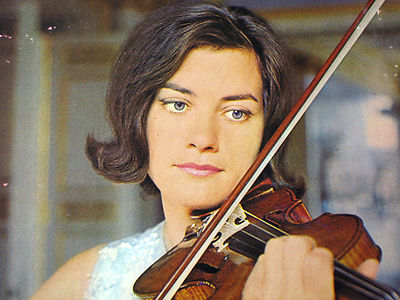
Edith PEINEMANN / Peter MAAG - Dvorak - DGG French de LUXE - MINT
$
94


Favourite Auctions
To save auctions to your favourites, please login
If you don't have an account, please register
Description
Edith PEINEMANN / Peter MAAG - Dvorak / Ravel
Deutsche Grammophon Gesellschaft DGG 139 120 - same as SLPM 139 306, 12" german stereo pressing, big tulip label with 'Made in Germany' pressing, date: 1966
De Luxe cover with hard cardboard cover, inbound record with texts and pictures - pressed in Germany for the French market.
Edith PEINEMANN, violin / Peter MAAG & Orchestre Philharmonique de Pague
Cover: Near Mint ( very few wear ) Vinyl: Mint ( beautiful unplayed condition )
Great musicians with wonderful music !! Amazing sonics !!
Plase note: We are located in Europe. Shipping costs are calculated from Europe with DHL or Hermes
Shipping costs: World € 10
Edith Peinemann (born 3 March 1937) is an internationally recognized German violinist and professor of violin. At age nineteen she won the ARD International Music Competition in Munich, and made her U.S. debut as soloist in 1962 with Max Rudolf, after which she became a protégé of George Szell. In 2005 she became president of the European String Teachers Association.
She made few recordings during her career, making her a "cult figure among violinists." Peinemann is considered one of the world's "finest violinists of her time."
Peinemann was born in Mainz, Germany, the daughter of a Mainz orchestra's concertmaster, with whom she learned violin until the age of fourteen. She later studied with Max Rostal in London,[3] and would fulfill the "prophecy of violinist Yehudi Menuhin who, upon hearing her play when she was 19, predicted a 'brilliant and successful career'."
In 1956, she won the first prize in the International Competition of the German Radio in Munich. At that competition, conductor William Steinberg, who was among the judges, invited her to make her American debut with the Pittsburgh Symphony Orchestra, which she did in 1962. Word spread among Germany's conductors, such as Max Rudolf, about her achievements in the U.S., including her Cleveland debut where she played Dvorak's Violin Concerto. Reviews of that concert were positive, with Carl Apone noting that Dvo?ák's concerto was "a proving ground on which to separate the men from the boys:"
By the time Germany's Edith Peinemann, 24, had reached the end of the first movement, it was obvious that this serious musician had the situation well in hand. . . When Miss Peinemann had completed her evening's work, she was called back for six curtain calls . . some of the men in the audience, as impressed with her physical beauty as with her musical talent. . . The orchestra violinists raved about her playing in a manner not often heard here and swarmed around to congratulate her.
Hungarian-born American conductor and composer George Szell saw her perform in Cleveland, invited her to perform with him at the Concertgebouw in Rotterdam in 1963, the Berlin Philharmonic, and the New York Philharmonic, and often gave her coaching before concerts. She began to call him "Uncle George," as they developed a close friendship during that period. Szell made a special attempt to obtain private funds from wealthy donors to buy her a violin of finer quality, which he helped her select. Peinemann recalls his assistance:
[Szell] was in Zurich and I had my violin dealer from Bern who had a lot of fine instruments come to Zurich. We went to the concert hall there and Mr. Szell went into the audience and I played to him five fine violins: two Guarneri, three Stradivari. And he chose the one I have now, a Guarneri. . . . He was marvelous to young musicians.
She performed as a soloist with the Chicago Symphony Orchestra at the start of their new year in 1966, and with the Atlanta Symphony in January, with Robert Mann conducting.
In 1967, after working with Szell to perfect a performance of Bartok's Violin Concerto No. 2 along with a Beethoven concerto, he asked her to perform Mozart's Violin Concerto No. 3, as Mozart, notes historian Michael Charry, was "a composer he reserved for his favorite and most mature artists.
Later career
Peinemann continued her career over the following decades, becoming a professor of music at Frankfurt University of Music and Performing Arts from 1976, and is listed among their notable teachers, having taught other notable violinists, including Yaakov Rubinstein. She performed as soloist with the Cleveland Symphony in July 1987.
Music professor Dr. David C. F. Wright, in an article acknowledging her contributions, notes that she made her American debut at Carnegie Hall in 1965. In later years, she gave master classes at the Cleveland Institute of Music, Indiana University at Bloomington, Kusatsu Festival in Japan and the Lucerne Conservatory. In 2005, she was the international president of the European String Teachers Association (ESTA). Wright offers his impression of her abilities:
Her recordings are few. There is the Dvo?ák Concerto, Prokofiev 1 and a sensational performance of the Berg conducted by Rudolf Kempe. I have heard and marvelled at her solo Bach and Bruch's first concerto with the BBC Philharmonic ... Along with Ginette Neveu, she is the best.
Critic Roger Hecht described her recorded performance with Kempe:
Edith Peinemann was a cult figure among violinists, and it is easy to hear why ... it is clear that she saw herself as a member of an ensemble rather than a virtuoso soloist. Her warm tone and singing style fit Kempe's approach well. The interplay between violin and orchestra is a pleasure to hear from the opening bars which actually glisten.
Peter Maag: He was born on 10 May 1919 in St. Gallen, Switzerland and died on 16 April 2001 in Verona, Italy.
His father, Otto, was a Lutheran minister, and his mother, Nelly, a violinist who performed in the Capet Quartet as second violinist. His great uncles were conductors Emil and Fritz Steinbach. Peter attended the universities of Zürich, Basel, and Geneva. He was mentored by Karl Barth and Emil Brunner in theology, and Karl Jaspers in philosophy. He studied piano and theory with Czes?aw Marek in Zürich and received further training on piano with Alfred Cortot in Paris. His conducting mentors were Ernest Ansermet, Wilhelm Furtwängler, and Franz von Hoesslin. Son Georg Maag is writer of children's books Georg maag.
Association with Furtwangler
He described his association with Wilhelm Furtwängler to be the most important in his life. He performed as pianist in a Furtwängler concert with Beethoven’s Piano Concerto No. 4 in G major. As recounted by Maag, Furtwängler told him: “"Why don't you try to conduct? I have observed you while you were playing the concert tonight, staring at the orchestra more than at the keyboard. It was more you than me that have given the entry”. He followed Furtwängler advice to start out at a small theatre. His new career began as répétiteur and then director at the Swiss Theater Biel-Solothurn 1943-46. After the first season at Biel-Solothurn was over he served as an assistant to Furtwängler prior to the opening of his second season there. After Biel-Solothurn, he became Ernest Ansermet's assistant with the Orchestre de la Suisse Romande.
Conductor
Maag was first conductor at the Düsseldorf Opera 1952-55. He became Generalmusikdirektor of the Bonn City Theater 1955-1959. His first appearance at the Royal Opera House Covent Garden was in 1959, with Mozart's Die Zauberflote. In the same year he made his debut at the Glyndebourne Festival Opera in Mozart's Le nozze di Figaro. His U.S. debut was as guest conductor in 1959 of the Minneapolis Symphony Orchestra, and he made his U.S. opera debut in 1961 at the Lyric Theatre in Chicago with Mozart’s Così fan tutte.
Religious Retreat
In 1962, Maag temporarily abandoned his musical career. Believing he was losing touch with music and theology, he sought guidance first from the Greek Orthodox Church and then planned to spend a few months at a Buddhist monastery near Hong Kong. "I decided it was time to retire because I was having too much success," Maag said. The planned "few months" grew to over two years. “Those two years spent meditating and praying in a small cell purified my soul." Maag’s retreat proved to be a detriment to his career when he returned to the world of conducting.
Return to Conducting
Maag was the chief conductor of the Vienna Volksoper 1964-68. His Metropolitan Opera debut was made on 23 September 1972 with Mozart's Don Giovanni. He became artistic director of the Teatro Regio di Parma in 1972 and of the Teatro Regio in Turin in 1974. He held posts at the RAI Symphony Orchestra, Turin and the Orquesta Nacional de España. He was the music director of the Berner Symphonie-Orchester during 1984-91. He served as the Principal Conductor of Orchestra di Padova e del Veneto from 1983 to 2001. He was also a frequent guest conductor with orchestras and opera houses worldwide.
He began recording for Decca Records in October 1950 with the Orchestre de la Suisse Romande. These monaural recordings included Mozart's Symphony No. 29 and Symphony No. 34 and Serenade No. 9 "Posthorn".
Maag's early stereophonic sound recordings for Decca were well received, and many have remained in the catalogs for decades. The original LPs, particularly with the London Symphony Orchestra, have become collector's items. He began recording with the London Symphony Orchestra in February 1957. This included a series of Mendelssohn and Mozart works, and the Schumann Piano Concerto. Maag’s favorite recordings came from this association: Mozart’s Symphony No. 29 and Symphony No. 34. His recording from this period of Mendelssohn's Symphony No. 3 (the "Scottish" symphony) was widely admired, and Maag came to be particularly associated with the piece.
Maag also recorded two LPs with the Orchestre de la Société des Concerts du Conservatoire in November 1958 with works of Chopin, Delibes, and Rossini.
For Decca he also recorded Verdi's Luisa Miller with the National Philharmonic Orchestra in June 1975 and Paer's Leonora with the Bavarian Symphony Orchestra (likely the Bavarian State Orchestra) in June and July 1978.
Other labels he recorded for include Arts, Conifer, Deutsche Grammophon, MCA Records, Naxos Records, Nuova Era, RCA Red Seal Records, and Vox Records. ( wiki )
price rating




![Black Sabbath [ Into The Void ] VINTAGE 7](https://www.popsike.mobi/php/thumbnail.php?url=https://www.popsike.pics/pix/20240322/266732896491.jpg)