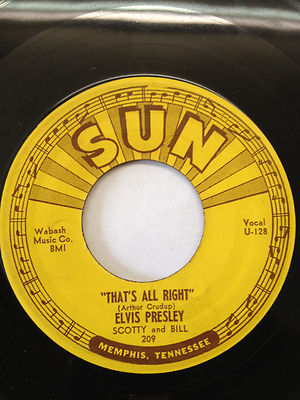
Elvis Presley Original Sun 209 "That's All Right" 45 rpm Record with Push marks
$
1,195


Favourite Auctions
To save auctions to your favourites, please login
If you don't have an account, please register
Description
“That’s All Right” and “Blue Moon of Kentucky” Sun Studio 45 rpm record #209
3 push marks, ORIGINAL Memphis, TN pressing 1954. NOT the California pressing.
“That’s All Right” side has etched on the dead wax: u-128-45 72
Label on “That’s All Right” side is Mint
This Gem hails from Tupelo, Mississippi, the home birthplace of Elvis, the King of Rock N Roll. He moved 95 miles north to Memphis to make music history.
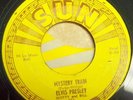
In August 1953, Elvis Presley walked into the offices of Sun. He aimed to pay for a few minutes of studio time to record a two-sided acetate disc: "My Happiness" and "That's When Your Heartaches Begin". He would later claim he intended the record as a gift for his mother, or was merely interested in what he "sounded like", though there was a much cheaper, amateur record-making service at a nearby general store. Biographer Peter Guralnick, argues that he chose Sun in the hope of being discovered. Asked by receptionist Marion Keisker what kind of singer he was, Presley responded, "I sing all kinds." When she pressed him on whom he sounded like, he repeatedly answered, "I don't sound like nobody." After he recorded, Phillips asked Keisker to note down the young man's name, which she did along with her own commentary: "Good ballad singer. Hold." Presley cut a second acetate in January 1954—"I'll Never Stand In Your Way" and "It Wouldn't Be the Same Without You"—but again nothing came of it. Phillips, meanwhile, was always on the lookout for someone who could bring the sound of the black musicians on whom Sun focused to a broader audience. As Keisker reported, "Over and over I remember Sam saying, 'If I could find a white man who had the Negro sound and the Negro feel, I could make a billion dollars.'" In June, he acquired a demo recording of a ballad, "Without You", that he thought might suit the teenaged singer. Presley came by the studio, but was unable to do it justice. Despite this, Phillips asked Presley to sing as many numbers as he knew. He was sufficiently affected by what he heard to invite two local musicians, guitarist Winfield "Scotty" Moore and upright bass player Bill Black, to work something up with Presley for a recording session. The session, held the evening of July 5, proved entirely unfruitful until late in the night. As they were about to give up and go home, Presley took his guitar and launched into a 1949 blues number, Arthur Crudup's "That's All Right". Moore recalled, "All of a sudden, Elvis just started singing this song, jumping around and acting the fool, and then Bill picked up his bass, and he started acting the fool, too, and I started playing with them. Sam, I think, had the door to the control booth open ... he stuck his head out and said, 'What are you doing?' And we said, 'We don't know.' 'Well, back up,' he said, 'try to find a place to start, and do it again.'" Phillips quickly began taping; this was the sound he had been looking for. Three days later, popular MemphisDJ Dewey Philipps played "That's All Right" on his Red, Hot, and Blue show. Listeners began phoning in, eager to find out who the singer was. The interest was such that Phillips played the record repeatedly during the last two hours of his show. Interviewing Presley on-air, Phillips asked him what high school he attended in order to clarify his color for the many callers who had assumed he was black. During the next few days the trio recorded a bluegrass number, Bill Monroe's "Blue Moon of Kentucky", again in a distinctive style and employing a jury-rigged echo effect that Sam Phillips dubbed "slapback". A single was pressed with "That's All Right" on the A side and "Blue Moon of Kentucky" on the reverse. In 1954, "Good Rockin' Tonight" was the second Sun Records release by Elvis Presley, along with "I Don't Care If The Sun Don't Shine" on the flip side. Presley and his bandmates hewed closer to the original Roy Brown version, but omitted the lyrics' by-then-dated roster of names in favor of a simpler, more energetic "We're gonna rock, rock, rock!" Described as "a flat-out rocker" country radio programmers blanched, and older audiences were somewhat mystified. A live show broadcast from Houston DJ Bill Collie's club documented that the crowd "barely responded" to the song. "Blue Moon of Kentucky", the uptempo version of the Bill Monroe classic, has "the fans go stark raving nuts with joy". Both sides of this second record featuring "Elvis Presley, Scotty and Bill". On December 8th, 1954 Elvis recorded "Milkcow Blues Boogie" and "You're A Heartbreaker". "Milkcow Blues Boogie" is a cover of a blues song recorded by Kokomo Arnold, which Elvis performed at a much faster tempo. Then Elvis went on to record "Baby, Let's Play House; a song written by Arthur Gunter. It was Elvis' fourth issue by Sun, and his first on a national chart, at #5 on the Billboard Country Singles in July 1955. Presley's version differs greatly from the original, replacing Gunter's line 'You may get religion' with the words 'You may have a Pink Cadillac" (Elvis' transportation). Elvis' version of "Mystery Train" was first released on August 20, 1955 as the B-sde of "I Forgot To Remember To Forget (Sun 223). Elvis' version would be ranked #77 on Rolling Stones 500 Greatest Songs of All Time. It featured Elvis on vocals and rhythm guitar, Scotty Moore on lead guitar, and Bill Black on bass.
“Blue Moon of Kentucky” has etched on the dead wax: u-129-45 72Label on "Blue Moon of Kentucky" side Excellent
Wax is VG++on both sides. Labels have no writing, no stickers, no stains and no warping.
If you want the ultimate SUN 210 for framing, this is IT. The labels are absolutely beautiful!!! If you're going to play it, this one will certainly meet your listening expectations with clear, bright sound.
I fully guarantee any item I sell. It will be shipped PACKAGED WELL, but with something this fragile, insurance is included. Priority Mail Postage costs for this item are $5 in the USA, $12 in the UK, and $16 to Japan. Insurance is included.