FEEDERZ - EVER FEEL LIKE KILLING YOUR BOSS? ORIG US VINYL LP RARE SANDPAPER CVR
£
40
$
53




Favourite Auctions
To save auctions to your favourites, please login
If you don't have an account, please register
Description
FEEDERZ - HAVE YOU EVER FELT LIKE KILLING YOUR BOSS?
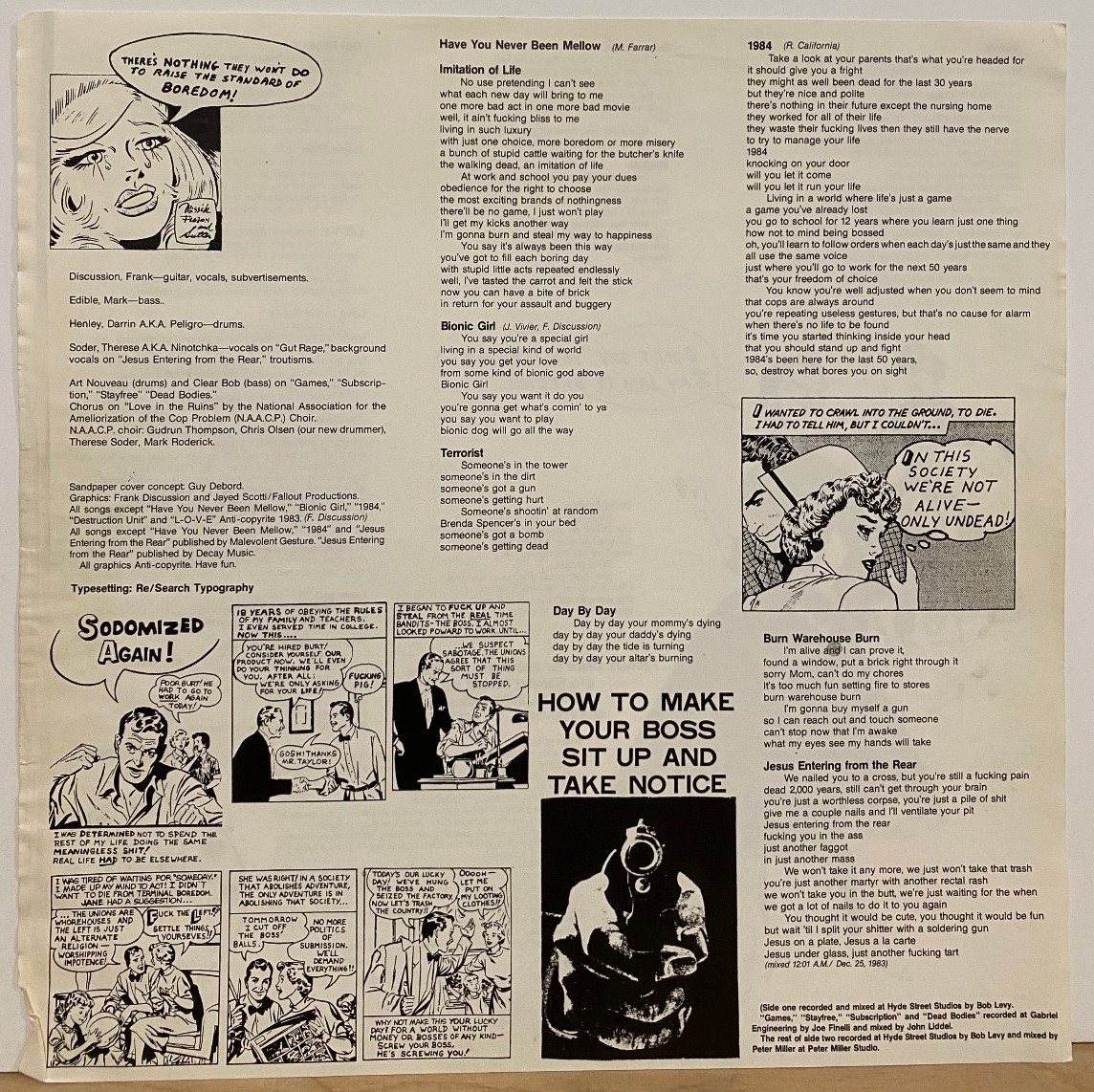
Original US Vinyl FLAMING BANKER pressing with original insert & sandpaper cover!
The Feederz are a punk rock band, originally from Arizona. They are known for their controversial song "Jesus" (aka "Jesus Entering from the Rear"), which was featured on Alternative Tentacles' infamous Let Them Eat Jellybeans! compilation, and for their provocative album covers. The Feederz have strong Situationist tendencies, verging into communism and anarchism. Their songs were highly critical of government, consumerism and religion.
Lead singer Frank Discussion is also known for his "subvertisements" or "derailments", an adaptation of the situationist tactic of detournement, as well as what he calls "interventions" whereby one detournes physical events by intervening with an out-of-place element in the physical world, a tactic expressed as simply as placing disparate items in unsuspecting people's shopping carts, thereby raising the action beyond the level of mere prank to a conscious tactic used to undermine society and to express a unified critique of it. He is also known for being one of the developers of "antistasiology", along with Tara Humara, defined as the comparative study of various types of tactics, strategies and organizational structures used by various resistance movements, historically and currently.
Moss Side
A1 Have You Never Been Mellow
Lyrics By [Additional] – F. Discussion*
Written-By – M. Farrar*
A2 Imitation Of Life
A3 Bionic Girl
A4 Terrorist
A5 Day By Day
A6 1984
Lyrics By [Additional] – F. Discussion*
Written-By – R. California*
A7 Burn Warehouse Burn
A8 Entering From The Rear
Backing Vocals – Soder, Therese A.K.A. Ninotchka*
Sao Paulo
B1 Games
B2 Subscription
B3 Stayfree
B4 Dead Bodies
B5 Gut Rage
Vocals – Soder, Therese A.K.A. Ninotchka*
B6 Destruction Unit
B7 L-O-V-E (Another Damp Thing)
B8 Love In The Ruins
Choir [N.A.A.C.P. Choir] – Chris Olsen*, Gudrun Thompson, Mark Roderick, Therese Soder
Chorus – National Association For The Ameliorization Of The Cop Problem (N.A.A.C.P.) Choir*
B9 F Y
Published By – Malevolent Gesture
Published By – Decay Music
Recorded At – Hyde Street Studios
Mixed At – Hyde Street Studios
Recorded At – Gabriel Studio (2)
Mixed At – Peter Miller Studios
Plated At – Greg Lee Processing – L∙16614
Bass – Clear Bob (tracks: B1 to B4), Edible, Mark* (tracks: A1 to A8, B5 to B9)
Design Concept [Sandpaper Cover] – Guy Debord
Drums – Art Nouveau (3) (tracks: B1 to B4), Henley, Darrin A.K.A. Peligro* (tracks: A1 to A8, B5 to B9)
Engineer – Joe Finell (tracks: B1 to B4)
Graphics – Fallout Productions, Frank Discussion, Jayed Scotti
Guitar, Vocals, Other [Subvertisements] – Discussion, Frank*
Mixed By – John Liddel (tracks: B1 to B4), Peter Miller (tracks: B5 to B9)
Producer – The Feederz*
Recorded By – Bob Levy (tracks: A1 to A8, B5 to B9)
Typography [Typesetting] – Re/Search Typography*
Written-By – D. Clark* (tracks: B7), F. Discussion* (tracks: A2 to A5, A7 to B9), J. Vivier* (tracks: A3, B6)
Record jacket covered (front/back) in 180 grit sandpaper.
Includes lyric insert.
On the back of the sleeve: "Pay no more than $0.00 for this record."
Matrix / Runout (Side A runout): Steal 1-A L∙16614 Destroy What Bores You!
Matrix / Runout (SIde B runout): Steal 1-B L∙16614∙X
Ready to post out in a solid protective card, record and sleeve separated for posting. Please view our other auctions for similar vinyl records.
Discogs uses the Goldmine Standard for grading the condition of items listed in their Marketplace.
Mint (M)
Vinyl
Absolutely perfect in every way. Certainly never been played, possibly even still sealed. Should be used sparingly as a grade, if at all.
CD
Perfect. No scuffs/scratches, unplayed - possibly still sealed.
Insert/Inlay/Booklet/Sleeve/Digipak: Perfect. No wear, marks, or any other imperfections - possibly still sealed.
Cassette
J-Card is crisp, clean and perfect in every way. Likely sealed. Cassette is brand new, and professionally produced. Used sparingly as a grade, should be free of even the slightest blemishes and/or defects. This grade should be used sparingly, if at all.
Near Mint (NM or M-)
Vinyl
A nearly perfect record. A NM or M- record has more than likely never been played, and the vinyl will play perfectly, with no imperfections during playback. Many dealers won't give a grade higher than this implying (perhaps correctly) that no record is ever truly perfect. The record should show no obvious signs of wear. A 45 RPM or EP sleeve should have no more than the most minor defects, such as any sign of slight handling. An LP cover should have no creases, folds, seam splits, cut-out holes, or other noticeable similar defects. The same should be true of any other inserts, such as posters, lyric sleeves, etc.
CD
Near perfect. No obvious signs of use, it may have been played - but it has been handled very carefully.
Insert/Inlay/Booklet/Sleeve/Digipak: Near Perfect. No obvious wear, it may have only the slightest of marks from handling.
Cassette
Sleeve should be totally crisp and clean with only the slightest evidence of handling. Tape is likely new, free of any wear or damage.
Very Good Plus (VG+)
Vinyl
A Very Good Plus record will show some signs that it was played and otherwise handled by a previous owner who took good care of it. Defects should be more of a cosmetic nature, not affecting the actual playback as a whole. Record surfaces may show some signs of wear and may have slight scuffs or very light scratches that don't affect one's listening experiences. Slight warps that do not affect the sound are "OK". The label may have some ring wear or discoloration, but it should be barely noticeable. Spindle marks may be present. Picture sleeves and inner sleeves will have some slight wear, slightly turned-up corners, or a slight seam split. An LP cover may have slight signs of wear, and may be marred by a cut-out hole, indentation, or cut corner. In general, if not for a couple of minor things wrong with it, this would be Near Mint.
CD
A few minor scuffs/scratches. This has been played, but handled with good care - and certainly not abused.
Insert/Inlay/Booklet/Sleeve/Digipak: Slight wear, marks, indentations, it may possibly have a cut-out hole (or similar).
Cassette
Sleeve has slight wear, marks, indentations, and/or may possibly have a cut-out hole (or similar). Tape has been taken very good care of and may have light marks or spindle wear. Should play cleanly with minimal noise or degradation.
Very Good (VG)
Vinyl
Many of the defects found in a VG+ record will be more pronounced in a VG disc. Surface noise will be evident upon playing, especially in soft passages and during a song's intro and fade, but will not overpower the music otherwise. Groove wear will start to be noticeable, as with light scratches (deep enough to feel with a fingernail) that will affect the sound. Labels may be marred by writing, or have tape or stickers (or their residue) attached. The same will be true of picture sleeves or LP covers. However, it will not have all of these problems at the same time. Goldmine price guides with more than one price will list Very Good as the lowest price.
CD
Quite a few light scuffs/scratches, or several more-pronounced scratches. This has obviously been played, but not handled as carefully as a VG+.
Insert/Inlay/Booklet/Sleeve/Digipak: More wear, marks, indentations than a VG+. May have slight fading, a small tear/rip, or some writing.
Cassette
Sleeve will contain more wear, marks, and/or indentations than a VG+. May have slight fading, a small tear/rip, or some writing. Shell may have heavier marks and wear than VG including plastic discoloration. Should play with some stronger hiss or degradation, but not enough to overpower music.
Good (G), Good Plus (G+)
Vinyl
A record in Good or Good Plus condition can be played through without skipping. But it will have significant surface noise, scratches, and visible groove wear. A cover or sleeve will have seam splits, especially at the bottom or on the spine. Tape, writing, ring wear, or other defects will be present. While the record will be playable without skipping, noticeable surface noise and "ticks" will almost certainly accompany the playback.
CD
There are a lot of scuffs/scratches. However it will still play through without problems. This has not been handled with much care at all.
Insert/Inlay/Booklet/Sleeve/Digipak: Well worn, marked, more obvious indentations, fading, writing, than a VG - possibly a more significant tear/rip.
Cassette
Sleeve will be well worn, marked, and contain obvious indentations, fading, and/or writing, more so than a VG grade - possibly a more significant tear/rip. Tape will have heavy wear on shell. Felt stopper may be missing. Tape may have minor creasing, but not broken. Must play through, may have heavier degradation that will overpower music.
Poor (P), Fair (F)
Vinyl
The record is cracked, badly warped, and won't play through without skipping or repeating. The picture sleeve is water damaged, split on all three seams and heavily marred by wear and writing. The LP cover barely keeps the LP inside it. Inner sleeves are fully split, crinkled, and written upon.
CD
The CD may or may not play some or all of the tracks. See the seller's comments for details.
Insert/Inlay/Booklet/Sleeve/Digipak: Very worn. It may have obvious writing on it, it may be ripped/torn, or significantly faded, or water damaged.
Cassette
Sleeve will be torn, heavily stained, showing general heavy damage, or will be partially missing. Likewise, tape will be heavily damaged, showing complete fading on the face, crinkled tape, missing screws or teeth, staining, and other heavy wear. Cassette will more than likely not play through.
Standard Jewel Cases: Standard Jewel Cases are not graded as they are replaceable.
Generic
The term "generic" refers to a type of sleeve that is not specific to the release. A generic sleeve is either a plain sleeve or a company sleeve with standard company artwork. A sleeve that is graded as "generic" needs no further grading, as a generic sleeve generally adds little value to the item and can be easily replaced. Sellers can further specify a generic sleeve's condition in the “Item condition comment” field if needed. A seller can also note if the sleeve is a company sleeve in the “Item condition comment” field.
price rating

![Lateralus [LP] by Tool Vinyl, Oct-2005, 2 Discs, Zomba USA NEW](https://www.popsike.mobi/php/thumbnail.php?url=https://www.popsike.pics/pix/20171006/112591687477.jpg)