FOUR ORIGINAL THOMAS EDISON DIAMOND RECORD DISCS WITH ORIGINAL LABELS VINTAGE RA
A$
40
$
27


Favourite Auctions
To save auctions to your favourites, please login
If you don't have an account, please register
Description
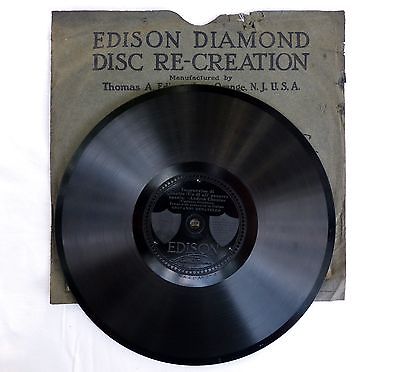
Price is for Four Edison Diamond Disc Records. Records look very good (see photos for condition) but may have a few chips on the rim but nothing that will affect their playing. There may be very minor scuffs. One record has small tears on the paper labels. Two etched labels (1910’s) and two paper labels (1920’s). SOLD AS IS. No duplicates.
Records are –
1. A. Pretty Little Boy, Phil Bakers’s Bad Boys,51645 – L
B. How Can You Look so Good, Phil Bakers’s Bad Boys, 51645 – R
2.
A. Fragrant Rose, Losey’s Orcestra, 80712 – L
B. Afterwards, Losey’s Instrumental Quartet, 80712 – R
3.
A. A Little Love, A Little Kiss, Lao Silesu, 5841 – C – 10 – 3 (80397)
B. One Fleeting Hour, 5168 – C – 2 – 96(80397)
4. Improviso Di Chenier, Giovanni Ventatello, 4421 –A – 5 – 4 (83052)
I will keep the postage as cheap as possible, but they will have to be well packed and cost may vary according to the distance in Australia. I will post overseas. Please wait until I have sent you an invoice.
History
In October 1912 the Edison Diamond Disc Record was introduced.Edison Laboratories had been experimenting with disc records for some 3 years, as the general public seemed to prefer them to cylinders. The thick Edison Discs recorded the sound vertically in the groove at a rate of 150 grooves-per-inch (GPI) rather than the typical laterally-cut groove of around 100 GPI, which gave 10-inch Edison discs a longer playing time (up to five minutes) than laterals and could only be played to their full advantage on Edison Diamond Disc Phonographs. This combination produced audio fidelity superior to any other home record playing system of the time. However, Edison Discs and phonographs were more expensive than their competitors'.
In 1914 Edison changed the name of his Edison Disc Phonograph to Diamond Disc Phonograph. The Disc record was changed to Diamond Disc Record. These records were also called "Diamond Disc Re-creations".
Early Edison Diamond Discs had no paper labels. Information about the record was actually engraved into the plastic of the record surface around the spindle hole. Edison's picture and signature were also engraved into the record.
Sales for Edison discs peaked in the early 1920’s, when Edison began producing Diamond Discs with paper labels but declined afterwards.
price rating


