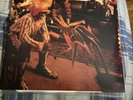
FRANK STOKES "Creator Of The Memphis Blues" LP NM/NM Reissue
$
25


Favourite Auctions
To save auctions to your favourites, please login
If you don't have an account, please register
Description
Condition: To my NON US customers, do NOT ask me to alter / change the declared value of your purchase for purposes of avoiding taxes in your country. I will NOT do so.
All Music Review by Nathan Bush [-]
The most prominent musicians in early country-blues tended to emerge from the Mississippi Delta. This region's rich tradition has long overshadowed developments in states like Tennessee and Texas. However, for blues fans in Memphis during the late '20s, Frank Stokes was the king. Having spent time traveling as a minstrel entertainer, Stokes picked up medicine show tunes and popular songs to complement his conventional blues material. His verses read like a catalog of common themes and phrases that roamed the American South.
While not a strong singer, Stokes was blessed with one of the music's most distinct voices. He was the antithesis of "hard" Delta singers like Son House and Charlie Patton. In comparison, Stokes seemed perpetually uncertain of himself. When he sings "Don't know what'n the world to do" on "Nehi Mama Blues," he is truly believable. Even on lighter material like "'Tain't Nobody's Business," an underlying worry is evident in his signature quiver. The effect begins to fade only on his most boisterous performances ("Beale Town Bound"). Concluding that Stokes was unstable, however, would be incorrect. "You Shall" and "Mr. Crump" are clearly meant to amuse. The blues itself, which is often construed as being autobiographical, typically served the function of entertainment.
Stokes is perhaps best remembered for his guitar duet work with performance partner Dan Sane. Typical of the Memphis blues, their style was lighter than the Delta equivalent. The hard playing and prominent slide was replaced by more intricate and graceful fingerpicking. Sane meshed so well with Stokes that he became an extension of his own guitar. The two incorporated more guitar breaks than were conventional (especially on record) to showcase their interplay. Sane is active on "Take Me Back," animating the song with his sprightly fills and runs. He has a similar effect on "'Tain't Nobody's Business," expanding on Stokes' standard chord work.
Frank Stokes ?– Creator Of The Memphis Blues
Label: Yazoo ?– L-1056 Format: Vinyl, LP, CompilationCountry: US Released: 1977 Genre: Blues Style: Country Blues
Tracklist
A1 Chicken You Can Roost Behind The Moon A2 Memphis Rounders Blues A3 Unnamed Blues A4 Stomp That Thing A5 Mr. Crump Don't Like It A6 Nehi Mamma Blues A7 It's A Good Thing B1 You Shall B2 It Won't Be Long Now B3 Mistreatin' Blues B4 Wasn't That Doggin' Me B5 'Tain't Nobody's Business If I Do Part 2 B6 Sweet To Mama B7 Beale Town BoundCredits
- Liner Notes – Steve Calt*
- Mastered By – Nick Perls
Notes
Tracks from 1927-1929.See our other EBAY auctions by using search by seller and using “record collector michigan”
Ferndale, Michigan 48220
Phone: 248-548-9888
Hours: Monday thru Saturday NOON to 6:00 PM (Eastern)
GOLDMINE GRADING
MINT ---- It should appear to be perfect. No scuffs or scratches, blotches or stains, labels or writing, tears or splits. Mint means perfect.
NEAR MINT ---- Otherwise mint but has one or two tiny inconsequential flaws that do not affect play. Covers should be close to perfect with minor signs of wear or age just becoming evident: slight ring-wear, minor denting to a corner, or writing on the cover should all be noted properly.
VERY GOOD PLUS ---- The record has been handled and played infrequently or very carefully. Not too far from perfect. On a disc, there may be light paper scuffs from sliding in and out of a sleeve or the vinyl or some of the original luster may be lost. A slight scratch that did not affect play would be acceptably VG+ for most collectors.
VERY GOOD ---- Record displays visible signs of handling and playing, such as loss of vinyl luster, light surface scratches, groove wear and spindle trails. Some audible surface noise, but should not overwhelm the musical experience. Usually a cover is VG when one or two of these problems are evident: ring wear, seam splits, bent corners, loss of gloss, stains, etc.
GOOD ---- Well played with little luster and significant surface noise. Despite defects, record should still play all the way through without skipping. Several cover flaws will be apparent, but should not obliterate the artwork.
POOR ---- Any record or cover that does not qualify for the above "Good" grading should be seen as Poor. Several cover flaws.
price rating