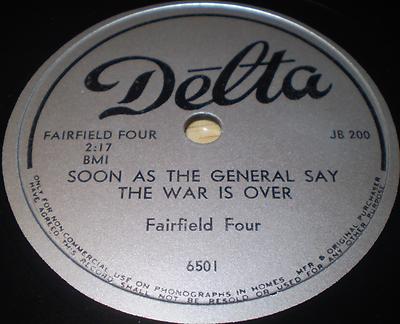
Fairfield Four 78 DELTA 200 General Say the War is Over A'Capella Black Gospel
$
40


Favourite Auctions
To save auctions to your favourites, please login
If you don't have an account, please register
Description
snw I intended to list these Friday and they started a day early so I ended them and restarted them on Friday.. and now ...
snw_ for your consideration..
FAIRFIELD FOUR
78rpm on DELTA
SOON AS THE GENERAL SAY THE WAR IS OVER /
DEAR LORD LOOK DOWN UP0N ME
E Condition, surface is great and shiny, just a few light scuffs. Great 40s A'Capella Gospel!
Scroll to bottom for bio and pic of group.
Even if you don't bid/win the record, if you see a sound clip for the record in the listing, I'm always happy to send somebody a FREE mp3 of the songs that will have each side in its entirety. It's great music to be shared, and to my ears, my (untreated) sound files sound full and clear, better than the files on amazon and even most CD's I've heard. Just reach out and I'll get it to you.
Item will be packed with appropriate care to ensure safe delivery. Please note my feedback as a seller, I ship many 78s in deep boxes with proper shock absorption. I know the desperate feeling of receiving an eagerly anticipated record in a shallow box or glorified envelope. Won't happen with me. See Shipping Rates below.
Be sure and check out my other records!
I'm listing some GREAT Prewar and Postwar Blues, Hillbilly, and Jazz in AUCTION format that should end Friday
and I'll be listing many Buy It Now's in the near future as well.
*Ask any questions I’ll do my best to answer as quickly as possible*
Please note: I do my best to grade conservatively. I can provide a Sound Sample upon request. Note my 5* Across the Board Ratings as a Seller and bid with confidence.
Payment Required within 48 hours of Auction No Exceptions unless you contact me before bidding.
SHIPPING: PLEASE NOTE $6 SHIPPING AND CONSIDERATE HANDLING within U.S. VIA MEDIA MAIL, INCLUDES TRACKING AND PACKAGING COST. Records over $100 will normally be upgradeded Priority Mail at no extra charge. Priority mail is always an option at Buyer request, usually under $12. I pack the 78 to float safely in in a sleeve between two slats of cardboard, surrounded by bubble wrap and/or peanuts/newspaper, floating in a roughly 12x12x6 box. Firm but not to the point of fearing for the record's well being. I don't tape the edges of records. I reuse boxes and packing materials but will use new materials at buyer request. Will be shipped via Media Mail, with tracking #, buyer pays insurance for purchases over $35, insurance is at buyer request below that amount.
INTERNATIONAL SHIPPING TO COUNTRIES INDICATED FOR BIDDERS WITH FLAWLESS FEEDBACK ONL
RETURNS: Returns are accepted within 14 days, refunds minus postage upon receipt of item back safely.
I like the VJM grading system for 78 RPM records:
- N. As new and unplayed (there are virtually no 78s that can categorically be claimed to be unplayed).
- N-. Nearly Mint, but has been played. No visible signs of wear or damage.
- E+. Plays like new, with very, very few signs of handling, such as tiny scuffs from being slipped in and out of jackets.
- E . Still very shiny, near new looking, with no visible signs of wear, but a few inaudible scuffs and scratches.
- E-. Still shiny but without the lustre of a new record, few light scratches.
- V+. An average condition 78 in which scuffs and general use has dulled the finish somewhat. Wear is moderate but playing is generally free from distortion. Surface noise not overly pronounced
- V. Moderate, even wear throughout, but still very playable. Surface noise and scratches audible but not intrusive.
- V-. Quite playable still, but distortion and heavy greying in loud passages. Music remains loud in most passages. Surface noise and scratches well below music level.
- G+. Grey throughout but still serviceable. Music begins to sound muffled. Heavy scratches.
- G. Quite seriously worn and scratched, but music level is still higher than surface noise.
- G-. Music still prominent, but wear and scratch damage extensive.
- F. Most of music remains audible over surface noise, but listening now uncomfortable.
- P. Unplayable
Fairfield Four
The Fairfield Four, the most distinguished proponents of traditional African American a cappella gospel singing working today, were organized in 1921 by Reverend J.R. Carrethers, assistant pastor of the Fairfield Baptist Church in Nashville, Tennessee. The group, initially a trio comprised of the Reverend's two sons, baritone Harold and bass Rufus along with tenor lead John Battle, evolved into a quartet with the addition of a second lead, Lattimer Green, later replaced by Samuel McCrary.
The quartet sang a cappella, performing traditional spirituals such as "Ezekiel Saw the Wheel" and "Dry Bones" arranged and taught to them by Reverend Carrethers. In time, the Fairfield Four became professionals with Rufus Carrethers and Samuel McCrary emerging as singers of reputation, Carrethers for his rhythmic style of bass singing, and McCrary for his exceptional clear tenor voice.
The a cappella style of the Fairfield Four was drawn from the Birmingham, Alabama quartet tradition exemplified by recording groups such as the Bessemer Sunset Four, the Birmingham Jubilee Singers, and the Famous Blue Jay Singers with lead vocalist, Silas Steele. The tradition is characterized by a percussive bass voice anchoring middle harmonies sung often on repeated rhythmic syllables ("boom a lanka lanka lanka") and a tenor voice out front carrying the lead.
The Fairfield Four were among pioneers of African American gospel groups that used radio to reach broader audiences. In 1942, they won a contest sponsored by the Colonial Coffee Company, the "prize," their own morning show over 50,000-watt WLAC out of Nashville. Within a few years under the sponsorship of Sunway Vitamins, the group's broadcasts were syndicated to major cities across the United States and they began billing themselves as the "Southland's Famous Fairfield Four."
Radio led to making records and, beginning in 1946, the Fairfield Four released sides on the Bullet, Dot, Delta, and M-G-M labels, and later on Champion, Old Town, and Nashboro. Extending themselves through the far reach of media, the Fairfield Four would influence both sacred and secular vocalists across the land, among them blues singer B.B. King. "Before I left my hometown of Indianola, Mississippi," says King, "the Fairfield Four used to come on the radio every morning real early before we went to work. I became a great fan and, in fact, ...(Sam) McCrary had a lot of influence on my singing over the years, and that's the truth."
In the mid-1940s, the Fairfield Four underwent personnel changes. The Carrethers brothers departed and McCrary assembled a new lineup with baritone James Hill, lead tenor Edward "Preacher" Thomas, utility singer Willie Frank Lewis, and Isaac "Dickie" Freeman, who developed as one of the most important bass vocalists in the genre. "This group," wrote gospel scholar Doug Seroff, "was invincible in 'Battles of Song' with the premier gospel groups in the nation."
The Fairfield Four had a successful run, but then ceased touring in 1950. Hill and Freeman formed a new group, the Skylarks, before retiring completely from professional singing, and McCrary became a church pastor, continuing to perform locally as the Fairfield Four with a revolving lineup of singers.
In 1980, the Fairfield Four reunited to perform at a celebration of pioneering Birmingham quartets. That event sparked a return to the professional arena with a lineup of Reverend Sam McCrary, James Hill, Isaac Freeman, Willie Richardson, Wilson Waters, and Robert Hamlett.
Over the ensuing two decades, the Fairfield Four reached audiences across cultures and worldwide, their tours, recordings, and nationally televised appearances with Lyle Lovett, Elvis Costello, and John Fogerty earning them a broader fan base even larger than in their heyday "golden age" years.
Today, the Fairfield Four are best known from their appearance on the soundtrack and on screen in the Coen Brothers 2000 film, O Brother Where Art Thou. They are multiple Grammy winners with albums including Standing in the Safety Zone (1992) and I Couldn't Hear Nobody Pray (1997) on Warner Brothers, Wreckin' the House (1998) on Dead Reckoning, The Fairfield Four and Friends Live from Mountain Stage (2000) on Blue Plate, and by their bass singer Isaac Freeman with the Bluebloods, Beautiful Stars (2003) on Lost Highway.
Among their awards and honors, the National Endowment for the Arts, National Heritage Award, 1989; Tennessee Lifetime Achievement Award, 1994; Nashville Music Award Lifetime Achievement Award, 1995; James Cleveland Stellar Award, 1996; Grammy Award, Best Traditional Gospel Recording, for I Couldn't Hear Nobody Pray, 1997; Gospel Music Hall of Fame, inducted, 1999.
The Fairfield Four, continuing to perform a cappella, have been singularly important in revitalizing and preserving the oldest style of traditional African American spiritual and gospel singing. Amazingly, the current line-up still maintains its ties to the earliest configuration of the Fairfield Four. Bass singer Isaac Freeman, in the group since the late 1940s, and Robert Hamlett were key figures in the Fairfield Four's reemergence in the 1980s. Joe Rice, the youngest member, came aboard in time for the 1997 Grammy-winning Warner Brothers album, I Couldn't Hear Nobody Pray.
Latest members Ed Hall and Joe Thompson also have longtime associations with the Fairfield Four. Ed Hall, a pioneering African American radio personality, sang starting in the late 1940s with the Fireside Singers, the Fairfield Four's auxiliary "juniors." Joe Thompson, a relative of the Fairfield Four's founding Carrethers brothers, worked with Reverend Sam McCrary's Fairfield Four throughout the 1950s.
--Jerry Zoltenprice rating