Farm Band Mantra 777 1972 Private Press Psych Folk Grateful Dead Rare w/ Poster
$
200

Favourite Auctions
To save auctions to your favourites, please login
If you don't have an account, please register
Description
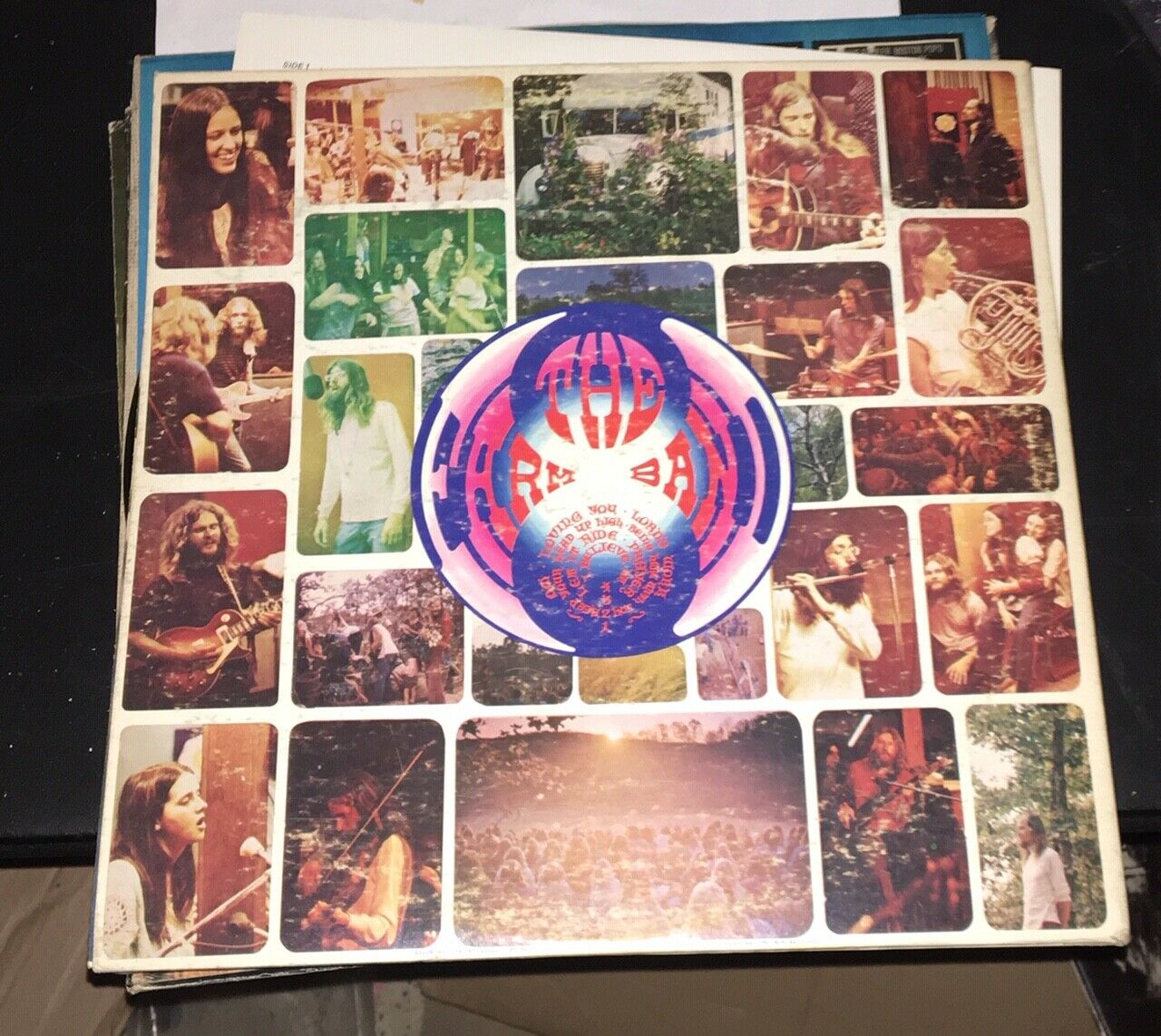
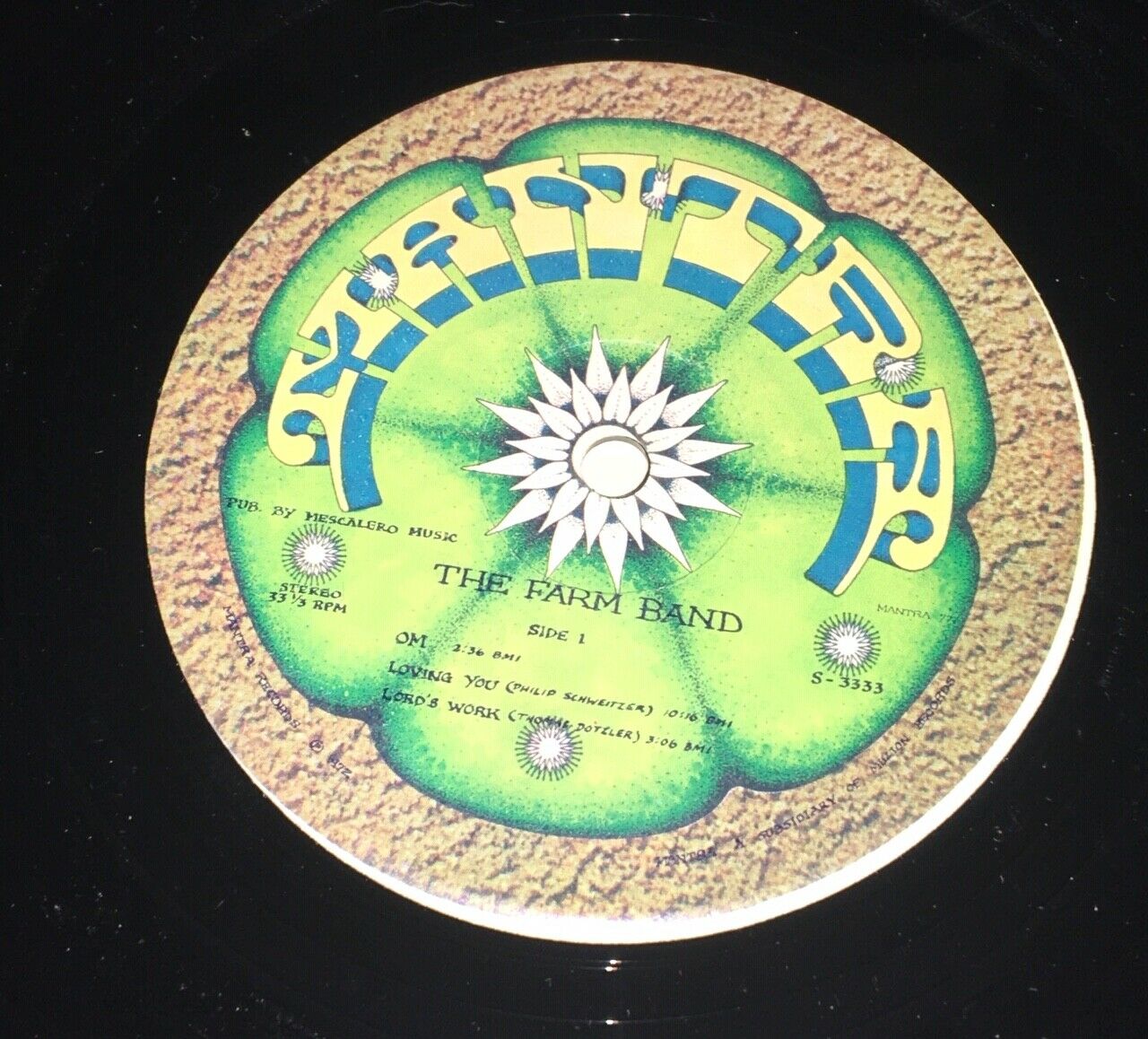
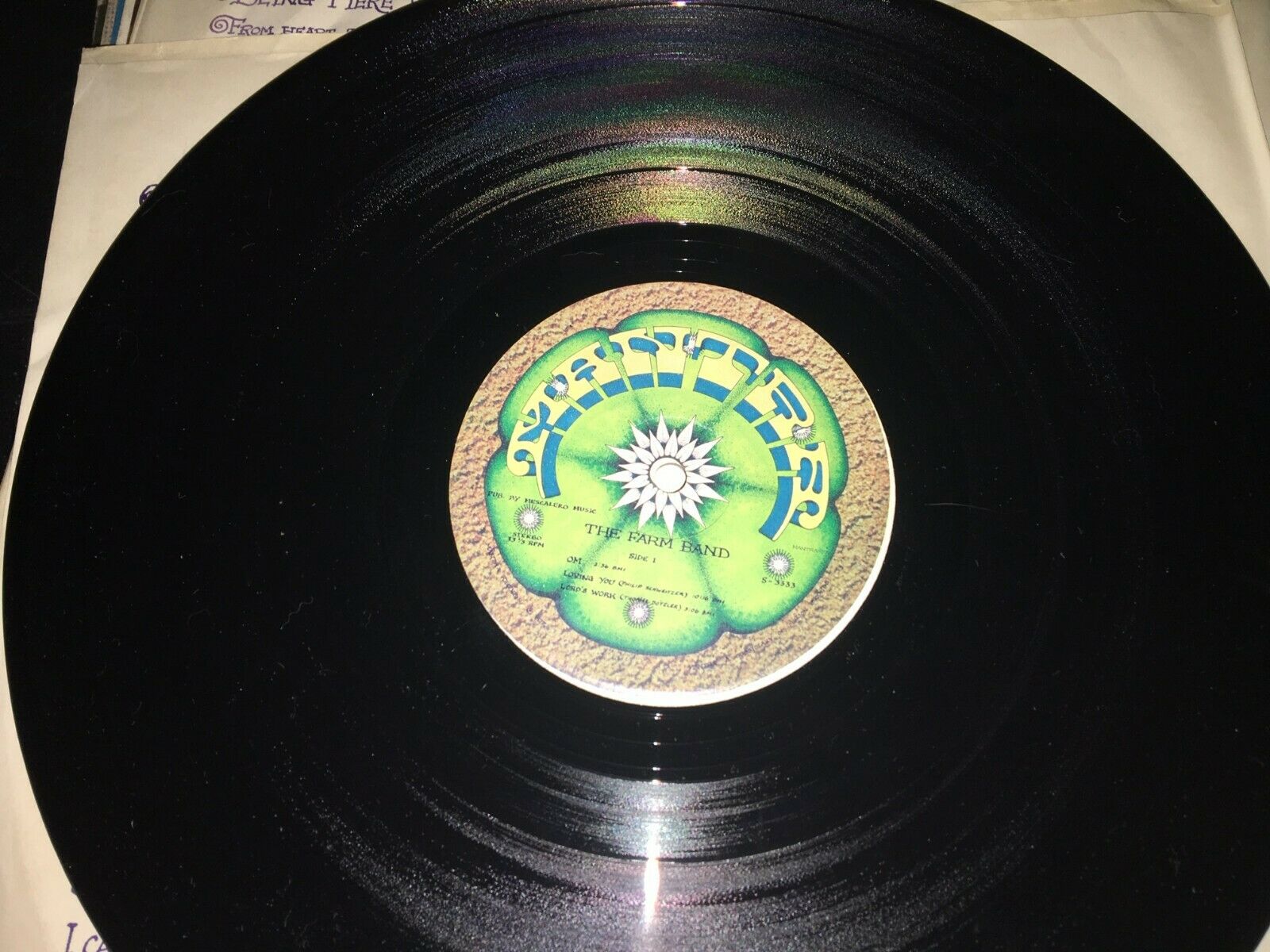
The Farm Band Label: Mantra 777 Format: 2 × Vinyl, LP, Album Country: US Released: 1972 Genre: Rock, Folk, World, & Country Style: Psychedelic Rock, Country Rock, Folk Rock
A1 Om 2:36 A2 Loving You Written-By – Phillip Schweitzer 10:16 A3 Lord's Work Written-By – Thomas Dotzler 3:06 B1 Keep Your Head Up High Written-By – Phillip Schweitzer 3:17 B2 Being Here With You Written-By – Thomas Dotzler 11:51 C1 Let It Ride Written-By – Phillip Schweitzer 12:05 C2 Prayer Written-By – Phillip Schweitzer 2:51 D1 I Believe It Written-By – Phillip Schweitzer 17:12 Companies, etc. Copyright (c) – Mescalero Music Published By – Mescalero Music Credits Acoustic Guitar, Electric Guitar, Vocals – Walter* Bass – William (20) Drums – David* Electric Guitar, Harmonica, Twelve-String Guitar, Vocals – Joseph (27) French Horn, Piano – Cynthia (13) Organ, Flute, Vocals, Piano – Thomas* Other [Inspired By] – Stephen Vocals – KayMarie, Louise* Vocals, Fiddle [Electric], Piano, Acoustic Guitar – Phillip* Notes Issued with inner sleeves containing the album credits and song lyrics and 22" x 28" poster.
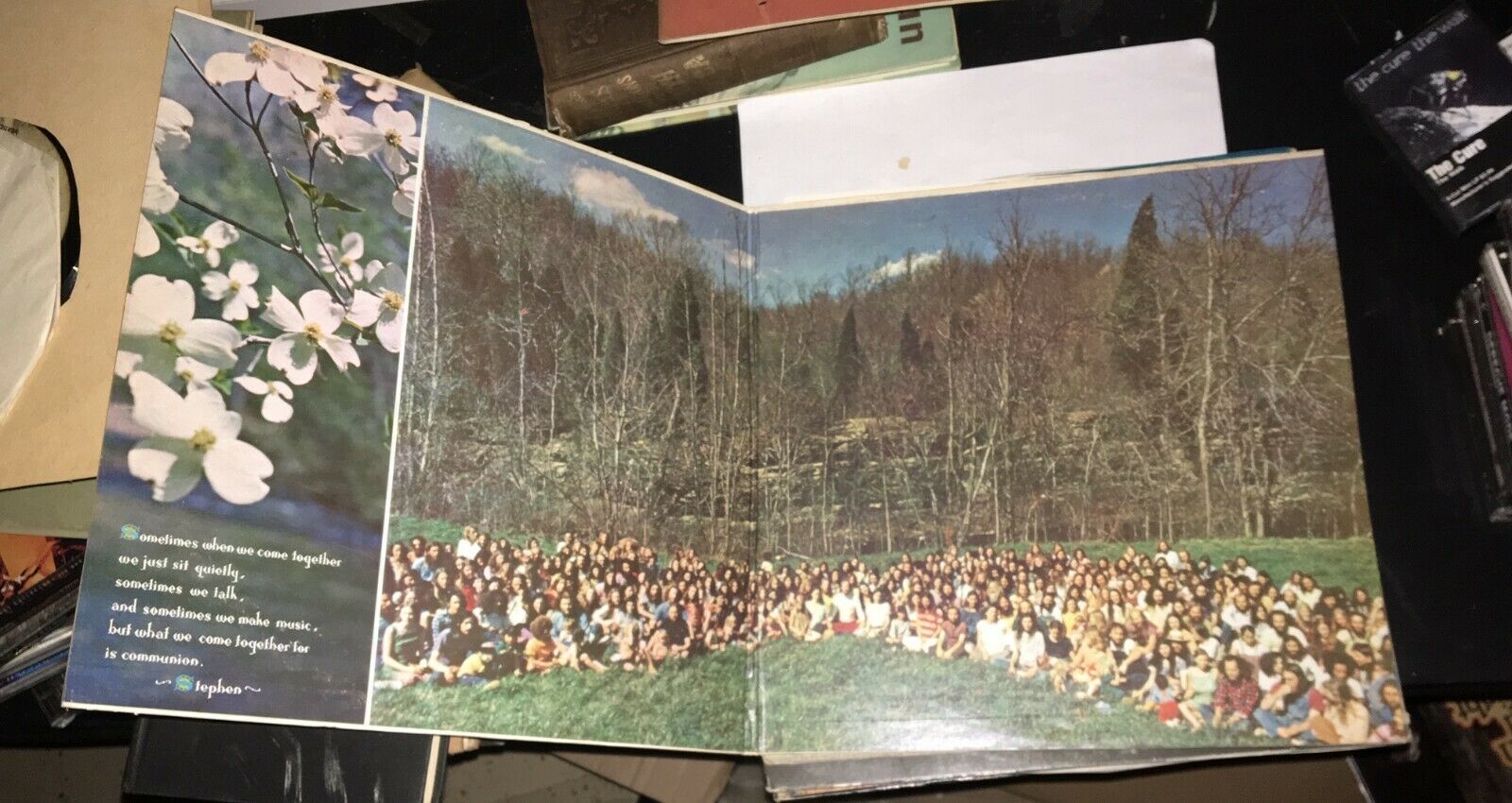
Gatefold cover.
"OM" is written on the lyric sheets, this LP is sometimes referred to as The Farm Band OM, but is credited here as on the labels and spine.
The Farm was established after Gaskin and friends led a caravan of 60 buses, vans and trucks on a cross country speaking tour across the US. Along the way, they checked out various places that might be suitable for settlement before deciding on Tennessee.[2] After buying 1,000 acres (4 km^2) for 70 dollars per acre and another adjoining 800 acres (3.2 km^2) for 100 dollars per acre, the Farm began building its village in the woods alongside the network of crude logging roads that followed its ridgelines.
From its founding through the 70's, Farm members took vows of poverty and owned no personal possessions, though this restriction loosened as time passed. During that time, Farm members did not use artificial birth control, alcohol, tobacco, man-made psychotropics or animal products.
The Farm installed its own water system, but resisted running 60-cycle alternating current powerlines beyond the main house that served as its administration office and publishing center, hoping some day to establish home power systems off the grid. Communications within the Farm were carried out via CB radio and later with an old plug wire phone system donated by a local town. Kerosene lamps and outhouses were standard for the first 5-10 years. A 12-volt trickle charge system charged used golf cart batteries in homes, which in turn powered automobile tail light bulbs hanging from the ceilings and walls. Many of the buildings on the Farm were unconventional, ranging from converted school buses to modified 16 x 32 army tents. Over time, larger homes were constructed, each providing shelter for multiple families and single people, often with up to 40 people under one roof. Visitors were also housed in a two-story tent made by sewing two army tents together.
Projects The Farm had its own electrical crew, compost crew, farming crew, construction & demolition crew, clinic, motor pool, laundromat, tofu plant, bakery, school and ambulance service. They established The Book Publishing Company, which published the works of the Gaskins and other Farm members. They maintained The Farm Band, a rock group in the early Jam Band genre', which toured the country. They also ran a "soy dairy", which developed and later marketed a soymilk ice "cream" called "Iced-Bean", and a vegetable store in the town of Summertown. A crew constantly manned the gate where all traffic passed and was logged.
Plenty International Plenty International In 1974, after helping local neighbors after a tornado, the Farm formed Plenty (later, Plenty International), its charitable works arm. It began by gathering and supplying food for local disaster victims, and holding weekly "quilting bees" to make blankets for them. Plenty's most notable projects came through its 4-year presence in the Guatemalan highlands after the earthquake of 1976, helping to rebuild 1200 houses and lay 27 kilometers of waterpipe. There, it established a micro-commune of volunteers and their families, living simply among Mayan populations and working under the approval of the military government. They have also set up clinics in Lesotho and Mexico, and created the Jefferson Award-winning South Bronx Ambulance Project in New York City. Plenty currently maintains an office in Belize, Central America, which initiated a school lunch program based on organic gardens planted next to each school to help provide more vegetables for the children's diets. A midwifery program helped train over 60 Mayan women from villages throughout the region in prenatal care and safe delivery techniques.
Plenty was one of the first relief organizations to enter New Orleans, getting past Federal roadblocks to bring supplies to survivors just three days after Hurricane Katrina. Plenty helped establish a base camp for volunteers and channeled funding to Common Ground, a local group assisting in clean up, legal defense services and the operation of free clinics. Plenty volunteers have purchased and restored a home in the area to serve as a headquarters for housing relief volunteers and construction crews helping to rebuild homes.
Changes At its peak, the Farm claimed somewhere between 1200 and 1600 members living on the main property, along with many small "satellite" communities located in the U.S. and internationally. However, the Tennessee community lacked the infrastructure and income to properly support its growing numbers and grew increasingly in debt.
In 1983, not only due to financial difficulties, but also a challenge to Gaskin's leadership and direction[citation needed], the Farm changed its agreement and began requiring members to support themselves with their own income rather than donate all income to the central bank.
The "Changeover" was a difficult time. The local area provided few possibilities for employment, with the nearest city over 2 hours drive away. Disillusioned, many people left to start over, and eventually the population settled down to about 250 adults and children. Those that stayed made the choice to continue living in community for its freedom and peaceful atmosphere, and the safety and security it provided for the children.
The $400,000 plus debt was paid off after several years and the community has remained debt free to this day. An entrepreneurial spirit took hold, and numerous small businesses were established to provide support for the residents. Many members went back to school to get degrees in the medical field, and many now work at clinics and hospitals throughout central Tennessee.
In the nineties, with the community back on solid ground, The Farm returned to its original purpose of initiating social change through outreach and example. The Ecovillage Training Center was established as an educational facility in new technologies such as solar energy, bio fuels, and construction techniques based on locally-available, eco-friendly materials.
The Farm maintains contact with its over 4000 former members through list serves, an annual reunion, and through the work of its nonprofit organizations. Former members have gone on to become leaders in many different fields and endeavors, maintaining a sense of right livlihood and a commitment to the betterment of the world.
Four ex-members of the Farm were instrumental in establishing and managing the Whole Earth Lectronic Link (The WELL), one of the most influential early online communities. One of them went on to found Women's Wire, which became Women.com, the first commercial women-focused online community. Another founded SFgate, one of the first newspaper-based online sites.
The Farm's former person in charge of growing food for the community has become a leader in the organic farming movement, managing production on over 4000 acres. Former members of Farm Foods are now the marketing force behind many healthy food products found on store shelves nationwide. A former member who was an MD spent years helping to eradicate polio in India, and many other former members help manage other nonprofits.
Today the Farm's population is growing, as a new crop of young families seeking a saner lifestyle that combines environmental, political and spiritual awareness discover the potential and opportunity the community has to offer. Those interested in becoming residents are encouraged to visit during the bi-annual Farm Experience Weekend, an inside look at how the community operates and functions and the agreements that have enabled it to survive for over 35 years
Three original 70's LP's by the Farm Band. They were members of a hippie commune in Summertown, Tennessee. Their music sounds like the Allman Brothers or Grateful Dead. The Farm Band: S/T (Mantra 777) Original 1972 debut 2 LP set includes NM poster, printed inner sleeves and propaganda from "The Farm". Cover is VG+ with some moderate ring and corner wear and an ink spot on the front cover the size of a large postage stamp. Vinyl is EX with few lite inaudible paper scuffs. Stephen and The Farm Band: Up In Your Thing (Farm Records FE 1776). From 1973. No insert. Overall grade is EX. Cover has small name written on back and very minor corner wear. Vinyl has few inaudible paper scuffs barely worth mentioning. The Farm Band: On The Rim Of The Nashville Basin- Farm Records (FB 1001). From 1975. Cover is near mint. Vinyl is VG+ with one nasty looking, but inaudible scuff.
FARM BAND a k a TENNESSEE FARM BAND; STEPHEN & THE FARM BAND (TN)
"Farm Band" 1972 (Mantra 777) [2LPs; gatefold; lyric innersleeves; poster] [2?] "Farm Band" 2004 (Akarma, Italy) [2LPs; gatefold; poster]
"Up In Your Thing" 1973 (Farm fe-1776) [1] -- credited to Stephen and the Farm Band
"On the Rim of the Nashville Basin" 1976 (Farm) [1]
"Communion" 1977 (Farm 1013) [1]
Religious communal group with westcoast jammy sound. They also recorded as Nuclear Regulatory Commission (197?; Official 1180; insert). [RM]
This record is the work of a Tennessee rural and vegetarian community directed by Stephen, their guru who released four albums between 1972 and 1977. Their debut album reproduced here contains two LPs with inner sleeves and a giant poster. Their music was somewhat inspired by the Grateful Dead: long bluesy jams with good guitar solos, flute and violin (several tracks last more than eight minutes)." "Collector's items since the beginning, all albums by the Farm Band have always been extremely hard to find due to the special nature of the band, a musical combo which sprang out from a hippie commune. Led by Thomas Dotzler (vocals/guitar/keyboards) and Walter Rabideau (guitar) the Farm Band's sound has much in common with hippie combos like the Grateful Dead but also with psych-rock ensembles like Jefferson Airplane."
In the late 1960s, Stephen Gaskin made a name for himself teaching a weekly class on the meaning of the psychedelic experience in San Francisco's Haight-Ashbury District. At the start of the 70s, he led a hippie exodus to Tennessee, where he created 'The Farm,' just about the only successful hippie commune still standing. This is the second album by Gaskin and the Farm Band who fall somewhere between the Grateful Dead and Jethro Tull performing long psycho blues suites with flute and violin solos. Featuring the original artwork which a poster and inlay notes about the history of the community." Back in 1970, Stephen Gaskin — a religious teacher in that mecca for the 60's Peace and Love movement, San Francisco — left on a speaking tour of the U.S., trailed by 30 remodeled school buses full of young people. For seven months, the mobile community lived together, grew together, and traveled together over the highways of America. When the tour was done, "The Caravan" was too united in purpose and experience to be willing to split up, so the community looked for some farmland . . . and settled in rural Summertown, Tennessee.
Today, ten years later, the community is still going strong (it even has treaties with some foreign countries!). In fact, some of the activities the folks in this collective are undertaking are so worthwhile that it's high time we gave MOTHER's readers. . .
Boogie I must have known there were plenty of musicians on the Caravan and then on the Farm, but like I said, we were strictly avoiding anything like serious music for quite a while. As I remember it, the first live music on the Farm was group singing of Amazing Grace. It was like we had intentionally forgotten the music that had been part of our growing up, of our rebelling, of our mind expansion - and we were about rediscovering music with new minds. At least that was the ideal. I know I was still listening in secret to my transistor radio, tuning in Nashville's one pop station for a taste of the soft rock that had followed the deaths of Joplin, Hendrix and Morrison.
There was a guy called Sitar Michael who still had his sitar. And there were rumors that some folks had guitars stashed away. I'd left mine with my brother to sell and send me the money to turn in to the Bank Lady. But then one day, walking by the head of the roads, I heard a most unfamiliar sound. Acoustic guitars being strummed and picked in earnest. Three guys were sitting there on fallen tree trunks - William Hershfield, William Gross and a new guy named Walter. Sittin' there jammin' with William H. singing some familiar melody. Music was back.
I don't remember any official proclamation or announcement that a policy change had happened. But suddenly music came out of the closet and it wasn't long before other instruments appeared including fiddles, a flute, drums and even a French horn. Some of these made their first appearances in square dances in the meadow. And though we didn't live with or around any of the musicians, we were glad that the taboo had been lifted, for what is a hippie with music?
As we entered the fall of that year - and I'll guess it was 1972 - the word got around that Stephen had invited some of the more accomplished musicians to form a band for him to take along on his planned road trips. This band - which would naturally be called The Farm Band - practiced in relative secrecy (as if anything could be kept secret in a community of gossip) until it was announced that they would be playing their first gig for the community one night in the horse barn.
The horse barn sheltered our Belgian Percheron draft horses, but also served as a bad weather Sunday meditation space. It was where we'd invited the local Church of Christ neighbors to have friendly religious debates after our meditations on a few occasions. It was the closest thing we had to an auditorium. I don't remember if the horses were in the barn for the Saturday night boogie, but I do remember how excited we all were that finally, after over two years without, we were going to experience live rock and roll again.
I'm sure the band must have sounded amateurish, but we whooped it up as if the Beatles had reunited. We let go completely, dancing freestyle, whipping our hair around for all it was worth, eyes rolling back in our heads, passing doobs and screaming our guts out at the end of each song as if it was the last song we'd ever hear. The original songs were sometimes a little strange and not all that inspiring, but they served only as the introductions to psychedelic jams that would go on for 20 minutes. The object for the band, for all of us, was to get as high as possible, and we all bought in completely.
The original Farm Band had that French horn included, along with two female singers, two male singers, and a bevy of dancing ladies flanking the band and serving as, I guess, go-go girls. It became a tradition for the Farm Band (and then for other bands on the Farm) to feature dancing ladies. ('Twas never really my cup o' tea, but there ya go.)
Before long, the Farm Band had its own place to practice, called BandLand, and being in Stephen's band became pretty much the fulltime job for some of our neighbors who we'd thought once were our fellow manual laborers. The Band cut an album titled High on the Rim of the Nashville Basin - a title that not only located us geographically, but also in the sense of our consciousness. And once Stephen got himself the Scenicruiser, the Band would be gone with him for weeks at a time where Stephen would rap and the band would play. Stephen even, for a while, assumed the role of the band's second drummer. It was, many of us thought, a mighty stretch since he didn't have either the training or rhythm to be a true drummer. But he was the teacher, and it must have been a lesson.
Naturally, all of the musicians and wannabe musicians living on the Farm at the time who did not get picked to be in the Farm Band were highly motivated to form other bands, but there was only so much real equipment and practice space to go around. By the time my family moved to the Mobile, Alabama Farm in the late spring of 1974, some groups were just getting off the ground. Soon, it became common to hear that there was a "boogie" happening the coming weekend. For a community of dope-smoking hippies with no nightlife, the boogie became a saving grace. http://www.socialchemy.com/Farmie/2005/12/boogie.html
The Farm is an intentional community on three square miles in rural mid-southern Tennessee. It was founded in 1971 by Stephen Gaskin—a former U.S. Marine and creative writing teacher—and about 250 young American hippies. It all started in 1970, when a group of ministers invited Stephen to take his message of a non-violent spiritual revolution to the heartland. At the time the U.S. was in the midst of a war of generations, with a backdrop of the Vietnam War, the Kent State killings, and mounting tension on college campuses. Stephen’s three-month speaking tour became a caravan of hippies that traveled around the country in 50 schoolbuses converted into mobile-homes.
In San Francisco, Stephen had been conducting “Monday Night Classes”—weekly discussions with huge crowds on topics ranging from politics to compassion, psychedelic tripping instructions to vegetarianism. Watching the hippies pouring into the city from around the world, Stephen realized that if this momentous awakening of spirit were to be more than a footnote in history, we needed to establish a few basic principles about how we were going to try to live. We were learning that what we did and said, how we chose to live, and how honest, forgiving, bold, visionary and holy we were could have a great impact on the future of the world.
After the Caravan, we decided to build a community based on our vision of a healthy, productive and spiritual lifestyle. By a series of coincidences and miracles we found land and an honest, fearless rancher who would sell it to us. We made peace with our neighbors by declaring our intention to be farmers and asking them to teach us. We built the Farm by salvaging the old abandoned barns, farmhouses and empty factories around us. We learned to build, farm and print books. We created a rock ‘n’ roll band, called Stephen and the Farm Band, and sent it around the country to college campuses, city parks and community halls. The message to the hippies was: “It’s time to get off welfare, hard drugs and alcohol, move out to the land, and get to work rebuilding America.” “Don’t take over the government, take over the government’s function,” Stephen would holler. The message to our parents’ generation and what we liked to call the “honest squares” was, “You don’t need to be afraid of us. We’re taking care of ourselves and we’re peaceful.” We thought of ourselves as the flagship of the hippie “movement.”
By 1980 the Farm had grown to a population of about 1,500, and we had satellite communities around the country. We had crews of volunteers working in the South Bronx running an ambulance service and in Guatemala training Mayan Indians to grow and process soybeans. We had 1,750 acres of woodlands in the poorest county in Tennessee. We were completely collective and vegetarian, and were living on under $5 a day per person. We had our own clinic and midwives. We were sure that by the year 2001 everyone in America would be living like we were then. But, of course, we still had a lot to learn; such as how to be more truly sustainable over the long-haul which meant, for one thing, that we couldn’t take every homeless hippie vagabond who showed up at the gate. Also, we had to start paying down the rapidly overwhelming debt that was beginning to put our land at risk of being seized by our creditors.
Today the Farm generates income for itself through the dues paid by every member and company. On-the-Farm businesses include the Book Publishing Company whose titles are mostly vegetarian cookbooks and Native American topics. Solar Electronics International (SEI) develops, manufactures, and sells nuclear radiation detection equipment worldwide. FarmSoy Company produces certified organic soy products for both the Farm and off-the-Farm markets. The Tempeh Lab is the first commercial producer of tempeh culture in the U.S. Besides these, we have three construction and remodeling companies and a company that produces solar hot water heaters and numerous other small businesses.
Commitment to Non-violence We’re not all homogenous in our beliefs, but we simply do not tolerate violence and we don’t believe that anger is a useful emotion. In fact, most of us would probably agree that the only emotion you can really ratchet up to full volume without hurting somebody is love. We’re still hippies about things like peace and love.
We decided to be vegetarians before we found our land. The first reason was the idea that we wanted to build a model for how people could live more simply, lightly and efficiently on this shrinking planet. Raising and slaughtering livestock didn’t seem to fit with that vision. When we discovered soybeans we realized we had found our source of high-quality protein, milk, yogurt, cheese and “ice-bean.” Not everyone on the Farm is a strict vegetarian. We’re not dogmatic about it, but we continue to promote vegetarian alternatives through the books we publish and around the world through our non-profit development organization, Plenty International.
Beyond the Farm Plenty International was founded in 1974. We had no idea what form it would take; we just decided it was important to do more for the world than just make the Farm a successful community. Two years later we found ourselves in the central highlands of earthquake-ravaged Guatemala where we met a group of Mayans—the poorest, most oppressed, yet spiritual and resilient people we had ever known. Over the next four years more than 100 of us lived and worked among the Mayans, and they taught us about what our role should be in partnership with people like themselves. Together we rebuilt houses and schools that had been destroyed by the earthquake. We set up primary care clinics and trained village heath promoters, grew and made food from soybeans, installed gravity-fed running water systems for isolated villages, delivered babies and set up a Cakchiquel language FM radio station in the town of Solola.
We went to the South Bronx in New York City in the late 1970s, after the federal government declared it a disaster area, and fielded an ambulance service and trained local residents to be state-certified emergency medical technicians. In Washington, DC, we lobbied for the rights of veterans and Native Americans who had been exposed to extreme radiation, and sued the government to try to force it to close nuclear plants in the U.S. We also co-founded what is now the largest low-income Hispanic clinic in the U.S., Clinica Del Pueblo. Today we are supporting projects in Belize, Nicaragua, Guatemala, Liberia, Dominica and at Pine Ridge Reservation, South Dakota.
On the Farm, we have a program called Kids to the Country, which offers urban youth an opportunity to get out of the city and away from the dangers and hardships of life on the streets. They come from homeless shelters, refugee centers and other institutions for at-risk kids, and get a taste of the world where nature rules, where they can see the stars, ride horses, swim and experience the kind of unbounded joy that every child needs to know is possible.
Fast-forward Today we hold our land in common but economically we are more of a “cooperative” than a “collective.” Our collective broke down under the strain of many growing families wanting a higher standard of living for their kids, the inevitable infection of cliques and hierarchy that historically has plagued communal experiments and, finally, the Reagan recession that battered poor people across America who depended on local jobs, like construction. There are approximately 180 people living here now with a certain amount of flux and flow as young people move out to make their own way in the world and some new people move in. Some former members are moving back. Overall, somewhere between eight and ten thousand people have lived here at one time or another.
In terms of what lies ahead, we would all like to see the Farm persist as a protected woodland, rich in wildlife, and a sanctuary of sanity. We aim to continue as a vibrant, living, evolving community of folks dedicated to caring for each other and the land while reaching out to the world with kindness, supporting the highest human instincts for fairness, standing up for the oppressed, being creative and revolutionary, and living lightly and bravely on the Earth. It’s the hippie dream, don’t you know, and it still waters the eyes and pierces the heart. What’s truly encouraging is that our young people are every bit as idealistic as we were when we came here, but they’re even more talented and skilled and prepared to take on the world—and we get along. What more could we ask for?
Peter Schweitzer is Executive Director of Plenty International and a founding member of the Farm. For information about how to visit or their businesses and non-profits, see thefarmcommunity.com, thefarm.org or plenty.org.
The Farm Band's self-titled 2 LP set from 1972 released on Mantra records (USA) Cat # Mantra 777.The Farm band were a Hippie Commune Band from Tennessee, and played West Coast Psych music with great lead guitar throughout their 4 albums.They have been compared to the Allman Brothers Band & Grateful Dead.Tracks 1)Om 2)Loving You 3)Lord's Work 4)keep your Head Up High 5)Being Here With You 6)Let It Ride 7)Prayer 8)Believe it. Cover is in excellent condition, and has original lyrics inner sleeves.Both discs have minor scuff marks,but play VG++ to EX. Airmail Postage Worldwide is US$17.00(heavy cover + 2 LPs!)
THE FARM BAND LP on the Mantra label, from 1972. Very rare original US pressing of a communal hippie psych album. This is by far, their rarest LP. Includes the ultra rare poster in mint condition, see photo below. Also includes both rare inner sleeves. The gatefold cover has light wear on corners, and is in VG++ condition. One disc is VG++/NMINT, with minor light marks on one side, the other disc is EX+/NMINT. A reasonable reserve. Winner pays for shipping. Please view our other auctions for more albums this week. Thanks.
1973/USA/Farm FE-1776,.....Stephen and the Farm Bamd "Up in Your Thing".....hippie psychedelic rock by this cool commune band, the thick cover is in Excellent condition with a bit of light storage wear, the vinyl
THE FARM BAND - (mantra333; stereo; 1972; *2 LPs). Commonly known as the 'Mantra' LP. This LP was made by hippie guru Stephen Gaskin and the Tennessee Commune. Great long psych jams!! Cuts: Side 1: "Om, Loving you, Lord's work". Side 2: "Keep your head up high, Being here with you". Side 3: "Let it ride, Prayer". Side 4: "I believe it". *Comes with 22" x 27" full color folded poster and original lyric inner sleeves. *Vinyl is Mint minus. *Fold-open cover has writing on the front, some general ring wear, some small stains, some seam split top and bottom, overall cover is VG. *Lyric sleeves are a bit age-browned. *Poster is Mint.
price rating