Fournier: Bach Cello Suites: DG / Archiv 3LP box set
$
203


Favourite Auctions
To save auctions to your favourites, please login
If you don't have an account, please register
Description
This handsome and quite rare 3 LP box set from Archiv Production / Deutsche Grammophon (2710 005, German pressing, silver & blue label, stereo, booklet included) features Pierre Fournier's beautifully refined and searching accounts of Bach's Six Suites for Solo Cello BWV 1007-1012, recorded in the Beethoven-Saal, Hannover, during 20-29 December 1960.
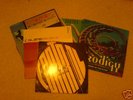
Although individual Suites do turn up, the more lavish box is quite elusive. This particular copy contains not only the beautiful full-size 18-page booklet (in German, French, and English), but also a fascinating curiosity – the original 'Archiv-Kartei des Musikhistorischen Studios der Deutschen Grammophon Ges.', a sort of producer's notecard (14.8 cm X 20.6 cm) with musical and discographic information related to this specific set. (See the scan)
From this we learn that Fournier played from the Urtext as edited by Paul Grummer and E.H. Muller von Asow, published in Vienna in 1944 and that the recordings were produced by Karl-Heinz Schneider and engineered by Heinz Wildhagen.
Wrote Nicholas Anderson in the March 1989 issue of The Gramophone: "Of all the great cellists I have heard playing Bach's six Cello Suites, BWV1007-12, either in the concert hall or in recordings of various kinds, Pierre Fournier came closer to the heart of the music, as I understand it, than almost any other. He made these recordings for Archiv in 1960 and they have seldom been out of the catalogue. Readers who prefer the charisma and extrovert flourishes of Tortelier (EMI), the penetrating though sometimes unstylish gestures of Casals (EMI References—reviewed on page 1512), or the brilliant but too often superficial readings of Schiff (EMI) and Maisky (DG) may be hard to win over to these concentrated, personally unassuming interpretations by Fournier.
"Fournier seems to me to have possessed all the virtues of his fellow cellists without yielding to any of their self-indulgences; irrelevant personal idiosyncrasies are never allowed to intrude these finely sustained performances. He could be brilliant in execution—his technique was second to none, as he proves throughout this set—profound in utterance, aristocratic in poise and wonderfully coherent in his understanding of Bach's articulation and phrases. We need look no further than the Prelude of the First Suite in G major to find the supreme artistry which characterizes each and every moment of these performances. To be sure, there are very occasionally notes which fail to reach their centre but they are few and far between and certainly Fournier's intonation compares favourably with that of some of his virtuoso companions. Fournier's rubato is held tightly in rein and when he does apply it it is in the interests of enlivening aspects of Bach's formal writing. Thus it is in the Preludes, where the music requires rhythmic freedom if it is not to be relegated to the ranks of mere study material, that Fournier demonstrates his intuition and fine sense of style most forcefully; the Preludes to the First and Third Suites provide good examples. Fournier can sparkle too, as he does in many of the faster dance-orientated movements such as courantes, gavottes, bourrees and so on; in the sarabandes, on the other hand, he invariably strikes a note of grandeur coupled with a concentration amounting at times—as in the sarabandes of Suites Nos. 2 and 3—almost to abstraction.
"Above all, Fournier's Bach playing is crowned with an eloquence, a lyricism and a grasp both of the formal and stylistic content of the music which will not easily be matched. Curiously, perhaps, it is the baroque cellist, Anner Bylsma on RCA who often provides close parallels with Fournier. Bylsma's tempos tend to be faster than those of Fournier—that, after all has been a trend in baroque music over the past 20 years or so—but his conception of the music shares ground with that of Fournier. All things considered, it is hardly surprising that these readings seem as fresh and as valid today as they did 25 or more years ago. Out and out purists, poor devils, may not be able to adjust to modern pitch, modern instrument and, in the case of Suites Nos. 5 and 6, the wrong instrument, but if that is so they are deserving more of compassion than censure. Fine recorded sound and strongly commended on virtually all counts."
CONDITON:
The condition of the clam-shell box is A-. There is some edgewear, as well as splitting to the corners of the box top (the corners of the lower box are perfectly intact). There is also a minor crease to the front panel of the box and areas of discoloration. Nevertheless, the box remains quite handsome and very sturdy and is free of owners' markings or other defects.
The condition of the full-size 18-page, heavy-paper booklet is MINT-. Indeed, there are no real flaws to speak of – a superb collector's copy. The producers card has a few small areas of discoloration, but is otherwise fine – without creases, bends, or cuts.
The condition of the 3 LPs is near-MINT throughout. There are one or two instances of brief and light surface noise, but nothing that would detract from the listener's enjoyment. All-in-all, all three are fine collector's copies.
All LPs have been play-graded and carefully cleaned.
PAYMENT:
Payment by PayPal is preferred, although I also accept payment via check, or money order (in U.S. dollars). If you choose to send a check or money order, I will provide you the address for mailing this. Please do not send cash.
SHIPPING:
This item will ship from Barcelona, Spain. If more than one item is purchased, shipping will be combined to reduce the cost to the buyer.
Within Spain: $7.00
Within Europe: $12.00
Rest of World (including U.S., Canada, and Far East): $25.00
Please see my other classical auctions and email me with any questions, I'll be glad to help.
price rating




![Lennon [VINYL] John Lennon Vinyl](https://www.popsike.mobi/php/thumbnail.php?url=https://www.popsike.pics/pix/20150823/311431018276.jpg)