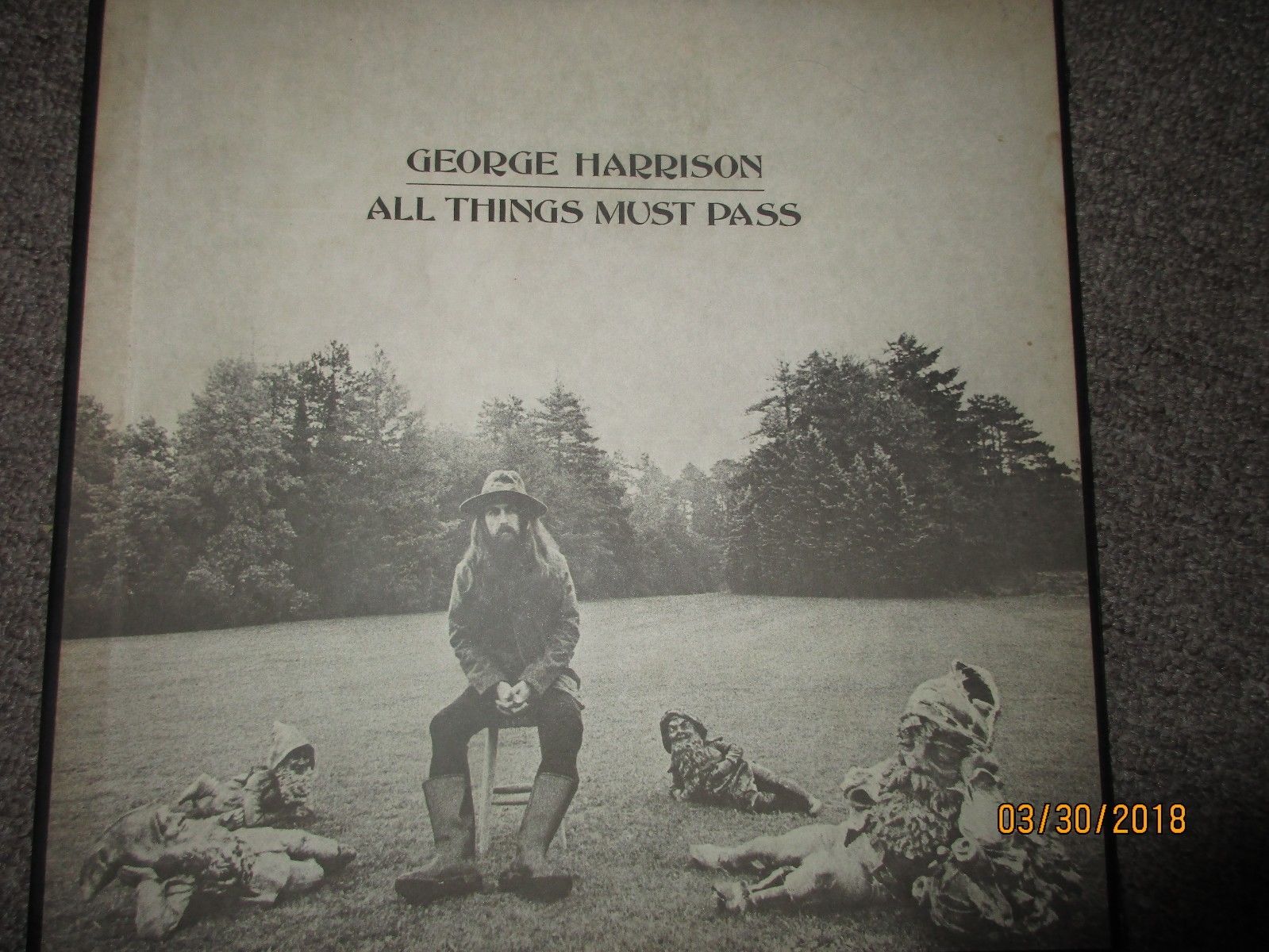
George Harrison 3 Lp set "All Things Must Pass"
$
22


Favourite Auctions
To save auctions to your favourites, please login
If you don't have an account, please register
Description
George Harrison 3 lp set ALL THINGS MUST PASS Record#1 on Side 1 and 2 .we grade as Fair. .show many sleeves and marks but Lp Plays well..(worst poping and Clicking is on Song 2 "If not for you) Record #2 ..Side 3&4 is VG++/NM Record #3 ..Side 5&6 is VG++/NM .Cover is Vg+ with clear tape on all sides...Poster is MINT Buyer to pay $4.00 s/h Thanks for looking All Things Must Pass Studio album by George Harrison Released 27 November 1970 Recorded 26 May–late October 1970 Studio Abbey Road Studios, London; Trident Studios, London; Apple Studio, London Genre
- Folk rock
- gospel
- hard rock
- country
(1969) All Things Must Pass
(1970) The Concert for Bangladesh
(1971) Singles from All Things Must Pass
- "My Sweet Lord"
Released: 23 November 1970 (US);
15 January 1971 (UK) - "What Is Life"
Released: 15 February 1971 (US)
All Things Must Pass is a triple album by English musician George Harrison. Recorded and released in 1970, the album was Harrison's first solo work since the break-up of the Beatles in April that year, and his third solo album overall. It includes the hit singles "My Sweet Lord" and "What Is Life", as well as songs such as "Isn't It a Pity" and the title trackthat had been turned down for inclusion on releases by the Beatles. The album reflects the influence of Harrison's musical activities with artists such as Bob Dylan, the Band, Delaney & Bonnie and Billy Preston during 1968–70, and his growth as an artist beyond his supporting role to former bandmates John Lennon and Paul McCartney. All Things Must Pass introduced Harrison's signature sound, the slide guitar, and the spiritual themes that would be present throughout his subsequent solo work. The original vinyl release consisted of two LPs of songs and a third disc of informal jams, titled Apple Jam. Several commentators interpret Barry Feinstein's album cover photo, showing Harrison surrounded by four garden gnomes, as a statement on his independence from the Beatles.
Production began at London's Abbey Road Studios in May 1970, with extensive overdubbing and mixing continuing through October. Among the large cast of backing musicians were Eric Clapton and Delaney & Bonnie's Friends band – three of whom formed Derek and the Dominos with Clapton during the recording – as well as Ringo Starr, Gary Wright, Preston, Klaus Voormann, John Barham, Badfinger and Pete Drake. The sessions produced a double album's worth of extra material, most of which remains unissued.
All Things Must Pass was critically and commercially successful on release, with long stays at number 1 on charts around the world. The album was co-produced by Phil Spectorand employs his Wall of Sound production technique to notable effect; Ben Gerson of Rolling Stone described the sound as "Wagnerian, Brucknerian, the music of mountain tops and vast horizons".[1] Reflecting the widespread surprise at the assuredness of Harrison's post-Beatles debut, Melody Maker's Richard Williams likened the album to Greta Garbo's first role in a talking picture and declared: "Garbo talks! – Harrison is free!"[2] According to Colin Larkin, writing in the 2011 edition of his Encyclopedia of Popular Music, All Things Must Pass is "generally rated" as the best of all the former Beatles' solo albums.[3]
During the final year of his life, Harrison oversaw a successful reissue campaign to mark the 30th anniversary of the album's release. Following this reissue, in March 2001, the set was certified six-times platinum by the Recording Industry Association of America. Among its appearances in critics' best-album lists, All Things Must Pass was ranked 79th on The Times' "The 100 Best Albums of All Time" in 1993, while Rolling Stone currently places it 433rd on the magazine's "500 Greatest Albums of All Time". In January 2014, All Things Must Pass was inducted into the Grammy Hall of Fame.
All Things Must Pass Studio album by George Harrison Released 27 November 1970 Recorded 26 May–late October 1970 Studio Abbey Road Studios, London; Trident Studios, London; Apple Studio, London Genre- Folk rock
- gospel
- hard rock
- country
(1969) All Things Must Pass
(1970) The Concert for Bangladesh
(1971) Singles from All Things Must Pass
- "My Sweet Lord"
Released: 23 November 1970 (US);
15 January 1971 (UK) - "What Is Life"
Released: 15 February 1971 (US)
All Things Must Pass is a triple album by English musician George Harrison. Recorded and released in 1970, the album was Harrison's first solo work since the break-up of the Beatles in April that year, and his third solo album overall. It includes the hit singles "My Sweet Lord" and "What Is Life", as well as songs such as "Isn't It a Pity" and the title trackthat had been turned down for inclusion on releases by the Beatles. The album reflects the influence of Harrison's musical activities with artists such as Bob Dylan, the Band, Delaney & Bonnie and Billy Preston during 1968–70, and his growth as an artist beyond his supporting role to former bandmates John Lennon and Paul McCartney. All Things Must Pass introduced Harrison's signature sound, the slide guitar, and the spiritual themes that would be present throughout his subsequent solo work. The original vinyl release consisted of two LPs of songs and a third disc of informal jams, titled Apple Jam. Several commentators interpret Barry Feinstein's album cover photo, showing Harrison surrounded by four garden gnomes, as a statement on his independence from the Beatles.
Production began at London's Abbey Road Studios in May 1970, with extensive overdubbing and mixing continuing through October. Among the large cast of backing musicians were Eric Clapton and Delaney & Bonnie's Friends band – three of whom formed Derek and the Dominos with Clapton during the recording – as well as Ringo Starr, Gary Wright, Preston, Klaus Voormann, John Barham, Badfinger and Pete Drake. The sessions produced a double album's worth of extra material, most of which remains unissued.
All Things Must Pass was critically and commercially successful on release, with long stays at number 1 on charts around the world. The album was co-produced by Phil Spectorand employs his Wall of Sound production technique to notable effect; Ben Gerson of Rolling Stone described the sound as "Wagnerian, Brucknerian, the music of mountain tops and vast horizons".[1] Reflecting the widespread surprise at the assuredness of Harrison's post-Beatles debut, Melody Maker's Richard Williams likened the album to Greta Garbo's first role in a talking picture and declared: "Garbo talks! – Harrison is free!"[2] According to Colin Larkin, writing in the 2011 edition of his Encyclopedia of Popular Music, All Things Must Pass is "generally rated" as the best of all the former Beatles' solo albums.[3]
During the final year of his life, Harrison oversaw a successful reissue campaign to mark the 30th anniversary of the album's release. Following this reissue, in March 2001, the set was certified six-times platinum by the Recording Industry Association of America. Among its appearances in critics' best-album lists, All Things Must Pass was ranked 79th on The Times' "The 100 Best Albums of All Time" in 1993, while Rolling Stone currently places it 433rd on the magazine's "500 Greatest Albums of All Time". In January 2014, All Things Must Pass was inducted into the Grammy Hall of FameThis article is about the album. For other uses, see All Things Must Pass (disambiguation). "Apple Jam" redirects here. For jam made from apples, see apple jam and apple sauce. All Things Must Pass Studio album by George Harrison Released 27 November 1970 Recorded 26 May–late October 1970 Studio Abbey Road Studios, London; Trident Studios, London; Apple Studio, London Genre- Folk rock
- gospel
- hard rock
- country
(1969) All Things Must Pass
(1970) The Concert for Bangladesh
(1971) Singles from All Things Must Pass
- "My Sweet Lord"
Released: 23 November 1970 (US);
15 January 1971 (UK) - "What Is Life"
Released: 15 February 1971 (US)
All Things Must Pass is a triple album by English musician George Harrison. Recorded and released in 1970, the album was Harrison's first solo work since the break-up of the Beatles in April that year, and his third solo album overall. It includes the hit singles "My Sweet Lord" and "What Is Life", as well as songs such as "Isn't It a Pity" and the title trackthat had been turned down for inclusion on releases by the Beatles. The album reflects the influence of Harrison's musical activities with artists such as Bob Dylan, the Band, Delaney & Bonnie and Billy Preston during 1968–70, and his growth as an artist beyond his supporting role to former bandmates John Lennon and Paul McCartney. All Things Must Pass introduced Harrison's signature sound, the slide guitar, and the spiritual themes that would be present throughout his subsequent solo work. The original vinyl release consisted of two LPs of songs and a third disc of informal jams, titled Apple Jam. Several commentators interpret Barry Feinstein's album cover photo, showing Harrison surrounded by four garden gnomes, as a statement on his independence from the Beatles.
Production began at London's Abbey Road Studios in May 1970, with extensive overdubbing and mixing continuing through October. Among the large cast of backing musicians were Eric Clapton and Delaney & Bonnie's Friends band – three of whom formed Derek and the Dominos with Clapton during the recording – as well as Ringo Starr, Gary Wright, Preston, Klaus Voormann, John Barham, Badfinger and Pete Drake. The sessions produced a double album's worth of extra material, most of which remains unissued.
All Things Must Pass was critically and commercially successful on release, with long stays at number 1 on charts around the world. The album was co-produced by Phil Spectorand employs his Wall of Sound production technique to notable effect; Ben Gerson of Rolling Stone described the sound as "Wagnerian, Brucknerian, the music of mountain tops and vast horizons".[1] Reflecting the widespread surprise at the assuredness of Harrison's post-Beatles debut, Melody Maker's Richard Williams likened the album to Greta Garbo's first role in a talking picture and declared: "Garbo talks! – Harrison is free!"[2] According to Colin Larkin, writing in the 2011 edition of his Encyclopedia of Popular Music, All Things Must Pass is "generally rated" as the best of all the former Beatles' solo albums.[3]
During the final year of his life, Harrison oversaw a successful reissue campaign to mark the 30th anniversary of the album's release. Following this reissue, in March 2001, the set was certified six-times platinum by the Recording Industry Association of America. Among its appearances in critics' best-album lists, All Things Must Pass was ranked 79th on The Times' "The 100 Best Albums of All Time" in 1993, while Rolling Stone currently places it 433rd on the magazine's "500 Greatest Albums of All Time". In January 2014, All Things Must Pass was inducted into the Grammy Hall of Fame.
price rating