George Harrison "All Things Must Pass" Apple STCH 639 3xLP Box +inners+poster
£
60
$
80


Favourite Auctions
To save auctions to your favourites, please login
If you don't have an account, please register
Description
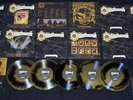
George Harrison ? "All Things Must Pass" Apple Records ?STCH 639. 3 × Vinyl, LP Box Set, released in 1970. Each album is housed in a different colour lyric inner sleeve. Record 1 Is Lilac, Record 2 Is Tawny, And Record 3 Is Mustard.
All three albums appear to have been lightly played and are in great condition. They played through beautifully on my elderly stereo unit - no hop, stick or hiss. The vinyl is housed in their original custom inner sleeves, which are intact. These sleeves have a little edge wear in places but they are intact - no writing or rips. The sleeves have a small "printed in the usa" text. The spine is intact and completely legible. The box is good condition, the corners are intact. The poster with a "printed in the usa" text has been on someone's wall previously, but it is in generally good shape, with no rips or writing. Matrix/Run Out Side 1 : YEX 817-1U Matrix/Run Out Side 2 : YEX 818-1U Matrix/Run Out Side 3 : YEX 819-1U Matrix/Run Out Side 4 : YEX 820-1U Matrix/Run Out Side 5 : YEX 821-1U Matrix/Run Out Side 6 : YEX 822-1U
"All Things Must Pass" is a triple album by George Harrison. Recorded and released in 1970, the album was Harrison's first solo work since the break-up of the Beatles in April that year, and his third solo album overall. It includes the hit singles "My Sweet Lord" and "What Is Life", as well as songs such as "Isn't It a Pity" and the title track that had been turned down for inclusion on releases by the Beatles. The album reflects the influence of Harrison's musical activities with artists such as Bob Dylan, the Band, Delaney & Bonnie and Billy Preston during 1968–70, and his growth as an artist beyond his supporting role to former band-mates John Lennon and Paul McCartney. "All Things Must Pass" introduced Harrison's signature sound, the slide guitar, and the spiritual themes that would be present throughout his subsequent solo work. The original vinyl release consisted of two LPs of songs and a third disc of informal jams, titled "Apple Jam". Several commentators interpret Barry Feinstein's album cover photo, showing Harrison surrounded by four garden gnomes, as a statement on his independence from the Beatles.
Production began at London's Abbey Road Studios in May 1970, with extensive overdubbing and mixing continuing through October. Among the large cast of backing musicians were Eric Clapton and Delaney & Bonnie's Friends band – three of whom formed Derek and the Dominos with Clapton during the recording – as well as Ringo Starr, Gary Wright, Preston, Klaus Voormann, John Barham, Badfinger and Pete Drake. The sessions produced a double album's worth of extra material, most of which remains unissued.
"All Things Must Pass" was critically and commercially successful on release, with long stays at number 1 on charts around the world. The album was co-produced by Phil Spector and employs his Wall of Sound production technique to notable effect; Ben Gerson of Rolling Stone described the sound as "Wagnerian, Brucknerian, the music of mountain tops and vast horizons". Reflecting the widespread surprise at the assuredness of Harrison's post-Beatles debut, Melody Maker's Richard Williams likened the album to Greta Garbo's first role in a talking picture and declared: "Garbo talks! – Harrison is free!" According to Colin Larkin, writing in the 2011 edition of his Encyclopedia of Popular Music, "All Things Must Pass" is "generally rated" as the best of all the former Beatles' solo albums.
During the final year of his life, Harrison oversaw a successful reissue campaign to mark the 30th anniversary of the album's release. Among its appearances in critics' best-album lists, "All Things Must Pass" was ranked 79th on The Times' "The 100 Best Albums of All Time" in 1993, while Rolling Stone currently places it 433rd on the magazine's "500 Greatest Albums of All Time". In January 2014, "All Things Must Pass" was inducted into the Grammy Hall of Fame.
The precise line-up of contributing musicians is open to conjecture. Due to the album's big sound and the many participants on the sessions, commentators have traditionally referred to the grand, orchestral nature of this line-up. In 2002, music critic Greg Kot described it as "a who's who of the decade's rock royalty", while Harris writes of the cast taking on "a Cecil B. De Mille aspect".
The musicians included Bobby Whitlock, Jim Gordon, Carl Radle, Bobby Keys, Jim Price and Dave Mason, all of whom had recently toured with Delaney & Bonnie. Along with Eric Clapton, there were also musicians whose link with Harrison went back some years, such as Ringo Starr and Billy Preston, and German bassist Klaus Voormann, formerly of Manfred Mann and a friend since the Beatles' years in Hamburg. Handling much of the keyboard work with Whitlock was Gary Wright, who went on to collaborate regularly with Harrison throughout the 1970s.
From within Apple's stable of musicians, Harrison recruited the band Badfinger, future Yes drummer Alan White, and Beatles assistant Mal Evans on percussion. Badfinger drummer Mike Gibbins' powerful tambourine work led to Spector giving him the nickname "Mr Tambourine Man", after the Dylan song, while bandmates Pete Ham, Tom Evans and Joey Molland provided rhythm acoustic-guitar parts that, in keeping with Spector's Wall of Sound principles, were to be "felt but not heard". Orchestral arranger John Barham also sat in on the sessions, occasionally contributing on harmonium and vibraphone. Other guests included Nashville pedal steel player Pete Drake, Procol Harum's Gary Brooker and a pre-Genesis Phil Collins. An uncredited Peter Frampton played acoustic guitar on the country tracks featuring Drake.
For contractual reasons, on UK pressings of "All Things Must Pass", Clapton's participation on the first two discs of the album remained unacknowledged for many years, although he was listed among the musicians appearing on the Apple Jam disc in Britain. Harrison was unaware of Collins's contribution until putting together the 30th anniversary reissue of the album in 2000, at which point he offered Collins his belated thanks. Clapton's former band-mate in Cream and Blind Faith, Ginger Baker, participated in the session for "I Remember Jeep" only, according to the album's sleeve notes.
Simon Leng consulted Voormann, Barham, Molland and Delaney Bramlett for his chapter covering the making of "All Things Must Pass" and credits Tony Ashton as one of the keyboard players on both versions of "Isn't It a Pity". Unsubstantiated claims exist regarding possible guest appearances from John Lennon, Maurice Gibb and Pink Floyd's Richard Wright. In addition, for some years after the album's release, rumours claimed that the Band backed Harrison on the country-influenced "Behind That Locked Door".
Harrison commissioned Tom Wilkes to design a hinged box in which to house the three vinyl discs, rather than have them packaged in a triple gatefold cover. Apple insider Tony Bramwell later recalled: "It was a bloody big thing ... You needed arms like an orang-utan to carry half a dozen." The packaging caused some confusion among retailers, who, at that time, associated boxed albums with opera or classical works.
Apple included a poster with the album, showing Harrison in a darkened corridor of his home, standing in front of an iron-framed window. Wilkes had designed a more adventurous poster, but according to Beatles author Bruce Spizer, Harrison was uncomfortable with the imagery. Some of the Feinstein photographs that Wilkes had incorporated into this original poster design appeared instead on the picture sleeves for the "My Sweet Lord" single and its follow-up, "What Is Life".
AllMusic's Richie Unterberger views "All Things Must Pass" as "[Harrison's] best ... a very moving work", while Roger Catlin of MusicHound describes the set as "epic and audacious", its "dense production and rich songs topped off by the extra album of jamming". Q magazine considers it to be an exemplary fusion of "rock and religion", as well as "the single most satisfying collection of any solo Beatle". Filmmaker Martin Scorsese has written of the "powerful sense of the ritualistic on the album", adding: "I remember feeling that it had the grandeur of liturgical music, of the bells used in Tibetan Buddhist ceremonies." Writing for Rolling Stone in 2002, Greg Kot described this grandeur as an "echo-laden cathedral of rock in excelsis" where the "real stars" are Harrison's songs; in the same publication, Mikal Gilmore labelled the album "the finest solo work any ex-Beatle ever produced". In his July 2001 feature for Mojo, John Harris called it "the inaugural solo album that still stands as the best Beatles solo record", while earlier that year the magazine's album review read in part: "This remains the best Beatles solo album ... oozing both the goggle-eyed joy of creative emancipation and the sense of someone pushing himself to the limit ..."
"All Things Must Pass" features in music reference books such as The Mojo Collection: The Greatest Albums of All Time, Robert Dimery's 1001 Albums You Must Hear Before You Die and Tom Moon's 1,000 Recordings to Hear Before You Die. In 1999, "All Things Must Pass" appeared at number 9 on The Guardian's "Alternative Top 100 Albums" list, where the editor described it as the "best, mellowest and most sophisticated" of all the Beatles' solo efforts. In 2006, Pitchfork Media placed it at number 82 on the site's "Top 100 Albums of the 1970s". Six year later, it was voted 433rd on Rolling Stone magazine's list of the "500 Greatest Albums of All Time". According to the website Acclaimed Music, "All Things Must Pass" has also appeared in the following critics' best-album books and lists, among others: Paul Gambaccini's The World Critics Best Albums of All Time (1977; ranked number 79), The Times' "100 Best Albums of All Time" (1993; number 79), Allan Kozinn's The 100 Greatest Pop Albums of the Century (published in 2000), Q's "The 50 (+50) Best British Albums Ever" (2004), Mojo's "70 of the Greatest Albums of the 70s" (2006), the NME's "100 Greatest British Albums Ever" (2006; number 86), Paste magazine's "The 70 Best Albums of the 1970s" (2012; number 27), and Craig Mathieson and Toby Creswell's The 100 Best Albums of All Time (2013). In January 2014, "All Things Must Pass" was inducted into the Grammy Hall of Fame, an award bestowed by the Recording Academy "to honor recordings of lasting qualitative or historical significance that are at least 25 years old".
price rating