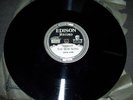
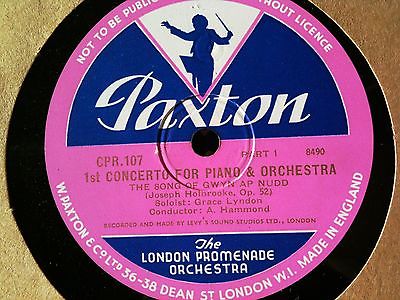
Grace Lyndon PIANO JOSEPH HOLBROOK Concerto 1 Op 52 The Song of Gwynn Ap Nudd 78
$
50


Favourite Auctions
To save auctions to your favourites, please login
If you don't have an account, please register
Description
Welcome to my auctions of great records
This is my FINAL WEEK of 3 weeks of great auctions – I WILL PACK AND BILL YOUR RECORDS after the close on September 27.
PLEASE DO NOT PAY before I send you an invoice. It will take me up to 48 hours to pack your records, but this is the ONLY WAY to get you the LOWEST POSTAGE. If you pay before I sent you an invoice, the EBAY system will charge you a HIGHER POSTAGE for shipping.
International shipping: approx postage 1x10"=$25: 1x12"=$28: 10"Album 4 Rec=45$: 12" Album 2 Rec=45$
About 30% less to Canada. Pls ignore international postage displayed in Ebay, rates are too high
Please wait for me to send you an invoice. DO NOT USE EBAY CHECKOUT if you want the lowest possible postage.
A series of great Violin, Piano and Orchestra records on rare labels, from 1902 Monarch to 1940 War Germany recordings.
Great recording by Grace Lyndon in what seems to be her only recording
of the JOSEPH HOLBROOK PIANO Concerto No 1 Op 52 The Song of Gwynn Ap Nudd
Another highlight was Paxton's 1949 recording of the piano concerto The Song of Gwyn ap Nudd played by Grace Lyndon with the London Promenade Orchestra conducted by Arthur Hammond (1904-1991).Filler Side: The Birds of Rhiannon conducted by Sir Granville Bantock
Rare set of 6x12" 78 rpm British Paxton record in generic album
Condition: EXCELLENT CLOSE TO PRISTINE, album solid
Joseph Holbrooke by E.O. Hoppé, 1913
Joseph Charles Holbrooke (5 July 1878 – 5 August 1958) was an English composer, conductor, and pianist.
Contents
1 Life
1.1 Early years
1.2 Success
1.3 Controversy
1.4 Neglect
2 Music
2.1 Style
2.2 Reputation
3 Recordings
4 Legacy
5 Notes
6 External links
Life
Early years
Joseph Holbrooke was born Joseph Charles Holbrook in Croydon, Surrey.[1] His father, also named Joseph, was a music hall musician and teacher, and his mother Helen was a Scottish singer. He had two older sisters (Helen and Mary) and two younger brothers (Robert and James), both of whom died in infancy.[2] The family travelled around the country, with both parents participating in musical entertainments.[3] Holbrooke's mother died in 1880 from tuberculosis,[4] leaving the family in the care of Joseph senior, who settled the family in London and took the position of pianist at Collins' Music Hall, Islington, and later at the Bedford Music Hall. Holbrooke was taught to play the piano and the violin by his father,[5] who was not averse to the use of violence as a method of instruction,[6][7] and played in music halls himself [8] before entering the Royal Academy of Music as a student in 1893, where he studied under Frederick Corder for composition and Frederick Westlake for piano. Whilst at the academy he composed several works, chiefly piano miniatures, songs and some chamber music, which were performed at student concerts:[9] at one recital, he substituted one of his own compositions in preference to Schumann's Toccata, incurring the wrath of the Principal, Sir Alexander Campbell Mackenzie.[10] Whilst at the Royal Academy, Holbrooke won several prizes including the Potter Exhibition for pianoforte (1895),[11] the Sterndale Bennett Scholarship (awarded on 29 April 1896),[12] the Heathcote Long Prize for pianoforte (1896) [13] and, in his final year (with the Pantomime Suite for strings), the Charles Lucas Prize for composition (1897).[14][15]
After leaving the Royal Academy Holbrooke sought a variety of occupations. In 1898 he undertook a tour of Scotland accompanying the music hall singer Arthur Lloyd,[16][17] but the venture failed and he was forced to return to live with his father in London.[18] He then moved out of the family home to Harringay where he began to teach music privately, but once again without financial success.[19] Around this time he decided to change his name from Holbrook to Holbrooke,[20][21] probably in order to avoid confusion as his father was also still teaching privately. He subsequently adopted the variant Josef Holbrooke which he continued to use inconsistently throughout the remainder of his life. Responding to an advertisement in Musical News, Holbrooke travelled to Horncastle in Lincolnshire where he briefly lived with and served as musical companion to the Reverend Edward Stewart Bengough (1839-1920).[22][23] He was soon travelling again, conducting a touring pantomime (Aladdin and the Lamp) during the 1899-1900 Christmas season. Once more, however, the enterprise collapsed and Holbrooke was left stranded and virtually destitute, at which point Bengough sent him money to enable him to return to London.[24][25]
Success
Whilst on tour, Holbrooke had sent the score of his orchestral poem The Raven to August Manns, conductor at the Crystal Palace. Manns accepted the work for performance and gave the premiere on 3 March 1900, whilst later that same year the orchestral variations on Three Blind Mice were also heard (Queen's Hall Promenade Concert, conducted by Henry Wood, 8 November 1900). In 1901 he won the Lesley Alexander Prize for chamber music with his Sextet in F minor and also received an invitation from Granville Bantock to become a member of the staff at the Birmingham and Midland Institute School of Music. He accepted the position, living with the Bantocks whilst teaching at the institution,[26] but rapidly became dissatisfied with the routine and returned to London in 1902.[27] There then followed a decade of prestigious commissions and performances, with notable works including the poem for chorus and orchestra Queen Mab (Leeds Festival, conducted by the composer, 6 October 1904), the orchestral poem Ulalume (Queen's Hall, conducted by the composer, 26 November 1904), the scena for baritone and orchestra Marino Faliero (Bristol Festival, conducted by the composer, 12 October 1905), the Bohemian Songs for baritone and orchestra (Norwich Festival, conducted by the composer, 25 October 1905), the poem for chorus and orchestra The Bells (Birmingham Festival, conducted by Hans Richter, 3 October 1906), the orchestral suite Les Hommages (Queen's Hall Promenade Concert, conducted by Henry Wood, 25 October 1906) and the choral symphony Homage to E.A. Poe (two movements first performed at the Bristol Festival, 16 October 1908). During this period Holbrooke also won a further prize, this time with his Fantasie Quartet, Op.17b entered for the 1905 chamber music competition initiated by Walter Willson Cobbett.[28]
In 1907 Holbrooke was approached by the poet Herbert Trench who wished the composer to set his extended poem on immortality Apollo and the Seaman.[29] This Holbrooke duly did, although only the final section of the poem (The Embarkation) is actually sung (by a male chorus), the rest of the score being a purely orchestral illustration of the verses. The completed work, styled "An Illuminated Symphony", was first performed at Queen's Hall on 20 January 1908, conducted by Thomas Beecham: on this occasion the orchestra and chorus were hidden from the audience behind an elaborate screen whilst the text of the poem was projected onto the screen using lantern slides at corresponding points in the music.[30] The rehearsals for Apollo and the Seaman were attended by Thomas Scott-Ellis, 8th Baron Howard de Walden who shortly after the first performance approached Holbrooke with one of his own poems, entitled Dylan - Son of the Wave:[31] this resulted in the composition of the opera Dylan, first performed at the Theatre Royal, Drury Lane, London, conducted by Artur Nikisch, on 4 July 1914. The staging included another technological wonder:
"in this work, in order to get convincing flights of wild fowl, films were made in the Outer Hebrides and projected on to the stage. This, of course, was in the days of the silent film, when there was no means of deadening the whirr or hum of the projector and the films themselves resolved into a series of flicks. The scoring, however, was vivid enough to cover the sounds, and this incipient film music was infinitely more successful than some of the over-vaunted high-level scores heard to-day. The theatre, however, was not ready for such an innovation, and the extra-musical effects were not taken seriously." [32]
Collaboration on two further operas, The Children of Don (first performed at the London Opera House, conducted by Thomas Beecham, on 12 June 1912) and Bronwen, brought about the completion of Holbrooke's most ambitious project, a trilogy under the collective title The Cauldron of Annwn setting Scott-Ellis' versions of tales from the Welsh Mabinogion. Until his death in 1946, Scott-Ellis effectively acted as patron to Holbrooke, subsidising performances and publication of many of his works.[33]
Throughout this period, Holbrooke also enjoyed a successful career as a virtuoso concert pianist. Besides his own compositions, his repertoire included the Toccata by Robert Schumann, Islamey by Mily Balakirev, Scriabin's Piano Sonata No.1, the fantasie Africa for piano and orchestra by Saint-Saëns, Tchaikovsky's Piano Concerto No.1 and Rachmaninoff's Piano Concerto No.2.[34][35]
Controversy
In 1902 Holbrooke had begun his own series of chamber music concerts to promote his music alongside new works by his British contemporaries. Audiences would regularly find admonishing notes printed in their programmes:
"Mr. JOSEF HOLBROOKE steps forward somewhat adventurously with his 12th year of endeavour for some Modern English Music to an apathetic public, and hopes to receive as few blows as possible (with the usual financial loss) in return." [36]
"While our good English musicians in power with fine orchestras and much money are pummelling to their utmost ability the down-trodden and unrecognised gifts (!) of Richard Strauss and his brethren abroad, we, in our small way, and where we can, try to leaven matters by writing out cheques and playing our own music to recalcitrant audiences! It is to be regretted that the Reger Pianoforte Quintet announced for this concert was found so long and turgid that we had to put it aside, in case it met with the sad fate of serious English music. We have found a place for more interesting native work and saved Mr. Reger's reputation, which, with Mr. Strauss, is sacred in this country." [37]
When war broke out in 1914 he turned his attention to vigorously denouncing both the lack of support given to British music and the continued favour afforded to that of other countries, especially Germany. He published a series of five essays entitled British Music Versus German Music which appeared weekly in The New Age between 5 November and 3 December 1914:
"The British people have ever listened to the alien, as in the days of Handel, and the critic (although not a villain!) is always ready with his enthusiasm, in large type, for Tetrazzini, Caruso, Busoni, Strauss, Puccini, Nikisch, Campanini, Van Rooy, Stravinski, Chaliapine, Debussy, Pavlova, Karsavina, Nijinski, Mengelberg, Steinbach, Schönberg, Savonoff, Paderewski, Elman, and a few other aliens! These are the 'gods' I am mentioning, the gods of the British people." [38]
"In a recent disclosing [...] I gave actual instances of the orchestras I had personally given concerts with in London, costing me many hundreds of pounds. My sole reward for this is to find them, the orchestras I engaged, united in ignoring, year after year, my works, until, I imagine, more money is forthcoming to spend on more performances!" [39]
"the despicable members of the music profession are encouraged to play German music by an absolutely indifferent audience. One wonders if any of such people have lost their sons or husbands at the front, or is it that the bulk of our music lovers 'do not fight'" [40]
The personal tone which informed much of the writing was too strong for some commentators who saw it as blatant self-promotion:
"I may be forgiven for reading between his lines. I am tempted to think that Mr. Holbrooke is only discussing his own grievances against the English public, and that the real heading of his articles should be 'Holbrooke's v. German or any other music'" [41]
"It is a little depressing to watch Mr. Holbrooke endeavouring, week after week, to precipitate Music into the dismal cesspool of Chauvinism that is already full to overflowing. [...] Mr. Holbrooke's position is analogous to that of the street-minstrel. It is as though the penny-whistler on the kerbstone were suddenly to belabour with his instrument all the passers-by who did not instantly lose the purpose of their passing-by in a passion of wonder and ecstasy at the sound of his piping. [...] Not all British composers have yet sunk into the mire of sordid commercialism, wherein Mr. Holbrooke would have them fellow-wallowers with himself, nor are they all intoxicated with those quixotic notions of nationalism that have caused Mr. Holbrooke to waste so much breath in spluttering invective against a public that persists in believing that Art is one, and life too short for futile arguments about its nationality." [42]
The fact that Holbrooke had recently issued a number of works [43] under a pseudonym was also seized upon and viewed with suspicion:
"I should like to ask Mr. Holbrooke to explain why, for all his patriotism, he has recently thought fit to publish several of his works under the name of Jean Hanze, and, in addition, to circulate a pamphlet puffing their soi-disant BELGIAN COMPOSER! - at this time, of all others, when the word 'Belgian' acts as a kind of magic formula for opening purses! One is reminded of the pavement artist who stuffed his legs through a hole in the wall, and posed as a hero who had given his legs for his country. He got several months." [44]
Undoubtedly, Holbrooke was a difficult and prickly person to deal with professionally. Shortly before a concert in Bournemouth on 22 February 1917, where the composer was to give a performance of his piano concerto Gwyn ap Nudd, the conductor Dan Godfrey was compelled to hastily insert apology slips into each of the programmes to the following effect:
"Mr Dan Godfrey begs to announce that Mr Joseph Holbrooke declines to play today, at this concert, because his name is not announced on the bills in large enough type, consequently the programme will be changed. The Piano Concerto and Dreamland Suite will be substituted by Violin Concerto, Paganini (H E Batten) Scènes Pittoresques, Massenet." [45]
In fact, what had annoyed Holbrooke was the greater prominence which the printed advertisements gave to Vladimir Pachmann who was due to play two days later: he felt that this was yet another instance where a foreigner was being given undue celebrity to the detriment of a native pianist.[46] Such outbursts of pique were characteristic and he gained the reputation of a troublesome and cantankerous eccentric:
"Holbrooke's personality has also been largely responsible for the amount of opposition that he has received. He is not a man of reticences, and what his heart feels, his tongue speaks without any arrière pensée. He is fond of talking, and nobody talks much who does not say unwise things at times. Being impulsive by nature and very open in character, he is apt to commit indiscretions which he afterwards regrets. He is his own worst enemy, and is well aware of the fact." [47]
"Josef Holbrooke, an excitable, deaf, talkative, combative musician, who lives in a solitary house in North London surrounded by ordinary Villadom, and writes there music which no one can play. It is music Wagner-like in form and Strauss-like in its intricate orchestration, almost unrecognised, except in foreign Culturedom. And Holbrooke, who composes it, is the enemy of the critics, the terror of publishers, and the intolerant hater of all that is commonplace in music. 'Holbrooke's Sauce,' they call him." [48]
More Great Records on sale right now:
http://shop.ebay.com/carsten_sf/m.html
http://shop.ebay.com/carsten_sf/m.html
====
A Quick NOTE ON GRADING AND SHIPPING:
As you can see from my feedback, I try hard to earn your POSITIVE FEEDBACK and FIVE STAR RATINGS.
If for any reason your transaction was NOT SATISFACTORY, pls contact me and I will work something out with you. YOU WILL NEVER HAVE A REASON TO GIVE ME A NEGATIVE RATING or a LOW STAR RATING.
Quick note on grading:
The Grade (Excellent to Fair, I don't give Mint) refers to the WEAR of the record. Any other defects are stated separately
When I listen to a record, I may also give it an aural grade (again E to F), and make a SUBJECTIVE judgment of the pressing quality for hiss and surface noise.
"SUPERQUIET" is basically noiseless, like a vinyl pressing.
"VERY QUIET" is an exceptionally quiet record for a given pressing.
"Quiet" is a record that is a great example without undue noise for a give pressing.
These judgments are SUBJECTIVE and will depend one the styli, phonograph etc. you use on your own equipment.
Pls check my other auctions for more great records and phonograph items:
Multiple item shipping: I am happy to combine items for shipment in one parcel.
If you win multiple items, pls send me an INVOICE REQUEST to calculate the correct postage. Ebay check out will not give you the multiple item discount!
Records will be packed safely between corrugated cardboard in a sturdy box with plenty of padding for safe shipment.
Shipment is usually Media Mail, unless another service is requested. Shipping is at your risk, I will be happy to insure items at your cost.
I charge actual postage plus a small fee for packing materials
As always, I guarantee your satisfaction. If you don't like the item, just return it, and I will refund the full purchase price.
If you are in the San Francisco area, I encourage pick-up in person.
US Domestic Shipping:
Here is a guideline for US Media Mail Shipping:
Prices below are for regular 78 rpm records. Up to about 5 records, I will ship Edison Discs for the same rates. Albums from Album Sets count as 1 record. Above that and for international shipments, it will be actual weight plus a small packing charge (1-3$ depending on size of shipment)
1 record: 4.50 – 5.00$
2 records: 5.75$
5 records: 7.50$
10 records: 9.50$
MANY MORE RECORDS: Don't worry. I safely ship 40 - 50 pounds of records double boxed in moving boxes, and even then Media Mail will probably not exceed 30$.
Please send me a message if you would like to lower your shipping rates!
International Buyers:
All'attenzione degli acquirenti italiani:
ATTENTION TO ITALIAN BUYERS:
Due to rare problems with delivery in ITALY, I will NOT GUARANTEE delivery of parcels sent by US Postal Service First Class and Priority Mail. If you prefer secure delivery, I will be happy to quote you either Registered Mail or shipment by FEDEX
I am very happy to ship records worldwide.
Please use the EBAY shipping cost only as a guideline. My actual charges are usually lower
One record usually ships for 25 – 28$ (Less for Canada).
I can get competitive rates from FedEx and the US Postal service for any kind of parcel weight, and will make use of all the cost-saving shipment methods
Pls contact me for a shipping estimate, or send me an invoice request after close of auction.
AND AGAIN -THANK YOU FOR YOUR INTEREST
As you can see from my feedback, I take great care in presenting, grading and shipping your items. I really want you to be happy with the purchase. If you feel that anything is wrong with the item or the shipping, contact me and we will work it out !!!
As always, I would appreciate any suggestions and corrections from you, pls contact me with any question.
Thank you very much, and good luck bidding !!!
price rating