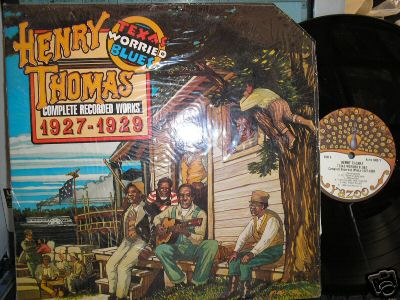
HENRY THOMAS"Texas Worried Blues"2LP YAZOO 1080/1
$
103


Favourite Auctions
To save auctions to your favourites, please login
If you don't have an account, please register
Description
Condition: Cover/ VG++, Gatefold, Cut Corner, shrink wrap intact. Record/ NM-M (Visual Grade).
AMG Biography
by Barry Lee Pearson
Texas songster Henry Thomas remains a relative stranger who made some great recordings, then returned to obscurity. Evidence suggests he was an itinerant street musician, a musical hobo who rode the rails across Texas and possibly to the World Fairs in St. Louis and Chicago just before and after the turn of the century. Most agree he was the oldest African-American folk artist to produce a significant body of recordings. His projected 1874 birthdate would predate Charley Patton by a good 17 years. Like Patton and a handful of other musicians generally termed songsters (including John Hurt, Jim Jackson, Mance Lipscomb, Furry Lewis, and Leadbelly), Thomas's repertoire bridged the 19th and 20th centuries, providing a compelling glimpse into a wide range of African-American musical genres. The 23 songs he cut for Vocalion between 1927 and 1929 include a spiritual, ballads, reels, dance songs, and eight selections titled blues. Obviously dance music, his songs were geared to older dance styles shared by Black and White audiences.
Thomas's sound, like his repertoire, is unique. He capoed his guitar high up the neck and strummed it in the manner of a banjo, favoring dance rhythm over complex fingerwork. On many of his pieces, he simultaneously played the quills or panpipes, a common but seldom-recorded African-American folk instrument indigenous to Mississippi, Louisiana, and Texas. Combining the quills, a limited-range melody instrument, with his banjo-like strummed guitar produced one of the most memorable sounds in American folk music. For example, his lead-in on "Bull Doze Blues" still worked as a hook when recycled 40 years later by blues/rockers Canned Heat in their version of "Going Up the Country." "Ragtime Texas," as Thomas was known, provides a welcome inroad to 19th-century dance music, but his music is neither obscure nor merely educational: it has a timeless quality — and while it may be an acquired taste, once you catch on to it, you're hooked.
AMG Review
by Bruce Eder
These recordings, dating between 1927 and 1929, are a unique body of work: work songs, minstrel numbers, rags, and what we now define as the blues, all offered in an unpretentious form that would have been every bit as compelling had Henry Thomas cut them this way 40 years later. Songs such as "Arkansas," "Fox and the Hounds" (featuring the reed pipes that Thomas also excelled at playing), and "Little Red Caboose" represent a brand of upbeat dance music associated with late-19th century entertainment, a tradition already largely lost or becoming lost when Thomas cut these numbers. Yet Thomas, who was already in his 50s when he recorded these tracks, sings and plays them with a beguiling ease and honesty, not to mention a dexterity on the guitar that makes him sound every bit as vital and urgent as Big Bill Broonzy or any of the other up-and-coming blues legends just starting out at the time these sides were laid down. The blues numbers, including "Shanty Blues," "Woodhouse Blues," "Honey, Won't You Allow Me One More Chance?," and "Bull Doze Blues" are compelling in their own right — they display musical and lyrical virtuosity and, in the latter two cases, offer a chance to hear the sources for classic works by Bob Dylan and Canned Heat, respectively. Luckily for historians, Henry Thomas recorded for Vocalion and not for one of the truly lost labels like Paramount, and all 23 surviving sides of his work sound very good
Shipping & Handling: US $7.50 Priority or $4.50 Media. Canada $7.50. Western Europe: $15.00 (Airmail), $8.00 (Surface- 4 - 12 Weeks) . Eastern Europe, Japan and Austrailia: $16.00 (Airmail), $8.50 (Surface- 4 - 12 Weeks) All others, please write.
Insurance is extra.
We are not responsible for items lost in the Mail.
Michigan residents must add 6.00% sales tax.
See our other EBAY auctions by using search by seller and using “recordcollectormichigan”
327 W. Nine Mile Rd.
Ferndale, Michigan 48220
Phone: 248-548-9888 Fax: 248-548-2180
Hours: Monday thru Saturday NOON to 9:00 PM (Eastern) Sunday: NOON to 6:00 PM.
GOLDMINE GRADING
MINT ---- It should appear to be perfect. No scuffs or scratches, blotches or stains, labels or writing, tears or splits. Mint means perfect.
NEAR MINT ---- Otherwise mint but has one or two tiny inconsequential flaws that do not affect play. Covers should be close to perfect with minor signs of wear or age just becoming evident: slight ring-wear, minor denting to a corner, or writing on the cover should all be noted properly.
VERY GOOD PLUS ---- The record has been handled and played infrequently or very carefully. Not too far from perfect. On a disc, there may be light paper scuffs from sliding in and out of a sleeve or the vinyl or some of the original luster may be lost. A slight scratch that did not affect play would be acceptably VG+ for most collectors.
VERY GOOD ---- Record displays visible signs of handling and playing, such as loss of vinyl luster, light surface scratches, groove wear and spindle trails. Some audible surface noise, but should not overwhelm the musical experience. Usually a cover is VG when one or two of these problems are evident: ring wear, seam splits, bent corners, loss of gloss, stains, etc.
GOOD ---- Well played with little luster and significant surface noise. Despite defects, record should still play all the way through without skipping. Several cover flaws will be apparent, but should not obliterate the artwork.
POOR ---- Any record or cover that does not qualify for the above "Good" grading should be seen as Poor. Several cover flaws.
price rating