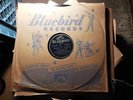
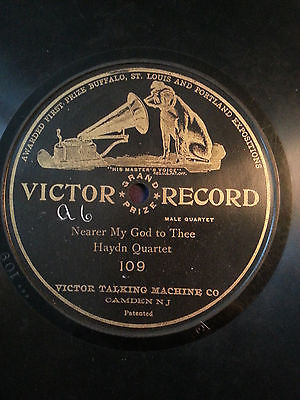
Haydn Quartet "Nearer My God To Thee" 78 RPM Victor (109) 1902
$
25


Favourite Auctions
To save auctions to your favourites, please login
If you don't have an account, please register
Description
You are bidding on the Haydn Quartet's recording of "Nearer My God To Thee" on 78 RPM disk on Victor Records (109). This single-sided disk was recorded on May 27, 1902 making it 113 years old - and is in excellent condition.
"Nearer, My God, to Thee" is associated with the sinking of the RMS Titanic, as some survivors later reported that the ship's string ensemble played the hymn as the vessel sank. Wallace Hartley, the ship's band leader (who like all the musicians on board, went down with the ship), was known to like the song and to wish to have it performed at his funeral. Violet Jessop said in her 1934 account of the disaster that she had heard the hymn being played; Archibald Gracie IV, however, emphatically denied it in his own account, written soon after the sinking, and Wireless Operator Harold Bride said that he had heard "Autumn", by which he may have meant Archibald Joyce's then-popular waltz "Songe d'Automne" (Autumn Dream). The "Bethany" version was used in the 1943 film Titanic and in the Jean Negulesco's 1953 film Titanic, whereas the "Horbury" version was played in Roy Ward Baker's 1958 movie about the sinking, A Night to Remember. The "Bethany" version was again used in James Cameron's 1997 Titanic.
The Haydn Quartet, later known as the Hayden Quartet, was one of the most popular recording close harmony quartets in the early twentieth century. It was originally formed in 1896 as the Edison Quartet to record for Edison Records; it took its new name when recording for other companies. The name was a homage to Joseph Haydn, the classical composer; the spelling was later revised to Hayden, which reflects the way it was pronounced.The group disbanded in 1914.The Edison Quartet formed in 1896, with a membership of John Bieling (tenor), Jere Mahoney (tenor), Samuel Holland Rous (who performed under the name S. H. Dudley, baritone),and William F. Hooley (bass). Mahoney was soon replaced by John Scantlebury Macdonald, who used the pseudonym Harry Macdonough.They recorded as the Edison Quartet (or Edison Male Quartet), before taking the name Haydn Quartet in order to record for companies other than Edison.
In about 1901 they signed a contract with Victor Records, and in 1902 also traveled to England to record.The group had great success over the next decade as one of the premier recording groups of the time, on a par with the Peerless Quartet. The Haydn Quartet often sang material at a slower tempo and in a statelier fashion than other groups. The Haydn Quartet's biggest commercial successes for Victor included "In the Good Old Summer Time" (1903), "Bedelia" (1904), "Sweet Adeline (You're the Flower of My Heart)" (1904), "How'd You Like To Spoon With Me" (with Corinne Morgan, 1906), "Take Me Out to the Ball Game" (with Billy Murray, 1908), "Sunbonnet Sue" (1908), "Put On Your Old Gray Bonnet" (1909), and "By the Light of the Silv'ry Moon" (with Murray, 1910).Other influential recordings include their 1901 version of "My Bonnie Lies Over The Ocean", "Way Down Yonder in the Cornfield" (1903),"Will You Love Me In December As You Do In May?" (1906), and "My Wild Irish Rose" (1907).The ensemble also performed vaudeville and minstrel show songs,one of which, "The Camp Meeting Jubilee", released in 1904 as Victor no. 4003, includes a very early recorded use of the phrase "rockin' and rollin'", albeit used with a spiritual rather than secular connotation.
Recordings credited to the Haydn Quartet began to be phased out from 1908.After that time, Billy Murray frequently sang lead with the group, and S. H. Dudley was often replaced by Reinald Werrenrath.Following the successful collaborations between Murray and the Haydn Quartet, Victor Records formed a new group, the American Quartet, in 1910, with Murray, Bieling and Hooley from the Haydn Quartet, and baritone Steve Porter. The group's name was spelled Hayden after 1910. The quartet disbanded in 1914.As well as members participating in the American Quartet, Macdonough and Hooley, together with Reinald Werranrath and tenor Lambert Murphy, also formed the Orpheus Quartet, who recorded successfully until 1919.
We gladly combine shipping!
price rating