Hi-Q LP-049: TCHAIKOVSKY - Swan Lake - Efrem KURTZ, Y. MENUHIN - UK 2015 SEALED
C$
40
$
29


C$ 40
Sold For
May 7, 2020
Sold Date
Jun 7, 2018
Start Date
1
Number Of Bids
Canada
Country Of Seller
eBay
Sold at
Favourite Auctions
To save auctions to your favourites, please login
If you don't have an account, please register
Description
****Welcome to our listing, thanks very much for looking!
****See our own website! We have lots of out of print LPs and CDs! Find us on the web at -
hearthedifference.net
****Shipping cost is only an estimate - it depends on the actual weight and size of the package as well as the service required. We do not profit from shipping costs, so if we overcharge, we will refund the difference back to you. It's always best to wait for our invoice before paying for your item. We will combine shipping for multiple items purchased.
****Please see our other listings - new items added daily.
****To access our eBay store click on the little red door at the top right section of any of our eBay listings or, click on -http://stores.ebay.com/Hear-The-Difference
Background -
Distinguished in performances of both the ballet and symphonic repertories, Efrem Kurtz lived for nearly an entire century. Leaving Russia in the aftermath of the revolution, he soon established himself as a quick study and conductor of sound musicianship. Trained in the works of the eighteenth and nineteenth centuries, Kurtz was an equally persuasive interpreter of the major works of his own time. After acquiring United States citizenship during WWII, he served two American orchestras, noticeably improving the performing standards of both.Kurtz studied at the Conservatory in his native St. Petersburg prior to the revolution, working with such instructors as Alexander Glazunov, Nicolai Tcherepnin, and Jazeps Vitols. After the change of regime, he transferred his academic pursuits first to Riga, then to Berlin. His conducting debut was a last-minute affair; when Artur Nikisch became ill, Kurtz deputized for him in directing the orchestra in a performance for dancer Isadora Duncan. His mastery of the situation led to his being given three concerts with the Berlin Philharmonic.
During the ensuing two years, Kurtz was in demand throughout Germany, his engagements taking him to more than 40 cities. In 1924, he was hired as music director of the Stuttgart Philharmonic where he remained for nine seasons. In addition, he was given oversight over all musical broadcasting in southern Germany. When another famous dancer, Anna Pavlova, attended a Stuttgart concert in 1927, she was impressed enough to engage Kurtz for a short season in London and, later, for a South American tour. During the latter, Kurtz conducted symphonic concerts in both Buenos Aires and Rio de Janeiro. Kurtz continued to conduct for Pavlova until her death in 1931, accompanying her on an Australian tour as well.
In 1930 and 1931, Kurtz was invited to the Salzburg Festival to conduct concerts devoted to the music of Handel. For eight years, beginning in 1933, Kurtz served as music director for the Ballets Russes de Monte Carlo, touring extensively with that company throughout Europe and the United States. A half-year was spent conducting symphonic concerts in Australia in 1939, Sydney and Melbourne sharing Kurtz between them. A series of guest performances with the New York Philharmonic that same year led to an invitation for further appearances in 1940.
In the 1940s, Kurtz began to work in motion pictures, conducting the scores to such feature films as Escape Me Never whose music was provided by William Walton, and the Orson Welles production of Macbeth with musical score by Jacques Ibert. During this same period, Kurtz also conducted the scores of several Ballets Russes productions being preserved on film.
In 1943, Kurtz became the music director of the Kansas City Philharmonic Orchestra, sharpening the performance capability of that ensemble and expanding its repertory. He held his directorship there until 1947. Kurtz next assumed the musical directorship of the Houston Symphony Orchestra in 1948 and continued in that capacity until 1954, accomplishing much the same improvement as he had managed in Kansas City. From 1955 to 1957, Kurtz undertook a joint directorship with John Pritchard of the Liverpool Philharmonic, and from 1957 until his retirement, he accepted engagements on a freelance basis. Returning to Russia in 1966 for the first time since it had become the Soviet Union, he conducted successful concerts in both Leningrad and Moscow. Kurtz undertook several opera house projects, conducting, among other places, in Milan and Rome.
He was married to flutist Elaine Shaffer. - Erik Eriksson
Great Sounding Classical Title from EMI! - Reissue of EMI ASD 271
180g Audiophile Vinyl Cut from the Original EMI Stereo Analogue Master Tapes at Abbey Road Studios!
Kurtz was a familiar name with the Philharmonia to the record collector of the 1950s and Yehudi Menuhin was in his prime. Menuhin’s presence on the recording can be explained by a long tradition of celebrated violinists performing the solo violin parts of Swan Lake, from Leopold Auer at the first production to Mischa Elman for Diaghilev and contemporary with this recording, Campoli for Fistoulari.
In the original review in The Gramophone of December 1958, W.S.M. remarked: “The sound of the orchestra is extremely well defined all the way through, and the tunes are enunciated in a most dapper fashion; Kurtz really understands the style of the music...” and found Menuhin’s solo violin contributions “make you sit up and listen hard, to his phrasing and expression...” and concluded that compared with rival versions, this record was “more stylish and more attractively played. Don’t try to dance to it, but do listen to it.”
“A tall, imposing figure in front of an orchestra, so tall that he often dispensed with the usual conductor's podium, Efrem Kurtz had a graceful, baton-less technique that drew a fluid yet well-controlled response from the players and infused a vivid poetry into romantic music in particular. Much sought after in the music of his native Russia, and in the ballet music in which he first made his name conducting Anna Pavlova, Kurtz was a link back to the musical life of pre-revolutionary St Petersburg.” So wrote most eloquently Noel Goodwin in his 1995 obituary in the Independent of the distinguished 95 years old Russian conductor, who had studied with Glazunov and Tcherepnin no less, and was a pupil of Arthur Nikisch.
Cut at Abbey Road Studios from the original stereo analogue master tapes with the Neumann VMS82 lathe fed an analogue pre-cut signal from a specially adapted Studer A80 tape deck with additional ‘advance’ playback head, making the cut a totally analogue process.
Pressed on 180g vinyl to audiophile standards using the original EMI presses by The Vinyl Factory in Hayes, England.
Although Russian-born, naturalized-American conductor Efrem Kurtz (1900-1995) lived well into the stereo age, he never became as famous as some of his contemporaries like Fritz Reiner, Bruno Walter, Leopold Stokowski, or Otto Klemperer. Still, he made some excellent stereo recordings, such as this 1958 album of highlights from Swan Lake with the Philharmonia Orchestra, with no less a star than Yehudi Menuhin doing the violin solos. The new remastering does justice to its still-impressive sound.
The director of the Moscow Imperial Theatre commissioned Peter Tchaikovsky (1840-93) to write the score for the ballet we now know as Swan Lake. Premiered in 1877, it was the first of the composer's big-three ballets, with The Nutcracker and Sleeping Beauty to follow. Today, we take Swan Lake for granted as one of the greatest ballets of all time, but initially it failed. The dancers complained they couldn't dance to the music, the conductor couldn't properly handle the tunes, and critics generally panned it. It would not be until 1895, several years after the composer's death, that the ballet's popularity began to soar in revival.
The story is that Swan Lake started life as a little ballet called The Lake of the Swans, which Tchaikovsky wrote for his family in 1871. Then, when he received the commission, the composer added Russian and German folk tales as his sources, the general plot based on a story by the German author Johann Karl August Musäus. One of the salient points about Tchaikovsky's writing it is that critics now consider it the first ballet composed by a writer who had previously worked almost exclusively in the symphonic field. Thus, if Swan Lake sounds more "symphonic" in structure, composition, and themes than earlier ballets, there is a reason.
In four acts Swan Lake tells the story of a young man, Prince Siegfried, whose mother insists it's about time he found a bride and marry. No sooner said than he chances upon a beautiful young woman, Odette, with whom he falls in love. However, as fate would have it, an evil magician has put her and her attendants under a spell whereby they may be human at night but turn into swans by day. Naturally, it is only a true and unfailing love that can save her.
Kurtz easily negotiates the ups and downs of a suite of popular items from the ballet, and the Philharmonia, then in its prime, perform flawlessly. Indeed, the performance is sparkling in every way. Yet Kurtz never simply goes for show, glitz, or glitter. The music flows naturally, in a fine onward course. What's more, there is an elegance about the reading that one can hardly ignore. It's not just thrills Kurtz is striving for but a genuine sense of place and time, a handsome story told in frank, handsome terms, with little additional embellishment from the conductor. Still, even though Kurtz keeps things on an even keel, he still manages to inject plenty of excitement into the score.
Then there's the matter of Menuhin's solos. I guess I hadn't realized how many solo violin parts there were in the ballet until noticing them here. Certainly, Menuhin handles them deftly, his playing dexterous, gentle, lush, scintillating, as the case may be. The music's idyll sounds particularly touching, with the strings of the Philharmonia adding a poignant glow.
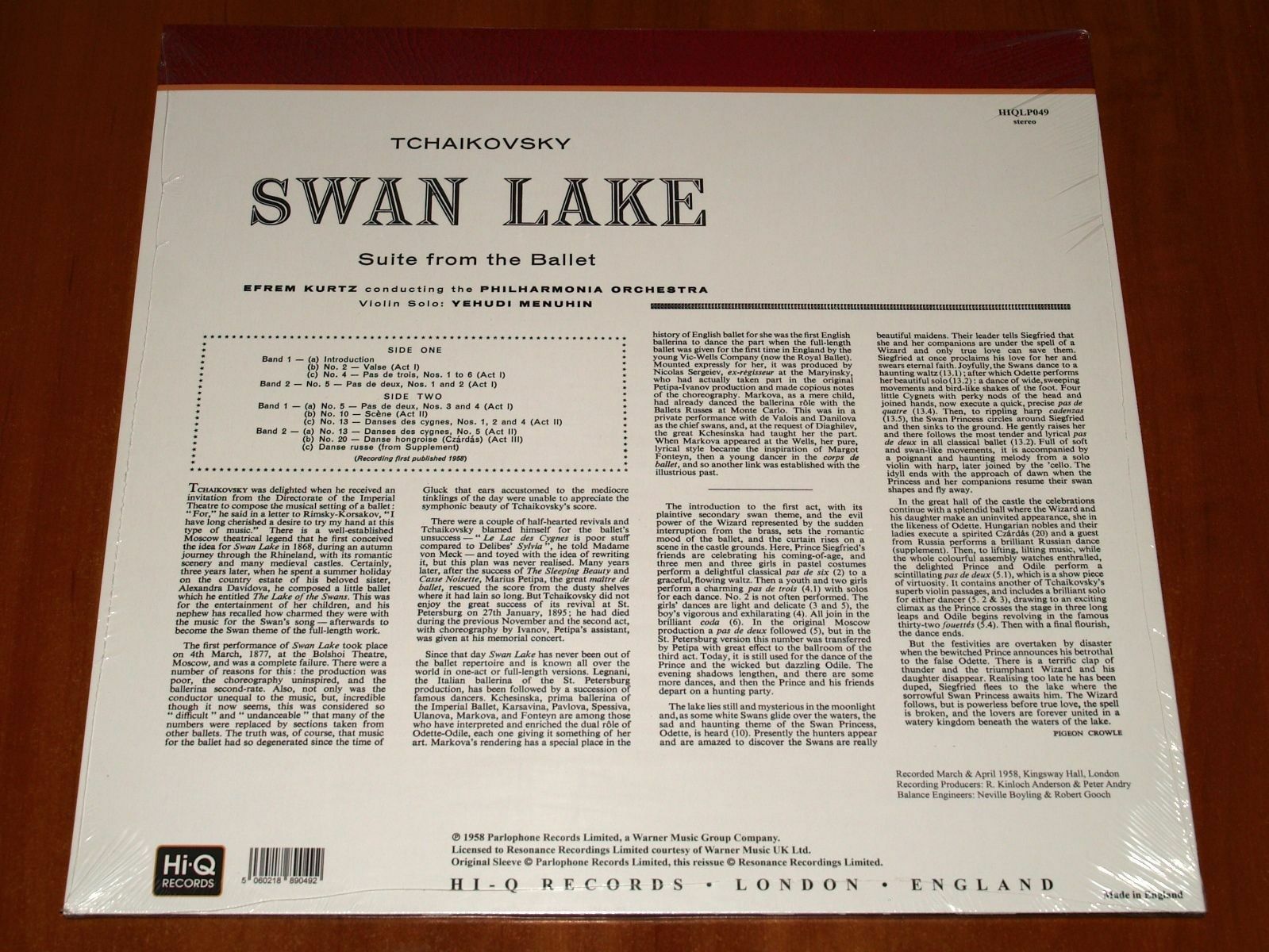
Producers R. Kinloch Anderson and Peter Andry and engineers Neville Boyling and Robert Gooch recorded the suite at Kingsway Hall, London in March and April of 1958.
I believe I can safely say based on what I heard from this remaster and the comparisons I have made of Hi-Q products in the past that this recording is no doubt an improvement over the original mastering. The clarity is outstanding, with a huge dynamic range, strong impact, and good frequency extremes. The high end sounds especially impressive, with a shimmering treble response. However, I must warn that if one's system already favors the high end, the disc might sound a little bright, and even with noise reduction there is a faint sizzle at the very top. Anyway, the stereo spread is also commendable, as is the orchestral depth. So, what we get are excellent sonics to match an exuberant performance. Never mind the age; it's better than almost anything made today. - John J. Puccio
-
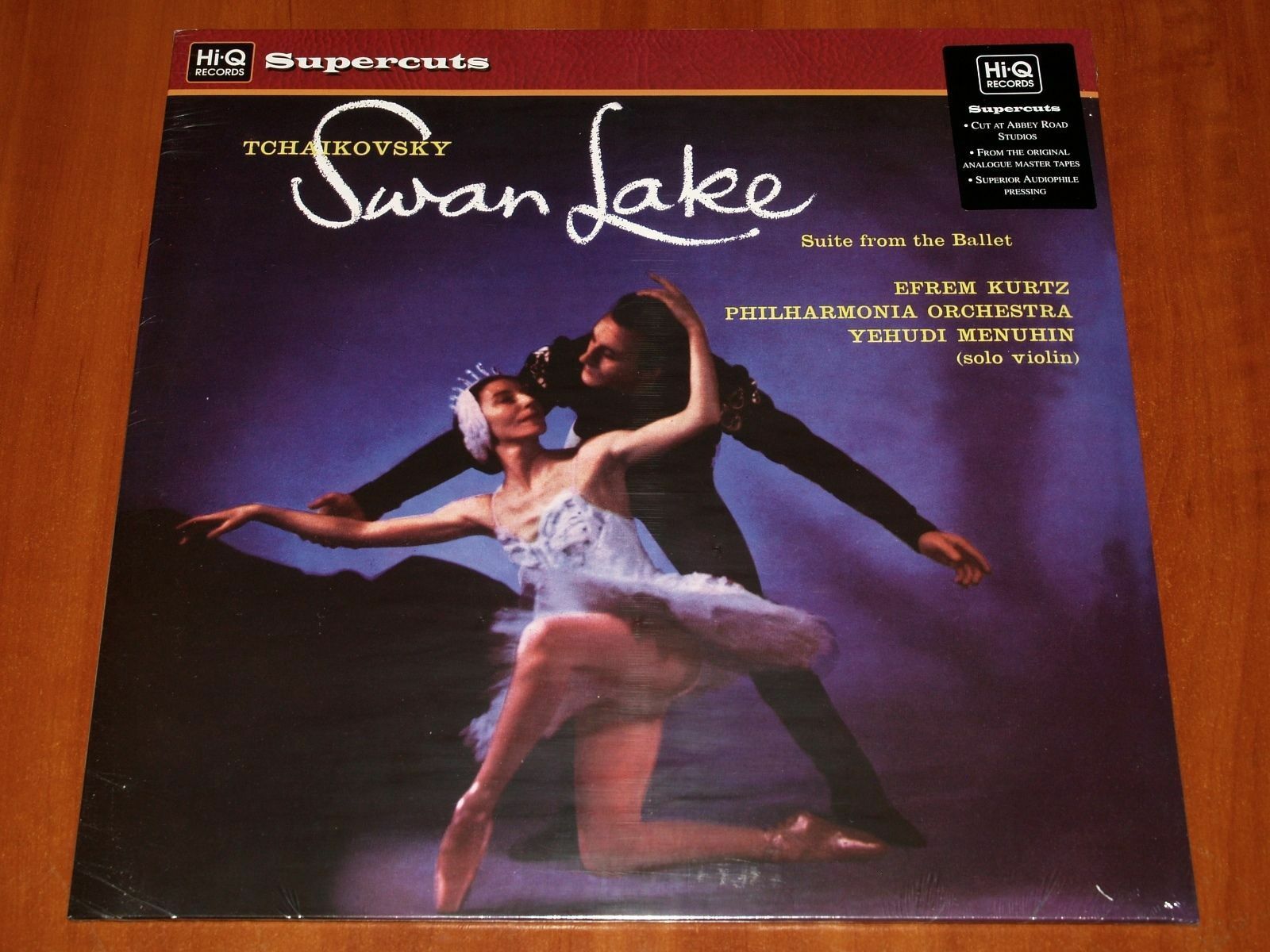
Hi-Q Records "Supercuts" LP item - FACTORY SEALED
-
Records Made in the UK / England / Great Britain
-
Pressing is in STEREO - recordings are from 1958 - originally issued on the EMI label
-
Limited Edition
-
Record Speed: 33 rpm
-
Record Made issued in: 2015
-
Record Catalog Number: HIQLP049
Featured on this item:
Tchaikovsky / Efrem Kurtz / Yehudi Menuhin
Title / Music on this Audiophile LP -
Swan Lake - Suite from the Ballet
Track Listings -
Tchaikovsky (1840-1893)Swan Lake "Le Lac Des Cygnes", Op. 20 Ballet Suite
Side A: 1. a. Introduction
b. No. 2: Valse (Act 1)
c. No. 4: Pas de trios, Nos. 1-6 (Act 1)
2. No. 5: Pas de deux, Nos. 1 & 2 (Act 1)
Side B: 1. a. No. 5: Pas de deux, Nos. 3 & 4 (Act 1)
b. No. 10: Scene (Act 2)
c. No. 13: Danses des cygnes Nos. 1, 2 & 4 (Act 2)
2. a. No. 13, Danses des cygnes, No. 5 (Act 2)
b. No. 20: Danse hongroise (Czardas) (Act 3)
c. Danse russe (from Supplement)
Performed By / Credits on this LP include -
Philharmonia Orchestra
Efrem Kurtz, conductor Yehudi Menuhin, violin solo
Other Information -
• Hi-Q Records Supercuts 180g Vinyl
• Cut at Abbey Road Studios from the original EMI stereo analogue master tapes
• Superior Audiophile Pressing
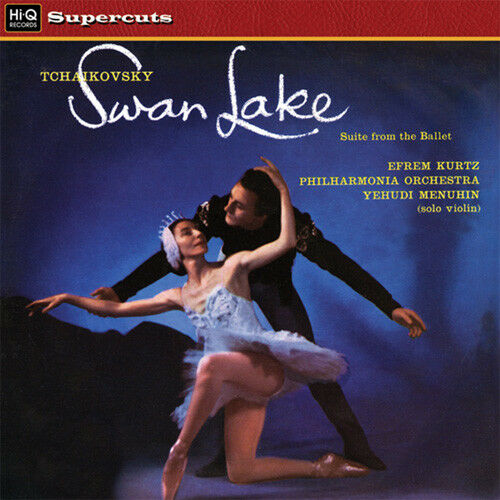
• Features original album artwork
• Made in England Recorded March & April 1958, Kingsway Hall, London. Recording Producers: R. Kinloch Anderson & Peter Andry. Balance Engineers: Neville Boyling & Robert Gooch
CONDITION Details:
LP Jacket:-
The jacket is in MINT condition - no seam splits or corner dings - FACTORY SEALED!
-
The jacket has NO splits of any kind - it is completely solid and intact, and shows only some very minimal shelf wear.
-
It has NO drill holes or saw marks of any kind.
-
There is NO writing on the front or back of the jacket.
-
The cover has clean and sharp colors - see picture with this listing for more detail.
-
The LP is assumed to be in MINT condition - FACTORY SEALED!
-
This is the mint copy you want for your collection - any super picky audiophile would be happy with this one!
-
As for any record, even brand new, sealed ones, we always recommend a proper record cleaning before playing!
A Short Note About LP GRADING -
- Mint = Only used for sealed items.
- Near Mint = Virtually flawless in every way.
- Near Mint Minus = Item has some minor imperfections, some audible.
- Excellent = Item obviously played and enjoyed with some noise.
- Very Good Plus = Many more imperfections which are noticeable and obtrusive.
price rating