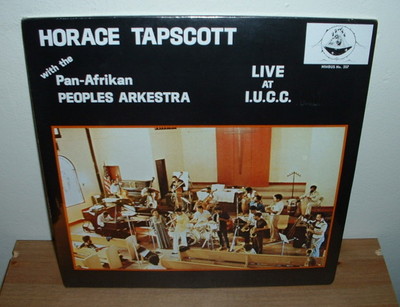
Horace Tapscott "Live at I.U.C.C." sealed 2xLP (1979) w/Sabir Mateen
$
60


Favourite Auctions
To save auctions to your favourites, please login
If you don't have an account, please register
Description
Baron Elmo proudly presents a stunning vinyl prize for fans of jazz pianist / composer / community activist HORACE TAPSCOTT, with THE PAN-AFRIKAN PEOPLES ARKESTRA: Live at I.U.C.C., a double LP issued in 1979 on the Nimbus label, now long out of print. Tapscott is easily one of the greatest neglected geniuses in the history of American jazz, with an astonishing and almost completely unavailable body of work to his credit. His decision to remain in Los Angeles, his outspoken activism, his endless dedication to bettering his local community and his refusal to play by industry rules certainly contributed to Tapscott's obscurity during his lifetime... while cutting the lion's share of his music for small labels (very little of which has made the transition to CD) may be why he is so little known even now. In 1961, Horace founded the Union of God's Musicians and Artists Ascension in Los Angeles. Like Chicago’s AACM, the Watts-based collective was created to promote local musicians; but UGMAA’s mandate also included dancers, actors and visual artists. Through UGMAA, Tapscott also taught music to hundreds of young musicians outside of a commercial context. Many of these musicians matriculated into Tapscott’s Pan-Afrikan Peoples Arkestra, which he also initiated in ’61. Even though Tapscott could have easily followed the lead of friends like Don Cherry and Eric Dolphy and built a high-profile career for himself through touring or moving to New York, Tapscott remained in Los Angeles to work with the Arkestra and UGMAA’s education program. His efforts gained little recognition until the 1965 Watts riots, when he put the Arkestra onto flatbed trucks and, like a fire brigade, played throughout the community to help extinguish the violence. Subsequently, UGMAA received enough state and Federal funding to present regular Arkestra concerts at churches and schools, and stabilize its education program. Between 1973 and 1981, Tapscott’s Arkestra performed on the last Sunday of the month at Immanuel United Church of Christ, located at 85th and Holmes. The concert series was an integral part of the community outreach policy of the church’s minister, Reverend Edgar Edwards, who was also a member of the Black Congress, a coalition of LA-based African American cultural, political and social organizations. The church was the site of this last Nimbus album, Live At I.U.C.C., which was recorded over a five-month period at Immanuel United. Jazz critic Bill Showmaker describes the contents:
The opening, sidelong track – soprano sax player Julian Sharps’ “Macrame” – is typical of the Arkestra’s book, inasmuch as balances two strains of post-Coltrane jazz. The tune is initially built upon a catchy vamp and short pentatonic motives, an oft-used method of such high-profile composers as McCoy Tyner and Woody Shaw. Typical of the Arkestra’s composers, Sharps’ groove is relatively sunny compared to the emphatic drumming preferred by Tyner, as well as the hard bop-informed feel favored by Shaw. From this base, Tyner tended to then build to a dramatic apex, while Shaw dazzled with brilliantly intricate, expertly crafted and delivered ensembles whose bold intervals and cadences were often subsumed by their sleekness. Again, Sharps is generally consistent with his Arkestra colleagues in using a high-contrast passage to resolve with the vamp. These tend to be more idiosyncratic than what Tyner or Shaw would typically employ. On “Macrame,” Sharps releases a flurry of arpeggios, sufficiently highlighted by flutes not to become a Tyner-like torrent.
Passages like this are cause to reexamine the album’s cover photo of an Arkestra I.U.C.C. concert. Even though sixteen musicians are performing, there are only four music stands between them. As Isoardi recounts, memorization of parts was central to Tapscott’s methodology with the Arkestra. This goes a long way to explaining the fluidity of their ensembles, regardless of the materials at hand.
The return to the vamp, which, depending on the soloist’s needs, was alternately bulked up and stretched out by Tapscott, bassists David Bryant and Alan Hines (double and even triple bass players are staples of Arkestra recordings) and drummer Everett Brown, Jr. Though Sharps’ soprano solo is solidly in the Coltrane mold, it is well formed and is persuasive when it counts most, on the long cry-like notes. Tenor saxophonist Sabir Mateen hands in a more idiosyncratic solo, abruptly and repeatedly jumping between the “in between” staked out by Booker Ervin and fierce screams. Tapscott’s solo runs the gamut from nimble, bluesy lines to tumultuous clusters. A riveting Brown solo ushers in the concluding ensemble.
Credited to Blythe and Stanley Crouch, “Future Sally’s Time” begins with an unaccompanied Tapscott solo, in which he coalesces disjointed phrases into a convivial Monk-like theme. Unfortunately, the ensemble points up the limitations of the recording set-up occasionally used at these concerts; as the various sections of the Arkestra bleed together into a single mass. However, this is mainly a vehicle for Tapscott, who rips through several choruses, mixing serpentine lines and chiming chords. A Hines solo and a duet by drummer Billy Hinton and percussionist Daa’oud Woods sustain the momentum until the band takes it out.
The first of two Mateen compositions, “Noissessprahs,” begins with furious drumming punctuated by stark chords stated by the Arkestra; after several blasts, a sprinting line slipped between them like a parenthetical phrase. This quickly gives way to a stunning arco bass statement by Roberto Miranda. There are many artists from this community who, perplexingly, did not receive their due: Miranda is first among equals on that count. Though he gained prolonged exposure through subsequent recordings and European tours with Tapscott, Vinny Golia and others, Miranda was off the international press’ radar by the mid 1990s. At the end of his solo, Miranda digs into a figure that the ensemble slips into section by section. Mateen inserts a curious Chimera-like line into the chart – part bop, part heroic theme, and part scribble – before launching a furious tenor solo. Mateen has been on the New York scene long enough for younger listeners not to know of his early work with Tapscott (or of saxophonist Will Connell’s for that matter); but, it is with the Arkestra where his unrelenting intensity came into its own. He certainly inspired flutist Aubrey Hart, and saxophonists Billie Harris and Desta Walker, who follow Mateen in kind. In short, this is the type of powerful performance that secured the Arkestra’s avant-garde bona fides. Mateen’s other composition, the sidelong “Village Dance,” veers back towards a motive-and-vamp-pegged structure, one that is sufficiently flexible to allow the percussion chorus to set the tone with buoyant rhythmic base for a succession of high-energy solos.
The lone Tapscott composition, “L.T.T.,” is built upon a terse, cha cha cha-tinged syncopation, initially stated by his jabbed block chords. A minor-keyed theme is draped across severely stated chord changes. It proves to be a serviceable backdrop for Mateen and Harris. Again, this is compositional not far from the post-Coltrane mainstream demarcated by Tyner, Shaw and others. What’s noteworthy about how Tapscott and the Arkestra distinguishes themselves on this track is its drama, which is first tapped by Miranda’s soaring arco and then Tapscott’s barbed clusters and rhapsodic swells. Although Sharps, who later led his own Nimbus date, penned “Desert Fairy Princess,” the lilting tune is closely associated with flutist Adele Sebastian, whose Nimbus album of the same name was the label’s best seller (and is available on a Nimbus CD). With changes and a groove reminiscent of period tunes like Freddie Hubbard’s “Little Sunflower,” the tune speaks to the diehard optimism prevailing in the Arkestra’s community.
Live at I.U.C.C. is a shining example of Horace Tapscott's artistry at its best, not to be missed by seekers of bold, provocative jazz. This copy is sealed and mint.
A $3.00 charge will be added to the winning total for shipment within the USA, $8.00 to Mexico and Canada, $16.00 to anywhere else in the world. We will combine multiple purchases, so the more you buy, the more you save on shipping. Thanks for the visit – please check out our eBay store to see the other amazing items we carry!
Track listingMacrame
Future Sally's Theme
Noissessprahs
Village Dance
L.T.T.
Desert Fairy Princess
Lift Every Voice
Personnel
Horace Tapscott (piano)
Jesse Sharps (soprano sax)
Sabir Mateen (tenor sax)
Billy Harris (tenor sax)
James Andrews (tenor sax)
Desta Walker (tenor sax)
John Williams (baritone sax)
Michael Session (alto sax)
Lester Robertson (trombone)
Red Callendar (tuba)
Kafi Roberts (flute)
Adele Sebastian (flute)
Aubrey Hart (flute)
Herbert Callies (alto clarinet)
Bob Watt, Jr. (french horn)
David Bryant (bass)
Roberto Miranda (bass)
Alan Hines (bass)
Louis Spears (cello)
Everett Brown, Jr. (drums)
Daa'oud Wood (percussion)
Mike Daniels (percussion)
price rating