IANNIS XENAKIS+ICHIYANAGI+TORU TAKEMITSU+LIGETI LP RARE
$
35


Favourite Auctions
To save auctions to your favourites, please login
If you don't have an account, please register
Description
IANNIS XENAKIS / GYORGY LIGETI / TORU TAKEMITSU / TOSHI ICHIYANAGI
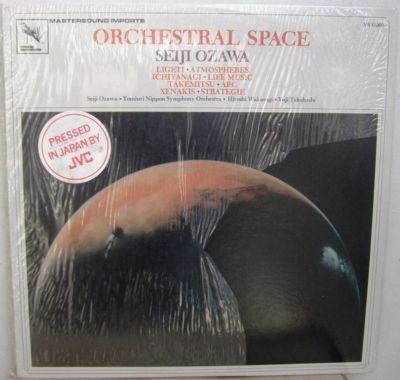
ORCHESTRAL SPACE LP
JVC Japan / Varese Sarabande
Works by Iannis Xenakis (Strategie), Toshi Ichiyanagi (Life Music), Toru Takemitsu (Arc) & Gyorgy Ligeti (Atmospheres) recorded live at Tokyo's Nissei Theatre on May 1, 2 and 4, 1966.
Some info on the release: Very rare original issue, released in Japan / Usa sometime in the 70's. Features works from composers like Iannis Xenakis, Toru Takemitsu, Toshi Ichiyanagi and Gyorgy Ligeti. On this record one can find Ligeti's most famous composition is his Atmosphères (1961). In this work he combines instruments into clusters of rapidly moving parts (a texture he calls "micropolyphony"), which are perceived as masses of sound. These clusters slowly change, causing a gradual transformation of sound. The piece established an international reputation for him, and it brought him to the attention of the general population when Stanley Kubrick used it in his film 2001: A Space Odyssey (1968).
Iannis Xenakis (May 29, 1922 – February 4, 2001) was a Greek composer, music theorist and architect. He is commonly recognized as one of the most important post-war avant-garde composers. Xenakis pioneered the use of mathematical models such as applications of set theory, varied use of stochastic processes, game theory, etc., in music, and was also an important influence on the development of electronic music.
Among his most important works are Metastaseis (1953–4) for orchestra, which introduced independent parts for every musician of the orchestra; percussion works such as Psappha (1975) and Pléïades (1979); compositions that introduced spatialization by dispersing musicians among the audience, such as Terretektorh (1966); electronic works created using Xenakis' UPIC system; and the massive multimedia performances Xenakis called polytopes. Among the numerous theoretical writings he authored, the book Formalized Music: Thought and Mathematics in Composition (1971) is regarded as one of his most important. As an architect, Xenakis is primarily known for his early work under Le Corbusier: the Sainte Marie de La Tourette, on which the two architects collaborated, and the Philips Pavilion at Expo 58, which Xenakis designed alone.
Xenakis pioneered electronic, computer music, the application of mathematics, statistics, and physics to music and music theory, and the integration of sound and architecture. He used techniques related to probability theory, stochastic processes, statistics, statistical mechanics, group theory, game theory, set theory, and other branches of mathematics and physics in his compositions. He integrated music with architecture, designing music for pre-existing spaces, and designing spaces to be integrated with specific music compositions and performances. He integrated both with political commentary. He viewed compositions as reification and formal structures of abstract ideas, not as ends, to be later incorporated into families of compositions, "a form of composition which is not the object in itself, but an idea in itself, that is to say, the beginnings of a family of compositions." Specific examples of mathematics, statistics, and physics applied to music composition are the use of the statistical mechanics of gases in Pithoprakta, statistical distribution of points on a plane in Diamorphoses, minimal constraints in Achorripsis, the normal distribution in ST/10 and Atrées, Markov chains in Analogiques, game theory in Duel and Stratégie, group theory in Nomos Alpha, set theory in Herma and Eonta, and Brownian motion in N'Shima. Xenakis was a contemporary with fellow greek composers Anestis Logothetis, Jani Christou and Kyriakos Sfetsas and was creating in a time that flourished the various sound experiments of Pierre Schaeffer & Pierre Henry, Henk Badings and of course Luciano Berio, Luigi Nono, Giacinto Scelsi, Alvin Curran and Toshi Ichiyanagi. At the Shirah Arts Festival in Persepolis, he designed Polytope as a composition specific to the historic site. The following year he was commissioned by the brutal dictator, the Shah of Iran, to compose Nuits, which Xenakis dedicated to political prisoners in protest at the Shah’s atrocities. Composers who have acknowledged being influenced by Xenakis include Krzysztof Penderecki and Toru Takemitsu. On the Nurse with wound list of influences.
Toshi Ichiyanagi is a Japanese composer of avant-garde music. He studied with Tomojiro Ikenouchi and John Badger Cage. One of his most notable works is the 1960 composition, Kaiki, which combined Japanese instruments, sho and koto, and western instruments, harmonica and saxophone. Another work Distance (1961) requires the performers to play from a distance of three meters from their instruments. Anima 7 (1964) states that chosen action should be performed "as slowly as possible." He was married to Yoko Ono from 1956 to 1963.
Toru Takemitsu was a Japanese composer and writer on aesthetics and music theory. Largely self-taught, Takemitsu possessed consummate skill in the subtle manipulation of instrumental and orchestral timbre. He drew from a wide range of influences, including jazz, popular music, avant-garde procedures and traditional Japanese music, in a harmonic idiom largely derived from the music of Claude Debussy and Olivier Messiaen.
In 1958, his Requiem for strings (1957) gained international attention, lead to several commissions from across the world and settled his reputation as the leading Japanese composer of the 20th century. He was the recipient of numerous awards, commissions and honours; he composed over 100 film scores and about 130 concert works for ensembles of various sizes and combinations.
In the foreword to a selection of Takemitsu's writings in English, conductor Seiji Ozawa writes: "I am very proud of my friend Toru Takemitsu. He is the first Japanese composer to write for a world audience and achieve international recognition." By 1970, Takemitsu's reputation as a leading member of avant-garde community was well established, and during his involvement with Expo '70 in Osaka, he was at last able to meet more of his Western colleagues, including Karlheinz Stockhausen. Also, during a contemporary music festival in April 1970, produced by the Japanese composer himself ("Iron and Steel Pavilion"), Takemitsu met among the participants Lukas Foss, Peter Sculthorpe, and Vinko Globokar. Later that year, as part of a commission from Paul Sacher and the Zurich Collegium Musicum, Takemitsu incorporated into his Eucalyptus I parts for international performers: flautist Aurèle Nicolet, oboist Heinz Holliger, and harpist Ursula Holliger.
Condition: Vinyl lies in mint condition, looks unplayed and plays perfectly, while cover is partially still in shrinkwrap (i am the one that removed it) and has only the most minimal edge wear.
Tracklist
A1 György Ligeti - Atmospheres 8:02 A2 Toshi Ichiyanagi - Life Music 16:45 B1 Toru Takemitsu - Arc For Piano And Orchestra 14:45 Piano - Yuji Takahashi B2 Iannis Xenakis - Strategie 13:13 Conductor - Hiroshi WakasugiCredits
Conductor - Seiji OzawaLiner Notes - Kuniharu Akiyama
Orchestra - Yomiuri Nippon Symphony
SHIPPING & PAYMENT
Shipping: Shipping for this LP is 7$ airmail in Europe / 9$ for the rest of the world
Registered mail: +5$
Insurance: optional
Combined shipping: BIG discounts
Payment: Paypal
Packaging: I am a collector too and i know
price rating