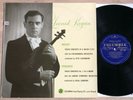
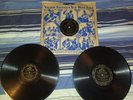
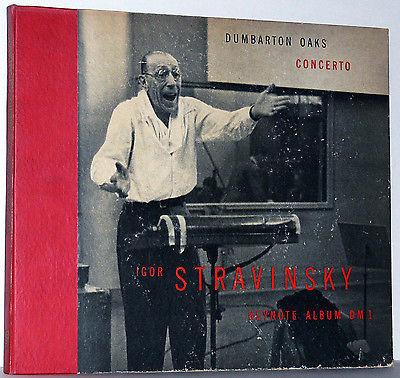
Igor Stravinsky conducts DUMBARTON OAKS CONCERTO Keynote Album DM1 78 rpm 12" x2
$
26


Favourite Auctions
To save auctions to your favourites, please login
If you don't have an account, please register
Description
IGOR STRAVINSKY conducts Dumbarton Oaks Concerto KEYNOTE ALBUM DM1 78 rpm 12" x 2 (Engineered by Robert Fine using a single microphone recording technique)
Concerto for chamber orchestra in E flat major ("Dumbarton Oaks")
1st mvt Tempo Giusto 2nd mvt Allegretto 3rd mvt Con moto
" ... a top-rate chamber ensemble led by Alexander Schneider, has an infectious joie de vivre."
STRAVINSKY'S Dumbarton Oaks Concerto is dedicated neither to the Harvard Byzantine Center nor to the United Nations conference. It was commissioned by the original owners. of Dumbarton Oaks for their thirtieth wedding anniversary. It is a light, lively piece, charming and remarkably entertaining. The piece is particularly taxing on the brasses and woodwinds, and they performed beautifully. The Concerto deliberately parallels the third Brandenburg in many ways, especially in the opening theme and the three part violin and viola sections.
... the philosophy evolved into using a single Altec microphone, probably a 639 "Birdcage," on the Hammond-produced 1947 recording of Igor Stravinsky conducting his Concerto in E-flat (Dumbarton Oaks) (Keynote DM-1, later released on Mercury).
Igor Stravinsky, conductor. Engineer Robert Fine was in charge of these recordings, made at the new Reeves Beaux Arts Studios in New York City on April 28, 1947.
Description by John Palmer
Considered by some to be a minor work, the Concerto in E flat, "Dumbarton Oaks" for chamber orchestra is representative of Stravinsky's "neo-Classic" period, which spanned the middle third of his extraordinarily creative life. The piece was commissioned in 1937 by Mr. And Mrs. Robert Woods Bliss of Dumbarton Oaks, the name of the Bliss' estate in Washington, D.C., in celebration of the couple's 30th wedding anniversary in 1938. At the time of the commission, Stravinsky had been diagnosed with tuberculosis and sent to a Swiss sanatorium to join his wife and two daughters, who were also ill. Poor health was to claim the lives of his eldest daughter, Ludmila, in 1938, and his wife, Katerina, in March 1939. While in Switzerland, Stravinsky immersed himself in the music of Bach while he wrote the Concerto in E flat. Because the composer's illness prevented him from traveling, the premiere performance, given on May 8, 1938, in Washington D.C., was conducted by Nadia Boulanger. As in numerous other of Stravinsky's neo-Classical works, he recapitulates forms and gestures of the Western musical tradition. Thus, the Dumbarton Oaks Concerto self-consciously becomes didactic music-about-music: an essay on the art of writing a concerto in the Baroque style realized in modern harmonic, rhythmic, and melodic idioms. Cast in three movements marked Tempo giusto, Allegretto, and Con moto, the Concerto in E flat deliberately evokes the style of J.S. Bach's Brandenburg Concertos. The resemblance of the beginning of Stravinsky's concerto to the first movement of Bach's Brandenburg No. 3 is particularly striking. Concerning this close relationship, Stravinsky noted, "I do not think that Bach would have begrudged me the loan of these ideas and materials, as borrowing in this way was something he liked to do himself." From the outset of the first movement, string outbursts frame and support the many solo woodwind excursions, and nearly every instrument has a chance to come to the foreground. The Concerto grosso contrasts of concertino and ripieno, and fugato writing permeate the movement, which ends with a slow, homophonic coda. A hesitant, repeated string figure marks the opening of the contrasting Allegretto, an ABA' structure with coda that begins with a much more sparse texture than in the first movement. More dense, the B section is built around a two-note ostinato accompaniment in the strings. A prominent flute part differentiates the return of the A section from the opening of the movement, and creates a busier atmosphere. Woodwinds punctuate a constant, slow staccato pulse in the cellos at the beginning of the third movement. In the central section, the bassoon fills a similar accompanimental role, but in a lighter and less detached manner. The cello returns, and repeated ostinato figures and stretto entrances of a short melody, both Baroque characteristics, propel the finale to its abrupt ending.
*(all photos are of the actual item)
price rating