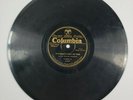
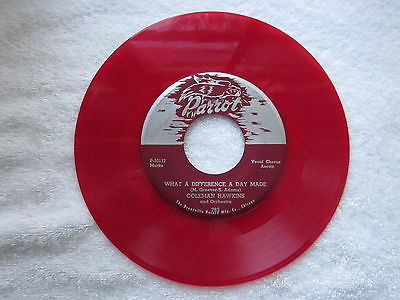
"I'll See You Later" Coleman Hawkins original 1953 red wax Parrot 45rpm exc cond
$
129


Favourite Auctions
To save auctions to your favourites, please login
If you don't have an account, please register
Description
Up for auction is this excellent condition original red vinyl 45rpm single, "I'll See You Later" b/w "What A Difference A Day Made" by Coleman Hawkins on Parrot Records #783 released in 1953. It was recorded in Chicago in the late Summer or early Fall 1953 and was the fifth release on the label. Records are not play graded and I do not use the Goldmine record grading standard. Every effort is made to accurately describe and photograph any defects or damage. . More photos available upon request. No return policy; item is sold as is. Please ask any questions before bidding. Shipping for this lot only is $4. to the USA only. Will be mailed USPS media mail. International buyers, special handling or for multiple wins in same auction, please request an invoice when you are done bidding. Check out our other eBay site: thevermontvillagegallery for other items. Thank you for looking.
Lorraine & John, The Vermont Village Gallery, North Bennington, USA ~ Rare & Unusual Records & Collectibles.
~~~~~~~~~~
From campber.people.clemson.edu [The Red Saunders Research Foundation]:
Parrot Records was the creation of noted Chicago DJ Al Benson (1908 - 1978). Born Arthur Leaner in Jackson, Mississippi, he arrived in Chicago in 1923. (There is a biographical profile in "Al Benson-The Godfather of Black Radio in Chicago" by the late Charles Walton, available on the Jazz Institute of Chicago website.) In his earlier days, Benson sang, produced shows at a theater in Jackson, worked as a probation officer, and preached. Al Benson began his career as a DJ in 1943, when he stated a gospel show on Chicago radio station WGES. His skill at selling commercial time on his church program landed him an R&B show on WGES toward the end of 1945. Quickly he became one of the biggest powers in the R&B business.
Benson began doing freelance recording in the spring of 1948 (when he taped at least 6 tracks at a live session at the Pershing Ballroom, edited them, and sold them to Aristocrat). He was in the studios a few months later, recording four numbers by the Benson All-Star Orchestra (see the Eddie Johnson pages for details), followed in the fall by a session with the Four Shades of Rhythm.
Benson opened his first company — it was called Old Swing-Master, after his DJ handle — in January 1949. Benson was really a front man; the outfit had come into being so his business partner, Egmont Sonderling, who owned Master Records and the United Broadcasting Studios, could issue jazz and R&B masters that Vitacoustic had recorded at his studio and failed to pay for. The label sustained itself by ingesting material acquired from defunct local labels like Rhumboogie, Marvel, Planet, and Sunbeam. Just the releases by the Benson All Star Orchestra, Old Swing-Master 15 and 16, and the Four Shades of Rhythm, Old Swing-Master 23, came out of Al Benson recording projects. And, so far as we can determine, those projects were done before the label was launched. Benson may have done a little freelance recording for sale to other labels while involved with Old Swing-Master; at least the session done at some point in 1949 by the Blues Rockers (later sold to Aristocrat) is thought to be his work. By the end of 1949, Old Swing-Master became inactive except as a conduit for some material Miracle had turned over to Sonderling to settle debts. Sonderling decided to phase out his involvement in the record business, closing down his pressing operation and acquiring radio station WOPA. Consequently Old Swing-Master shut down in June 1950.
Benson couldn't stay away from recording for long. In March 1951, he supervised a session by jazz violinist Eddie South, which he sold to the Chess brothers (see our Eddie Johnson page for details). The session includes Benson himself singing (well, reciting) "I Can't Give You Anything but Love." In 1952 he started a series of recording sessions at Universal Recording, in the hope of selling the material to established companies; a U4300 matrix series was opened for this effort. The Chess brothers were his best (as far as we know, his only) customers, purchasing masters by Willie Mabon, Danny Overbea, and Joe Williams and issuing them on their Chess and Checker labels. Our King Kolax discography presents details of the Williams and Overbea sides.
The standard date for the Coleman Hawkins sessions is clearly wrong. Following all existing discographies, John Chilton's book The High and Mighty Hawk puts them on May 27, 1954, while Hawk was headlining at the Beehive in Chicago. But the releases on Parrot 783 and 784 took place in September or October of 1953. And their matrix numbers are early in the 53100 series, sandwiched between a batch of sessions from August 10 and another bach of sessions from September. The date wasn't May 27, 1953, either. Coleman Hawkins was pictured in the Chicago Defender of June 4, 1953, annoucing a gig at the Beehive slated to start on June 12 of that year (Hawk's contract for 4 weeks was accepted and filed by Local 208 on June 18). Hawk moved to the Toast of the Town on August 7; members of his band on that job—Laurell Howell, Tom Phillips, and guitarist Leo Blevins—were hauled in front of the Board of Local 208 on August 20, 1953 because of some dispute arising out of Hawk's gig. (Unfortunately, Local 208's Secretary, William Everett Samuels, who had a gift for taking down beefs using the speech patterns of the contending parties, was on vacation, and his stand-in didn't bother to note what the dispute was about.)
Our conclusion: Hawk's Parrot sessions took place in August, during the Toast of the Town engagement. The gig was over by the end of the month, judging from the fact that Leo Blevins next picked up a job as a leader at the Paris Club (contract posted September 3). (The matrix numbers 6994-7001 were affixed to these tracks after Savoy purchased them in 1956; Al Benson attached Parrot matrix numbers only to the four sides that he decided to release.)
Coleman Hawkins, the father of the jazz tenor saxophone, should need no introduction here. Born in St. Joseph, Missouri, on November 21, 1904, Hawk broke in with Mamie Smith's Jazz Hounds in 1920. He began recording with Fletcher Henderson's big band in 1923 and by the middle of the decade was a star soloist. The 1950 - 1954 period was a down time for Hawk, who, like many other Swing-era stars, was having a tough time getting recorded; his 12 sides for Parrot are one of his biggest bodies of work from this period. Since Al Benson usually cut 4 sides to a session, and sometimes reduced his target to 2, he must have been thinking of putting out an LP on Hawk. But if that was Benson's plan, nothing came of it. (Incidentally, Benson committed one of the all-time great bloopers when he rendered "I'll Follow My Secret Heart" as "I'll Follow My Sacred Heart"!)
Six of the Hawk releases (including all 4 that were released on Parrot) back him with organ, piano, guitar, bass, and drums. We thought the organist was Lonnie Simmons, who was in the midst of a long-running gig at the Club DeLisa at the time, and would record his own session for Parrot in a couple of months. But Craig Browning notes that the organist sounds like the legendary Les Strand (who was credited, in an entry in Leonard Feather's encyclopedia, with making his debut on a Coleman Hawkins recording for "Peacock"). Comparing these sides with Les Strand's 1957 LP for Fantasy, and Lonnie Simmons' own session for Parrot, Browning says that Simmons "plays with more block chords and heavier vibrato than does Les Strand" (email, December 21, 2004). The guitarist solos on "Blue Blue Days"; he appears to be Leo Blevins, who was on Hawk's Toast of the Town gig. On "What a Difference a Day Made" Hawk's accompaniment swells to include a rather square choir, though unlike their counterparts on Charlie Parker's "Old Folks," they sing nothing but scat syllables. The choir, still restricted to nonwords, resurfaces on the second ballad, "I'll Follow My Secret Heart." The pianist gets a solo on this number. "I'll See You Later" is a straightahead jazz performance. Strand clogs the texture a bit, and his solo is definitely pre-Jimmy Smith, but Hawk keeps the number aloft. The tracks later titled "On My Way" and "Last Stop" are also from this session; they are instrumentals mercifully sans choir.
The six tracks that were given matrix numbers 6994 through 6999 by Savoy later on came from a different session than those later numbered 7000 through 7003 (including all 4 sides that Parrot issued at the time). As first released, on Savoy MG-12013, they were grouped together on the B side of the LP. As Browning notes, the piano is out of tune on 6994 through 6999, in tune on the other tracks. These are strictly quartet sides by Hawkins with a different pianist, bass, and drums; and, out-of-tuneness aside, they are oddly balanced, as if they'd been recorded on portable equipment in an empty club. We thought these might have been made with the house rhythm section from the Beehive. However, Chris Trent has now identified the pianist on the quartet sides as Sun Ra. The playing on two Ra piano solos dated September 23, 1953 (and now released on a 14-CD box from Transparency) is noticeably similar, though the solos were not made using the same piano. The bassist and drummer remain unidentified.
Hawk is the dominant figure, soloing eloquently on his Parrot sessions. (All 12 tracks can be heard on Classics 1416, Coleman Hawkins 1953-1954, a 2006 CD that was among that label's last.) We just think Al Benson would have done better musically—and saved on session expenses—by sticking to Sun Ra on piano, bass, and drums, the winning formula on six of the sides. Hawk would soon rebound from this period of lowered exposure; in his fifties, he would record extensively over the next decade, often working with modernists like Thelonious Monk, Randy Weston, and Max Roach. His health began to decline in 1965 and he died in New York City, on May 19, 1969.
.Some might describe this item as a gem, one-of-a-kind, the holy grail, a first edition, grade A, top quality, 5 star, five star, a museum piece, stone mint, out of print, unavailable, rare, rarely seen, unique, psa 10, investment quality, new to the market, may never be seen again or never before seen, but I won’t. Not in visible font anyway.
price rating