JANOS STARKER/Suites 4 UNACCOMPANIED CELLO/Sealed
$
79


Favourite Auctions
To save auctions to your favourites, please login
If you don't have an account, please register
Description
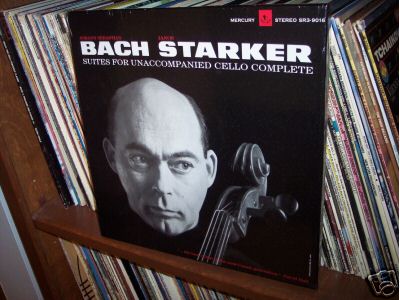
BRAND NEW FACTORY SEALED MERCURY Records SR3 9016
(THREE LP BOX SET, recorded in 1966 By Mercury Living Presence, Speaker's Corner German pressing!) AUDIOPHILE stereo LP recordings of
"JOHANN SEBASTIAN BACH: Suites For Unaccompanied Cello (COMPLETE!) "
performed by legendary cellist
JANOS STARKER
originally recorded in 1966 and considered, by many, to be THE BEST recordings of these Bach suites!!
Janos Starker, who began to play the cello in Budapest in 1933, at the age of nine, first appeared on the musical horizons of a New Yorker in 1949, when he moved from Dallas to be the first cello of the Metropolitan Opera. The Met Orchestra was then being beefed up, smoothed down, and licked (not to say whipped) into shape by the remarkable combination of Fritz Reiner and George Szell (both Hungarians); it had never played so well before, and it hasn't played so well since. By common consent, the most improved section was the cellos, and the credit went, quite legitimately, to the 25-year-old new section leader. Starker was already an experienced man--he had been first cello of the Budapest Opera four years before.
By 1949, Starker spoke a recognizable English, somewhat distorted by his year of "priding myself on my ability to interpret Texan," and people outside the Hungarian community of musicians had got to know him. He was already a pretty fierce specimen--a muscular, terrifyingly bright young man, with black eyes staring out below black eyebrows and an almost bald head. If there had been no Yul Brynner, Starker could have invented one. Technically, he was a cellist of almost unbelievable skill, who had developed personal techniques of both bowing and fingering; musically, his taste was severe, as befitted a man brought up on Bach and Bartok. He could play loud and soft, legato, staccato, and molto agitato, with that angry, biting attack which is so much more convincing on the cello than on the other strings. He always made musical sense as well as musical sounds. Fritz Reiner thought he was phenomenal, and when Reiner left to become conductor of the Chicago Symphony, he took Starker with him.
Apart from a few months in a string quartet on the Riviera, Starker had spent 1946 and 1947 in Paris, thinking about what he wanted to do, and not playing much. He had decided a long time before--he says, when he was nine--on a career as a solo cellist. When Antal Dorati (another Hungarian) brought him from Paris to Dallas in 1948, he determined to make his career from an American base. Leaving the Met in 1952, he planned on five years with Reiner in Chicago--he was already a family man, with a four-year-old daughter, and he had to get established. World events disrupted his planning; his parents escaped from Budapest in the aftermath of the abortive revolution, and he served another year in the relative anonymity of the orchestra to bring them to America.
Starker has never regretted his time in Chicago. "Playing with Reiner," he once said, "you learn something new at every rehearsal." He still wears as a souvenir of Chicago days a tiepin given to him by the members of his section to commemorate an event of the last season. Reiner, who had been as close to Starker as he ever permits himself to be with an employee, had paid public tribute to his retiring first cellist shorly before a performance of the Verdi Requiem. At the final rehearsal, however, Starker forgot to count during a passage for unaccompanied sopranos, and came in, loudly, a bar too soon. Reiner gave him an infuriated look and threw his baton violently to the ground, where it snapped. Some time passed before the two men made it up, and in the interim the section bought Starker a gold tiepin in the shape of a broken baton.
As part of his campaign for solo status, Starker, while still at the Met, began making records, first for Period, a little company owned by another Hungarian. Later he moved his allegiance to Angel, where he worked for Walter Legge, who is English but easily recognizable to a Hungarian as a character out of a Molnar play. His first contact with any American lady in any business, however, had been with Wilma Cozart of Mercury, to whom Dorati had introduced him as he arrived in Dallas. "I understood no more than ten percent of what she said," Starker recalls. (This was not too bad an average: Miss Cozart is a flower of Southern femininity, whose native tongue is not always recognized as English by those brought up outside the Confederate States.) "But it was charming." There is a kind of pleasant justice in the idea that Starker, now thoroughly American and independent, with all the Hungarian leading strings cut, should wind up on the Mercury label.
Like all string players. Starker has a deep love for chamber music, which he played virtually on a non-stop basis while at the Budapest Conservatory ("with professionals, with other students, with amateurs--doctors and such"). He does not refer to an "accompanist"; instead, he says he has "formed a duo" with the pianist Gyorgy Sebok, an old friend from Cosnervatory days and a grand prix winner on his own. Starker also has an interest in teaching, which he does in the summer at Indiana University, where he makes his home. A few years ago, he helped the composer Roy Harris, whose new cello concerto he commissiond on a Ford grant, to lay out the plans for the first International String Congress. And he writes, not always for a professional audience--this year he had an article in Mademoiselle. "I have gone into competition with you," he told a writer recently, "but only because I found I could get paid for it."
In common with other modern cellists, Starker has an interesting love-hate relationship with Casals, the idol of his youth, who virtually re-invented the instrument and introduced a generation to the remarkable music written for it. But Starker feels strongly that both the technique of the instrument and the interpretation of cello pieces have advanced beyond what Casals did. "Once I played Bach like Casals," Starker says, "but I have learned better. Students must learn the modern approach to the instrument."
Partly because of Casals' great success in its early years, this century has been big for cellists. Composers as different from each other as Hindemith, Walton, Bloch, Virgil Thomson, Shostakovich, Britten, Samuel Barber, Kodaly, and Elliott Carter have written major works for the instrument. Competition ahs been heavy, too. Without thinking about it, anybody who keeps in touch can reel off the names of half a dozen good cellists--Piatigorsky, Rose, Schuster, Fournier, Garbousova, Silva, Janigro, Greenhouse, Rostropovich, as well as Starker. Starker this year has more major solo dates than any of the others. That he has risen to the top of such company is a great tribute to his technique, his musical perceptions, and his tough intelligence. It is also a tribute to the taste of the people who hand out the rewards in the musical world, because Starker has not pandered to the big audience in program or personality.
He is a serious man, a major figure on the musical scene. The next generation of cellists may well be rebelling against Starker's dominance and authority just the way he rebels today against Casals.
In the years since his Mercury recordings, Janos Starker's career has taken one brilliant turn after another. Composers who have been inspired to write concertos for him include David Baker, Antal Dorati, Bernard Heiden, Jean Martinon, Miklos Rozsa, and Robert Starer. He has appeared in recital on every continent and performed with nearly all the world's major orchestras. As a much-honored Distinguished Professor on the faculty of the School of Music at Indiana University in Bloomington, his classes there attract talented string players from around the world. Elsewhere his famous master classes, string seminars, and lecture/demonstrations are an eagerly anticipated adjunct to his concert tours. In addition to his concert, recording, and teaching activities, Starker has edited a number of editions of cello music by Bach, Schubert, Bottermund, Dvorak, Beethoven, and others; published an edition of his own cadenzas; and contributed several articles on musical and humorous subjects to educational and popular periodicals. He is the author of An Organized Method of String Playing for Cello (and one for the Bass), which he developed from his own lifelong search for the most efficient and effective way to play the cello. Five honorary doctorates and numerous honors and awards (including that of Honorary Citizen, State of Texas) cap a career that now spans more than five decades--undoubtedly one of the great musical careers of our century.
This hard to find top quality GERMAN pressing audiophile stereo 3 LP box set is
BRAND NEW FACTORY SEALED with NO HOLES OR CUTS!!
Securely packaged U.S. media mail is only 2.50! (See "Payment Instructions" for more shipping rates-COMBINE WINS AND SAVE!!$$)
ATTENTION OUTSIDE U.S. BIDDERS!
FOR ONLY ONLY $11.00, (4-6 weeks) I can ship up to 15 LPs WORLDWIDE! (economy surface rate-see "Payment Instructions")
FOR U.S. BIDDERS: Buy FOUR ITEMS and U.S. MEDIA MAIL IS FREE!!
FOR ALL BIDDERS BUY EIGHT ITEMS and you get a 10% DISCOUNT!!
All items are *GUARANTEED (see 'CONDITIONS' below) to be as described are exactly the item as pictured! (Any errors in photography should be reported to me BEFORE bidding)
*ALL WHO PLACE BIDS AGREE WITH THE FOLLOWING CONDITIONS:
(1) Any sealed LP, that is OPENED, is *NON-REFUNDABLE (*but does qualify for credit toward future purchases based on the actual bid price).
(2) Since all items are unconditionally guaranteed to be as described, bidders that submit, or offer the threat of negative feedback, agree to WAIVE ALL REFUNDS until such feedback is removed, retracted or withdrawn.
(3) Any item that is lost or damaged in transit MUST BE INSURED to receive a refund and buyer agrees that all claims for refunds must be made solely through the United States Postal Service.
(4) All bidders agree to pay for items within 7 days (30 days for multiple wins).
IF YOU DO NOT AGREE WITH THESE CONDITIONS, PLEASE DO NOT BID!
I also appreciate and thank those who bid responsibly and pay for their items promptly!
*NEW USERS/BIDDERS WITH ZERO FEEDBACK:
You MUST email me within 24 HOURS after winning bid or, make a payment within SEVEN DAYS . Failure to do either will put you on my blocked bidder list until payment is received.
Please remember that ALL LP's, regardless of condition, will have an occasional light "tic" and can sometimes be improved by a VIP (or equivalent) professional LP cleaner. In many cases, a simple damp cotton cloth, applied carefully, will clean LPs effectively. Do not use chemicals or harsh soaps and use as little pressure as possible to avoid abrasion.
PAYMENT OPTIONS: PAYPAL, *WESTERN UNION Money Orders (only!), Personal Checks, Cash.
PLEASE NOTE:
(*ALL Money Orders, checks and cash payments must be MAILED TO MY LOCATION-no 'pick ups' please)
BID WITH CONFIDENCE!
As a seven year Ebay veteran, I stand behind my items and am also a member of SQUARE TRADE! I ship as quickly as possible and pack each item with care!
PACKAGING: ALL single unsealed LPs are REMOVED FROM THEIR COVER and placed inside STURDY cardboard packaging for MAXIMUM PROTECTION! THANKS FOR BIDDING!
On Feb-03-05 at 14:30:53 PST, seller added the following information:
e © AP6.0
price rating